
How long do fruit flies live? Understanding their lifespan is key to stopping an infestation before it explodes. In a lab, a fruit fly can live up to 80 days, but in your kitchen, stress and temperature slash that to just days.
Female fruit flies actually outlive males in cooler conditions, so a warm home speeds up their entire life cycle. The real pest control secret is that dehydration can kill them in under 24 hours—no sprays needed.
Most flies die from organ failure, not old age, which means targeting their food and moisture sources works fast. Stick around, and we’ll break down exactly how to break their breeding cycle for good.
At A Glance
- Average fruit fly lifespan is 80 days under standard lab conditions.
- Maximum lifespan reaches up to 100 days in ideal setups.
- Lifespan ranges from one day to 188 days, depending on conditions.
- Temperature can double or halve lifespan; 18°C extends life, 28°C shortens it.
- Females outlive males at cooler temperatures, living 10 to 20 days longer.
How Long Do Fruit Flies Actually Live?
The short answer is one to 188 days, though the typical fruit fly clocks out around day 80 under lab conditions. That wide spread is driven by two main forces: genetic variance in each fly’s DNA and environmental variance like temperature or diet.
The typical fruit fly lives about 80 days, but lifespan ranges from one to 188 days.
Females tend to outlive males at cooler temps, but not at warmer ones, since heat scrambles that advantage. Maximum lifespan tops out near 100 days in ideal setups, but most flies never see that.
Why? Death sneaks in via organ failure or dehydration, not a single clock. So think of lifespan as a flexible range, not a fixed number, roughly two to three months on average with outliers on both ends.
If you are dealing with an infestation, professional pest control can target these resilient pests at any life stage. Knowing their lifespan helps you time treatments like commercial ones for maximum impact.
Remember that even a few days of ideal conditions can produce hundreds of eggs. That is why quick action with store bought sprays or natural remedies is so important for home pest management.
What Factors Control Fruit Fly Lifespan?
Genes are a big factor, with over 2,000 candidates influencing lifespan and a heritability of about 0.40. Sex also plays a role, as females outlive males in cool temperatures but not in hot conditions.
Stress is a major killer. Dehydration can finish them off in under a day, no contest.
These factors constantly interact, so a favorable gene might fail under environmental stress. Genetic correlations between sexes are weak at only 0.31.
In short, fruit fly lifespan is a messy tug of war. For effective pest control, understanding these variables helps you target vulnerable life stages and environmental weaknesses. However, unlike fruit flies, some wasp repellents use plant-based essential oils that are weather-resistant and safe for use near children and pets.
Why Temperature Is the Biggest Lifespan Factor
Whereas other factors nudge lifespan up or down by a few days, temperature can effectively double or halve it. At a cool 18°C, fruit flies live about twice as long as those at 25°C.
Crank it to 28°C, and lifespan drops by 60%. Why such a big swing? Cold slows down the nasty stuff. Telomere attrition, the slow fraying of chromosome ends, slows down. Oxidative damage from those bothersome free radicals builds up less.
Think of it like letting a banana sit in hot sun versus a fridge. The lower temperature means fewer biochemical car crashes. One study found flies at 18°C show nearly double the average lifespan. So if you’re managing pet flies or dealing with a real pest issue, temperature is your biggest lever.
For effective pest control, keeping your home cool can slow insect activity and reproduction. A simple fly trap or bug spray works best when paired with a cooler environment. Stick to the cooler end of your thermostat if you want to reduce fly infestations naturally. It’s the single biggest lever you can pull for pest management. Similarly, using a quality dehumidifier directly targets the high humidity that other pests like booklice need to survive.
Do Male or Female Fruit Flies Live Longer?
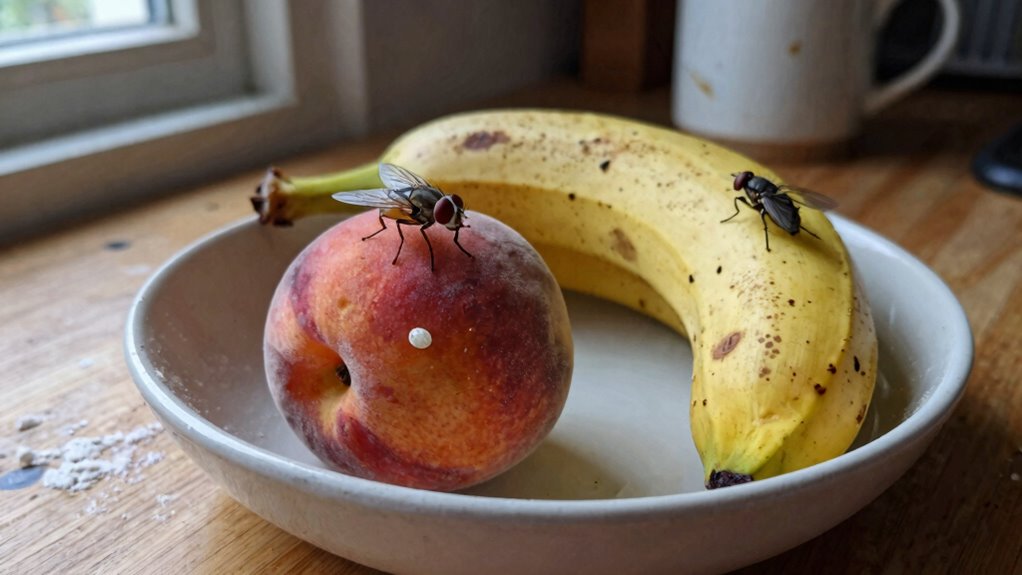
Three key reasons explain this gap. Mating costs hit males hard, reducing lifespan by 20% when they are housed with females compared to isolated males.
Three key reasons explain this gap, with mating costs reducing male lifespan by 20% versus isolated males.
Females metabolically benefit from egg production, which buffers against early death. Reproductive trade offs favor male reproduction now over longevity.
This means females live 10 to 20 days longer on average at 25°C. The bottom line is females consistently win the longevity contest.
This is a quirk of fly biology where romance literally shortens male lifespans. For pest control, targeting breeding sites helps reduce fruit fly populations.
Can Diet and Nutrition Extend a Fruit Fly’s Life?
Diet and nutrition have a powerful effect on fruit fly lifespan. A standard sugar yeast diet gives them about 80 days, but adjusting nutrient ratios can add weeks.
Protein restriction reduces oxidative stress, the damage from unstable molecules, and extends life considerably. Gene editing experiments that alter fly DNA show that modifying insulin pathways helps them thrive on calorie restricted diets.
This is simple biology, not magic. Flies fed yeast poor diets often outlive well fed peers, though they lay fewer eggs.
The trade off is clear: less reproduction means more longevity. For researchers, controlling diet is a practical and effective tool.
A well planned menu, not just genetics, can push those 80 day flies past 100 days. No fancy lab tricks are required.
Skip the sugar and they might stick around longer. For pest control, understanding these dietary limits can help manage fruit fly populations in your home.
How Much of Fruit Fly Lifespan Is Genetic?
Genetics plays a big role in how long a fruit fly lives, but it is not the whole story. Over 2,000 genes have been linked to lifespan, and broad sense heritability sits around 0.36 to 0.42.
That means roughly 40% of the longevity lottery is in their genes. For effective fruit fly control, understanding these genetic limits helps explain why populations can bounce back so quickly.
Evolutionary trade offs force flies to balance living long with reproducing early. A fly that lives forever would probably never have kids.
Mutation accumulation means random, harmful DNA changes pile up over generations. This slowly drags down average lifespan, which is why regular pest inspection is key in homes.
Genotype by sex interactions show that a gene boosting male lifespan might shorten a female fly’s. This makes simple genetic predictions a mess for any extermination strategy.
Knowing these genetic factors helps pest control professionals target breeding hotspots more accurately. It also explains why fruit fly traps and sanitation are essential for long term management.
However, applying high-purity boric acid powders in cracks and crevices provides residual control that disrupts these rapid reproductive cycles.
How Scientists Measure Lifespan in a Lab Setting
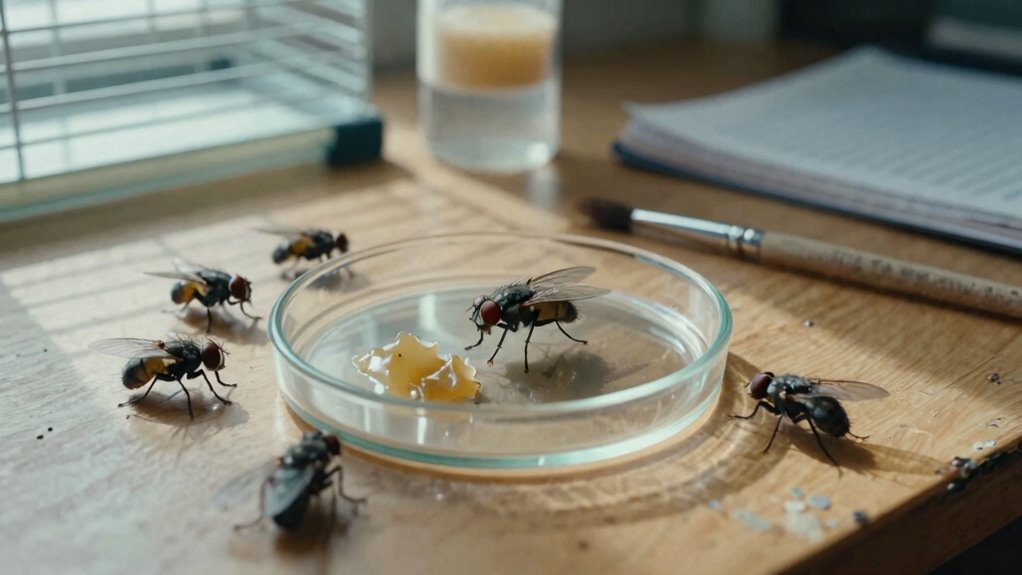
Standard lab setups for fruit flies are simple: small vials, a sugar‑yeast diet, and controlled temperatures.
Recording death dates is straightforward, as researchers check daily for completely still flies, avoiding CO₂ or cold immobilization.
From that data, they generate lifespan curves using life table analyses.
This method helps track who lives longest, much like optimizing pest control strategies for longevity monitoring.
Standard Lab Setups
A standard fruit fly lifespan assay starts with a simple setup. Use a small glass vial, a dab of sugary yeast-based food, and a manageable group of flies, typically three males and three females per vial.
Culture density is kept low to prevent early death from overcrowding or resource competition. Nutritional media is a precise sugar-yeast paste, chosen since diet drastically alters longevity.
Vials are changed every 2 to 3 days, preventing mold and ensuring fresh food. This routine also helps you spot pest control issues like grain mites or fungal outbreaks early.
Too many flies crammed into a small space die young. Too few, and sterile housing becomes wasteful.
The goal is finding a Goldilocks zone, enough flies for good statistics but not so many they kill each other over the last crumb. It is a balancing act between social collapse and data integrity.
Maintaining a clean habitat is similar to using diatomaceous earth to dehydrate and control household pests without harmful chemicals.
Recording Dates of Death
Tiny fruit flies don’t come with little gravestones, so scientists get creative when tracking each insect’s final moments. Death recording is a daily ritual where researchers poke each fly with a brush to check for movement.
If it doesn’t react, they note the date on a chart as a key assay endpoint. This precise moment confirms death, which helps pest control studies measure true lifespan.
Standard lab setups use vials with three males and three females, and scientists scan each one every day. They avoid counting flies immobilized by CO₂ or hypothermia, since those aren’t real deaths. This tedious work is the only way to get reliable data for insect control products, much like how passive interceptor traps under furniture legs provide chemical-free, around-the-clock monitoring for bed bugs without disturbing their natural behavior. For anyone serious about effective pest management, these death recording methods are essential.
Lifespan Curve Generation
Once the death dates are noted in charts, the data is turned into something useful. Scientists plug the information into life tables to generate survival curves that show how a population declines over time.
These curves help test aging interventions like adjusting diet or temperature, and they also probe lifespan genetics. To hook your interest, here is what they track.
Median lifespan is the age where half the flies have died, typically 80 days in standard conditions. Maximum lifespan is the longest lived individual, up to 100 days in perfect setups.
Heritability ranges from 36% to 42%, meaning genetics control a key part of lifespan variation. It is a slow, data heavy grind, but it is how we know if a treatment actually extends life.
The bottom line is that without these curves, you are just watching flies die. This method even helps in testing pest control strategies relevant to your home.
What Causes Death in Laboratory Fruit Flies?
In laboratory fruit flies, death usually comes from critical organs failing as they age. These tiny pests are prone to drying out and can survive less than a day without water under standard conditions.
This quick dehydration deadline means pest control strategies often target moisture sources to eliminate infestations. Before death, flies lose the ability to maintain stable internal conditions, leading to system-wide shutdown.
Monitoring humidity levels is a helpful prevention tip for keeping fruit flies out of your home. Their short lifespan makes them vulnerable to targeted treatments like traps and sprays. Using enzyme drain cleaners regularly can break down the organic waste that attracts and sustains these pests.
Organ Failure Dynamics
The gut degrades first, losing its ability to absorb nutrients, leading to starvation-like wasting.
Neural tissues, including the brain, show cumulative damage, impairing coordination and behavior.
Cardiac function falters, with the fly’s heart tube becoming irregular and inefficient. This critical failure snowballs, one organ’s collapse stresses others until the whole system gives out.
Flies don’t just stop, they unravel. It is less a gentle fade and more a chain reaction of breakdowns.
This reminds us that even in a controlled vial, death is a cascade of small failures. For effective pest control, targeting the earliest point of this cascade with professional fly treatments stops the chain before it starts. Choosing sprays with plant-based active ingredients can interrupt this chain safely in kitchen areas.
Desiccation Vulnerability
Desiccation vulnerability is a fast, brutal end for fruit flies lacking water. Under desiccation stress, these tiny creatures lose hydration through their exoskeletons at alarming rates.
Water loss happens in hours, not days, leading to rapid cellular collapse. A fly without a water source survives less than a single day, much shorter than the typical 80-day median lifespan.
Laboratory conditions create a paradox: ideal humidity slows desiccation, but even minor airflow accelerates it. One missed water drop, and a fly’s internal systems dry out like a forgotten grape in a sunbeam.
This isn’t gradual aging, it’s a sudden shutdown. Researchers must carefully monitor vial dampness levels to avoid skewing lifespan data.
For those managing pest control, understanding this quick evaporation helps target infestations before they spread. Death from desiccation isn’t subtle, it’s a measurable loss of life you can track.
In labs, controlling humidity is as critical as feeding flies sugar. If you are buying humidity control products, focus on steady moisture levels to protect your research.
For pest management buyers, rapid water loss means fruit fly populations crash fast in dry conditions. This makes desiccation a practical tool for breaking their life cycle.
Keep your space dry to stop flies from thriving. Use reliable monitoring equipment to maintain the right balance. Similarly, mosquito dunks target larvae in standing water, offering a different but complementary approach to pest control.
Loss of Homeostasis
Under ideal lab conditions, fruit flies can live up to 100 days, but they do not fade away peacefully. They die from a loss of homeostasis, which means their internal systems like fluid balance and energy levels fail.
This homeostatic collapse is a messy, systemic breakdown, not a single tidy event.
Here is what actually goes wrong. First, fluid balance fails as flies lose water faster than they can replace it.
This leads to lethal desiccation, a key concern for anyone managing pest control in humid environments.
Second, energy reserves crash when cells run out of fuel and shut down critical processes.
Third, organ function breaks down as the gut, heart, or nervous system stops cooperating.
Eventually, one of these failures triggers a final shutdown, much like a sputtering engine.
The bottom line is that even under perfect lab conditions, death comes from accumulated breakdown. For effective pest control management, understanding this homeostatic failure can help you target weaknesses in insect lifecycles. This includes using long-lasting adhesive traps that target flies during their active lifespan.
This knowledge supports better pest prevention strategies and long term insect control solutions.
You can apply these insights to pest elimination plans in your facility or home.
How 18°C vs. 28°C Changes Fruit Fly Lifespan
Though temperature might not sound like the most thrilling variable, it turns out that shifting a fruit fly from a cozy 18°C to a balmy 28°C is basically the difference between a leisurely retirement and a fast‑forwarded life.
Shifting a fruit fly from 18°C to 28°C is the difference between a leisurely retirement and a fast-forwarded life.
At 18°C, flies live roughly twice as long as those at standard 25°C, enjoying a calm, extended existence.
But crank the heat to 28°C, and their average lifespan plummets by about 60%.
That is a sharp, accelerated decline you can measure with simple pest control monitoring in your own lab.
This thermal shift is a key tool for testing nutritional interventions like tweaking diets or pharmacological interventions such as drug candidates.
Researchers use these temperatures to see how easily lifespan bends, giving concrete data on what actually works for eliminating pests in controlled environments.
The bottom line is that temperature is a master lever for lifespan plasticity.
If you want to speed up your fly elimination trials, a warmer setting delivers faster results.
For long-term outdoor studies, UV-stabilized polyethylene netting can be used to block other pests while controlling temperature exposure.
How Micro-Environment and Stress Affect Lifespan
Beyond the controlled chill of a lab fridge or the heat of a warming tray, the tiny world a fruit fly inhabits, its micro-environment, throws constant curveballs at its lifespan.
Micro environmental variance, the subtle differences in humidity or crowding between neighboring vials, can alter a fly’s days by weeks.
Consider the everyday stresses that come with pest control in real-world settings.
A dry vial kills flies in under a day, slashing lifespan to nearly zero, which is why moisture control is a top priority for any fruit fly infestation treatment.
Crowded vials mean more flies per tube, increasing competition for food and reducing median lifespan by 20%.
This crowding effect mimics what happens in a neglected compost bin, so proactive fly prevention often involves reducing breeding sites.
Rotting fruit introduces microbes that accelerate cellular breakdown, shortening life even faster.
For anyone seeking fruit fly elimination services, removing overripe produce is your first line of defense.
These hidden factors, like a broken thermostat in a lab, create wild lifespan swings.
The takeaway is simple: for longer-lived flies, control every crumb of air and food.
If you’re managing a lab or a home kitchen, a professional pest control visit can help stabilize those micro-environmental stressors.
Regular monitoring of humidity and waste removal keeps lifespan consistent and reduces unexpected die-offs.
A friendly tip is to seal food containers and dry out damp sponges, because desiccation stress is the fastest killer.
And if you notice a sudden fly spike, a targeted pesticide application works best when paired with cleaning up the underlying clutter.
Using a UV light trap with a sticky adhesive surface can silently capture adult flies without chemicals, addressing the infestation while you manage the environment.
Ultimately, the micro-environment is the silent boss of fly longevity.
What Fruit Fly Lifespan Reveals About Human Aging
Fruit flies share roughly 60% of human disease genes, making them a surprisingly honest mirror for aging research. Their lifespan ranges from a week to over a hundred days, depending on temperature and genetics.
This highlights three key lessons: specific genes control longevity, heat speeds up the aging clock, and males and females age differently. If you are dealing with a fruit fly problem, understanding these patterns can help you target pest control strategies more effectively. For example, using beneficial nematodes in soil can target larvae while adults are caught with yellow sticky traps.
These patterns, though not a perfect copy of human biology, offer a cheap and fast way to test ideas about slowing down our own decline. For anyone seeking pest control solutions, the fly’s rapid lifecycle means you can quickly test which products or traps work best.
Genetic Links to Longevity
The fruit fly genome offers a surprisingly useful map for understanding human aging. Over 2,000 candidate genes influence lifespan, revealing how genetic links drive longevity.
Here is how that affects how long fruit flies live. Studying single genes in isolation helps identify essential pathways, but real-world lifespan depends on complex interactions with the environment.
Longevity traits can pass across generations, meaning a fly’s lifespan is shaped by its ancestors’ conditions and not just its own. Heritability ranges from 36% to 42%, which means genetics plays a major role, though environment still tweaks the dial significantly.
These tiny bugs carry big clues for human aging and pest control research. They prove that lifespan is a flickering interplay between genes and surroundings, a lesson we can take to the lab.
For anyone managing fruit fly infestations, knowing their genetic adaptability can help target effective removal strategies. Applying pet-safe natural sprays can help manage small colonies while studying these longevity factors improves both scientific insight and practical pest management solutions.
Temperature Shapes Aging
Temperature nudges lifespan in fruit flies more than almost anything else. Flies at 18°C live twice as long as those at 25°C, whereas 28°C cuts life by 60 percent.
This isn’t just about cold slowing metabolism. It’s a fundamental shift in aging that researchers can control like a pest management lever.
Fruit fly husbandry matters here because standard lab conditions use 25°C. Results vary wildly with temperature, so keeping stable conditions is as important as choosing the right food.
Cold increases both genetic and environmental variance in lifespan. Some flies thrive while others don’t, which reminds us that temperature works like a selective treatment.
Laboratory diet composition additionally plays a role. Simple sugar and yeast diets keep things consistent, but temperature changes how flies process those nutrients.
Bottom line: temperature is the single biggest lever on fruit fly lifespan. It dwarfs most genetic tweaks, similar to how a targeted pest control solution outperforms generic sprays.
For aging research, controlling temperature is as critical as controlling the food. Airtight lids help prevent fruit flies from detecting odors and entering containers, ensuring a controlled environment for accurate lifespan studies. A consistent climate along with clean husbandry practices keeps your data reliable and your flies healthy.
Sex-Specific Lifespan Differences
Sex presents another twist in the fruit fly lifespan story, one that mirrors human aging differences in intriguing ways. Females tend to outlive males at cooler temps, but heat flips that script, a classic case of sex dependent mortality.
Here is the scoop from the lab. Genes play favorites: genetic variation effects mean lifespan depends on whether you are XX or XY, with heritability ranging 36 to 42 percent.
Temperature works as a switch. At 18 degrees Celsius, females live twice as long; at 28 degrees, the advantage vanishes.
Same genes, different fates: many lifespan genes work differently in each sex, like a recipe that changes depending on who cooks. This is not random: sex dependent aging rules are baked into the fly’s DNA.
For pest control professionals, these sex specific lifespan differences can guide population management strategies. Applying targeted control methods during cooler periods may affect female dominated populations more effectively. Effective ant baits like those containing abamectin 0.011% disrupt nervous systems to eliminate entire nests within one to two weeks.
Frequently Asked Questions
Can Fruit Flies Die From Old Age?
Yes, fruit flies can die from old age, and their natural death often results from cumulative organ failure. This is a classic sign of aging that pest control experts see in lab studies and real world infestations alike.
Genetic tweaking of insulin pathways can extend their lifespan, while dietary restriction without malnutrition also stretches it. But even under ideal conditions, most fruit flies cap out around 80 days.
They get wrinkles too, just microscopically, so old age is a real killer for these tiny lab celebrities. If you spot fruit flies in your kitchen, don’t wait for them to die naturally.
Use a targeted fruit fly trap or an insecticidal spray to break the breeding cycle fast. For persistent problems, consider a drain treatment to eliminate larvae hiding in sink pipes.
Whether you need a quick fix or a long term pest control solution, buying the right product now can save you weeks of frustration. Shop our selection of fruit fly killers to get your home back to normal.
How Does Humidity Affect Fruit Fly Lifespan?
Humidity matters a lot for fruit flies, but not in a neat, clean way. Think of it as a hydration seesaw, where too little moisture causes rapid desiccation and a shorter lifespan.
If the air gets too dry, adult flies dry out fast and die well before their normal expectancy. Flip the scale to excessive wetness, and fungal growth becomes a real problem for your pest control efforts.
The real kicker is larval hydration, since that juvenile stage absolutely needs dampness to survive. Grown-ups handle some dryness, but larvae are picky, so your breeding hotspots become the deciding factor.
For effective fruit fly management, aim for moderate humidity around 60-70% relative humidity in your kitchen or storage areas. Otherwise, you’ll just trade one death cause for another, and that’s not a smart purchase decision for any DIY pest control setup.
Bottom line: balance the moisture, or they’re gone before you can say “overripe banana.” When you’re shopping for pest control products, look for traps and baits that work well in that sweet spot humidity range.
Pair that with proper sanitation and dehumidifiers if needed, and you’ll see far fewer flies surviving to reproduce. That’s the practical, cost-effective way to protect your home without wasting money on the wrong treatments.
What Happens if Fruit Flies Are Kept in Total Darkness?
Total darkness doesn’t drastically shorten a fruit fly’s lifespan, but it messes with their internal clock. Without light cues, their circadian rhythm gets thrown off, reducing lifespan by 10 to 20 percent compared to a normal light/dark cycle.
For effective fruit fly control, understanding their behavior matters. Dark conditions also hinder visual mating, since males rely on sight to court females.
This means fruit flies survive but live shorter, lonelier lives. A targeted pest control product, like a fruit fly trap with ultraviolet light, can exploit their need for visual cues.
If you want to eliminate infestations fast, focus on removing breeding sources and using lures that mimic light cycles. Buy a reliable fruit fly killer today to stop them from reproducing in your kitchen.
Do Fruit Flies Live Longer in Groups or Alone?
Fruit flies typically live longer in groups than alone. Social isolation shortens their lifespan, likely because of added stress.
When managing a fruit fly infestation, knowing their behavior helps you choose the right pest control products. In a group, flies share resources and regulate temperature, which mimics a built in support system.
A lone fly, stuck with only its own thoughts, tends to wear out faster. Even flies need a little company, apparently.
For best results, keep small clusters away from your home using sticky traps or sprays. To eliminate fruit flies fast, buy targeted baits that break up their groups and stop breeding.
Can Fruit Flies Live Longer With Vitamins or Supplements?
Fruit flies don’t benefit much from vitamin pills or mineral boosters when they’re already on a standard lab diet of sugar and yeast. Think of it like handing extra gummy vitamins to a kid who just ate a balanced lunch: completely pointless but harmless in theory.
In practice, adding supplements can actually shorten a fruit fly’s lifespan by throwing off its delicate nutritional balance. These tiny insects thrive on a simple, consistent food source, so any extras can do more harm than good.
If you’re dealing with fruit flies in your kitchen, skip the supplement experiment and focus on proven pest control products instead. Sticky traps, apple cider vinegar baits, and targeted fruit fly sprays are the real winners for quick elimination.
Before you buy any pest control solution, look for products with fast-acting ingredients and clear instructions for indoor use. A quality fruit fly trap or spray will handle infestations far better than any dietary tweak ever could.
For long-term prevention, keep your produce covered and your drains clean, then pair that with a reliable insecticide if the swarm persists. That combination gives you the best chance at a fly-free home without wasting money on gimmicks.
Stick to the basics: simple diet for the flies, solid traps for your space, and smart purchasing decisions for your peace of mind. You don’t need fancy supplements or overpriced remedies to win this battle.


