
Flying ants in your house usually mean a mature colony has been living in your walls or attic for at least a year. You’re seeing their annual mating flight, and these harmless romantics aren’t after your food—just a mate and a damp crevice.
Spotting wing piles near windows or baseboards is your cue to seal cracks and check for humidity. Ignore the swarm, and you could be hosting a 28‑year tenant. Below, we’ll cover the exact steps to evict them for good.
At A Glance
- Warm, humid weather triggers flying ants to swarm and seek new nesting sites.
- A mature indoor nest releases winged ants looking to mate and start colonies.
- Cracks around doors, windows, and foundations allow flying ants easy entry.
- Attraction to light draws flying ants toward windows and baseboards inside your home.
- Moisture from leaks or rotting wood invites ants to establish a nest indoors.
What Exactly Are Flying Ants and Why Do They Swarm?
Since the sudden appearance of winged insects in your living room can feel like a personal invasion, it helps to know these ants are not out to get you. They are out to mate. These are alates, reproductive ants on a nuptial flight.
In the UK, you are mostly dealing with black garden ants. Their sole mission is to find a mate and start a new colony.
In the UK, black garden ants have one purpose: to find a mate and start a new colony.
They are not after your sandwich. Nevertheless, if you are spotting them in winter or near wood, that is a red flag.
It suggests a mature nest inside your home, possibly from carpenter ants. Those pests love damp wood. To eliminate an established colony, targeted treatments like a gel bait can be applied near trails and nests, allowing foraging ants to carry the poison back to the source.
An indoor nest means workers have been living with you for a year or more. The bottom line is summer swarmers are harmless romantics.
Winter ones signal a hidden problem requiring professional pest control inspection. If you need ant exterminator services, do not wait for the damage to spread.
How to Tell Flying Ants Apart From Termites
Flying ants and termites might look alike, but their key differences matter for pest control.
Flying ants have elbowed antennae, pinched waists, and forewings longer than hindwings.
Termites have straight antennae, thick waists, and equal-length wings that shed easily.
So if you spot a winged insect with a narrow waist and bent antennae, it is likely an ant.
This means you probably do not have a termite infestation causing structural damage.
Knowing this difference helps you choose the right professional pest control treatment.
If you need termite control or ant removal services, contact a local exterminator for an inspection.
Identifying the insect correctly can save you money and prevent unnecessary damage to your home.
If the ants are common household species like odorous house or pavement ants, a borax-based bait can eliminate the colony from within in two to four weeks.
Wing Structure Differences
One key distinction lies in the wing structure, and it is easier to spot than you might think. Flying ants have a distinct wing pattern where their forewings are noticeably longer than their hindwings, with a complex vein structure.
Termites, contrastingly, have four equal-sized delicate wings that stack flat over their backs like a pale papery shawl. Ant wings hold a clear firm shape, so you will see the size mismatch at rest.
Termite wings conversely look identical and readily fall off. If the wings look uneven or have many fine veins, you are likely dealing with ants.
If they are all the same length with fewer veins, that is a termite and probably a call to a pro for pest control services. Spotting this wing difference is a helpful termite identification trick during swarming season.
Bottom line: check the wing difference first as the quickest tell for ant control or termite inspection. A clear wing pattern is your best initial clue for accurate pest identification.
Antennae vs. Termites
Another quick way to tell them apart, and thankfully one that requires no magnifying glass or entomology degree, is the antennae.
Flying ants have distinctly elbowed or bent antennae, like a tiny, jointed elbow.
Termites, by comparison, sport straight, bead-like antennae that look like a string of pearls.
This difference is visible even during swarm behavior, when these winged insects are actively flying around your windows.
If you spot antennae that bend sharply, you’re likely dealing with ants.
If they’re straight and uniform, termites are the culprit.
No need to catch them for a closer look, just watch how they hold their heads.
Bent equals ant, straight equals termite.
It’s a simple, reliable clue that saves you from mistaking a harmless swarm for a costly infestation requiring pest control.
Identifying the right pest early helps you schedule professional treatment or termite inspection with confidence.
To keep these pests from entering your home, you can also use botanical oils like thyme to repel insects from plants around the house.
Waist Shape Comparison
The waist is where ants really show off their hourglass figure, while termites have a more straight up and down look. This body shape difference is your fastest identification clue for pest control.
Flying ants have a distinct, pinched waist that is noticeably narrow between thorax and abdomen. Termites have a thick, uniform waist with no pinch at all.
If the waist is pinched, it is an ant. If it is straight, it is a termite, simple as that. This distinction is not subtle, it is like comparing a wasp to a grain of rice.
One is built for agility, the other for tunneling. For effective insect management, remember ants have a narrow hourglass waist.
Termites have a blocky uniform body. Checking the waist is the fastest ID trick for protecting your home from termite damage.
Boric acid acts as a stomach poison that can be used to control these flying ants.
Why Flying Ants Suddenly Appear Inside Your Home
Look for the signs of a pest invasion. Wing piles near windows or light fixtures are a clear clue.
Trails of wingless workers searching for food indicate an active colony. Moisture damage in wood points to carpenter ants as the culprit.
Contrary to common belief, these ants do not eat wood. They excavate it to build their nests.
A single queen can lose her wings and start a colony right under your floorboards. That nest can grow quickly if left untreated.
Seal cracks and fix leaks to prevent new entry points. Call a pest control professional if you find ants in winter.
That swarm is a house warming party you did not invite. Take action now to stop an infestation before it spreads. Plant-based essential oil sprays can provide a non-toxic way to repel the ants and discourage new ones from entering treated areas.
Why Flying Ants Swarm in July and August

Humidity above 65 percent helps queen ants take flight more easily. Temperatures between 24 and 30°C speed up their emergence from underground nests. Wind speeds below 10 km/h keep swarming ants from drifting away. A sudden barometric drop after a storm signals the “go” for mating flights. If you notice swarming near your home, now is the time to call a pest control expert. These flying ants often indicate a nearby colony that needs professional treatment. Use ant baits and barrier sprays before the main swarming period in July and August. Treating early reduces the chance of ants entering your living space.
Where Flying Ants Enter Your Home
Warm, damp air after rain triggers swarming, and the ants exploit cracks around doors, windows, and foundations. Missing weatherstripping or a loose pipe seal is like leaving the front door open for a pest infestation.
A swarm near a window often hints at a nest location inside a wall void or attic, not just a random fly-in. These entry points are barely a sixteenth of an inch wide, letting alates slip through.
The lesson here is simple prevention. Caulk and foam are cheap, and a ten dollar tube beats a hundred dollar pest control visit.
If you see them consistently, seal every gap as part of your home pest control routine. Check for dampness that invites nesting, and you will stop the problem at the source.
For added protection around the exterior, applying perimeter granules in a 6-10 foot band along the foundation can help create a barrier that targets crawling insects before they enter.
Why You See Winged Ants Near Windows and Baseboards
Winged ants gather near windows and baseboards for two simple reasons: light attraction and hidden nests. These alates fly toward sunny windows during their mating flight, often getting trapped inside your home.
> Winged ants are drawn to sunny windows and hidden nests in baseboard gaps.
Baseboards frequently hide cracks where a mature colony has settled in wall voids. After mating, queens chew off their own wings to start a new colony underground or in wood.
This wing removal marks the end of the mating phase and dramatically shortens a queen’s lifespan. She then faces weeks alone without food, a risky gamble for ant royalty.
For effective pest control, inspect window frames and baseboard gaps for entry points. Sealing these cracks with caulk can stop future winged ant invasions, and for ongoing prevention you can also use peppermint oil sprays as a natural deterrent around those areas.
Does Moisture or Rotting Wood Attract Flying Ants?
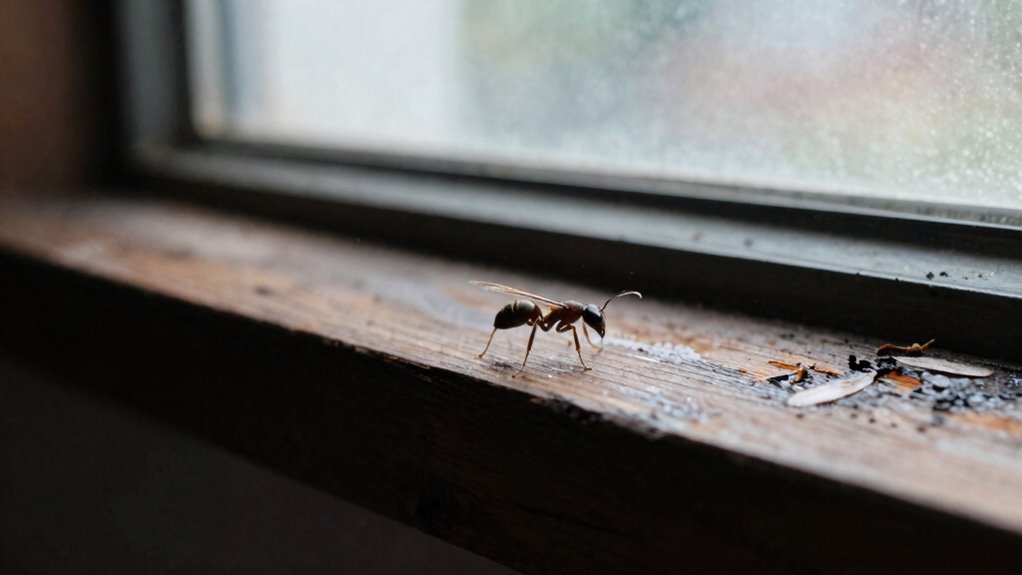
Moisture is the main culprit, not the flying ants themselves, but the nests they signal. Rotting wood often caused by leaky pipes or poor ventilation invites carpenter ant colonies to set up shop inside walls or window frames.
That stray winged ant near a damp baseboard is a red flag for a hidden, established nest. Spotting one means it is time for a pest control inspection to stop structural damage.
Flying ants swarm from mature colonies, so seeing them indoors points to a moisture problem you need to fix. Homeowners should check for rotting wood and call an exterminator to treat the infestation.
Carpenter ant control starts with drying out damp areas and replacing decayed lumber. Borate powders provide dampness resistance for outdoor perimeter control, offering longer-lasting protection in moist conditions. A professional pest management service can seal entry points and remove the nest entirely.
Moisture Attracts Nests
Moisture and rotting wood don’t directly attract flying ants, but they definitely lure worker ants that build nests. Persistent moisture from leaky pipes or damp basements creates ideal nest locations for whole ant colonies. Using a dehumidifier to maintain indoor humidity levels between 50 and 60 percent can make the environment less suitable for these pests. Worker ants need water to survive and will quickly set up near a drippy faucet or humid crawlspace. For effective ant control, tackling these moisture sources is a key pest prevention step. Leaky plumbing under sinks is a prime target, because workers can smell damp soil from a distance. A professional inspection can identify these hidden spots before an infestation takes hold. Clogged gutters cause water to pool near foundations, turning your home’s edge into prime real estate for nests. This is why gutter maintenance is a crucial home pest control tip. Condensation on windows, especially in winter, creates tiny puddles that workers use for hydration. Sealing window gaps and using a dehumidifier can stop this ant attractant. Poor ventilation in attics or bathrooms traps humidity, making them cozy spots for colony expansion. Adding exhaust fans or improving airflow is a smart long term ant management strategy.
Rotting Wood Invades Homes
Rotting wood is a welcome mat, not a love letter, for flying ants. Carpenter ants are the species most likely to swarm indoors. They do not eat rotten timber. They tunnel through it to build nests.
Moisture softens the wood, making excavation easy for pest colonies. That damp, decayed environment signals a safe nursery to ant queens. The real question is not attraction. It is invitation.
Here is how the problem escalates for your home. Dry, intact wood is rarely colonized by these insects. Minor dampness leads to foraging only. Active rot allows a nest site to become established.
Severe decay means structural damage begins. Ignoring that sagging porch or leaky window frame hands the ants a mansion. Each colony can have up to 3,000 workers expanding galleries. These galleries weaken beams over years.
The bottom line is to fix leaks fast and replace rotten timber promptly. You should also seal cracks to prevent infestation. For established colonies, use perimeter treatments like Amdro to target the nest and eliminate the invading ants. Otherwise, you are not just hosting swarmers. You are funding demolition.
What Attracts Flying Ants to Your Kitchen and Bathroom?
Two things really attract flying ants to your kitchen and bathroom: crumbs and condensation. These rooms offer exactly what winged wanderers seek after a long flight.
Food residues like spilled sugar or forgotten cereal bits create an all-you-can-eat buffet for scout ants. They then call in the swarmers to join the feast.
Moisture sources such as leaky pipes or damp sink corners provide critical hydration. This is especially important after a hot, exhausting nuptial flight.
Leftover pet food dishes attract ants because it’s easy protein they can carry back to a new colony. Even dry kibble can draw in a full ant infestation.
Poorly sealed windows or vents let in humid air and cause condensation on tiles. This creates a perfect drinking fountain for thirsty alates ready to start a new colony.
To block their entry, apply a long-lasting barrier around windows and vents to prevent flying ants from finding their way inside.
Do Flying Ants Inside Mean a Nest Nearby?
Seeing winged ants inside doesn’t automatically mean the nest is in your living room, but it’s a strong clue worth acting on.
Multiple swarmers near a window or baseboard suggest a mature colony, likely over a year old, is established somewhere close by, possibly in a wall void or attic.
The real question isn’t just about the flying ants; it’s about whether there’s decaying wood or a dampness problem feeding their hidden home.
That moisture issue is exactly what attracts carpenter ants, so checking for water leaks or rotting lumber is your first step toward pest control.
If you’re noticing these winged insects repeatedly, you’re probably looking at a hidden nest that needs professional treatment, not just a one-off visitor.
Contacting a local exterminator for an inspection can pinpoint the colony’s location and stop potential structural damage before it worsens.
You can also reduce the risk by sealing cracks around doors and windows, and trimming vegetation that touches your roofline.
Those simple home pest prevention moves lower the chances of swarmers finding an entry point, but they won’t eliminate an established nest inside.
For a permanent fix, consider a targeted insecticide application in wall voids or attic spaces, ideally done by a licensed technician.
If you prefer a non-chemical approach, diatomaceous earth with peppermint oil offers a safe way to repel ants around kids and pets.
Colony Maturity Signs
Seeing multiple winged ants indoors is not just bad luck. It is a clear sign that a mature colony is nearby, possibly inside your walls.
Ant colonies only produce swarmers after one to six years of growth. This means winged ants indicate a firmly established nest needing professional pest control treatment.
Queen longevity can reach up to 28 years. She stores sperm from a single mating flight to produce eggs for decades.
Worker foraging is relentless as wingless ants scout for crumbs and moisture day and night. This brings food back to sustain thousands inside your walls.
A single mature nest can release dozens of alates seeking mates and new homes. Winged ants indoors confirm the colony has reached reproductive age and is fully settled.
Entry Point Clues
A single flying ant indoors is less like a random trespasser and more like a tiny, panicked real estate agent. It is scouting for a new colony site, often after a warm spell following rain signals the start of nuptial flight season.
If the ant seems drawn to windows or baseboards, it likely entered through a gap in a cracked foundation or loose siding. These entry points do not always mean a nest is nearby, but they do suggest the home’s exterior needs better sealing.
Persistent sightings around wood trim or damp areas hint at structural damage like rotting sills or hollow walls. Carpenter ants exploit such damage, so fixing those cracks now costs less than a colony removal later.
Nest Location Risks
Seeing a flying ant indoors does not always mean a nest is inside your walls, but it is a strong clue.
A mature colony, perhaps one to six years old, likely lives nearby in a wall void, attic, or damp wood, risking property damage over time.
A single flying ant might wander in from outdoors, but multiple swarmers suggest a substantial mother colony.
Nests in wood, like those of carpenter ants, weaken structural beams and trim, demanding costly repairs.
The colony lifespan can span decades, with a queen laying eggs for up to 28 years.
That is why early detection and professional pest control are critical for preventing long-term damage.
Dampness attracts these pests, so rotting window frames or leaky pipes often hide the nest itself.
Call a local exterminator if you see several, since they are not just visitors.
They are property inspectors with a lease.
What Happens After Flying Ants Mate Indoors?
After mating indoors, the process shifts from a frantic swarm to a quiet, strategic phase. The mating aftermath is grim for males, as male ant death occurs within a day or two after their sole purpose is fulfilled.
The queen, now fertilized, focuses on survival and immediate queen wing loss. She chews them off, which is a clear sign of her new mission to start an indoor colony.
She then seeks a hidden crevice in a wall void or baseboard. This hidden colony becomes a persistent headache for homeowners, with workers emerging silently for years.
The frantic swarm was just the prelude to a long-term nesting problem. If you spot these winged insects, prompt ant control services can prevent an infestation before it takes hold.
How to Get Rid of Flying Ants and Prevent Return
Removing the current swarm is step one. Preventing a return is the real win.
Vacuuming them up works for now. Those lucky survivors might just laugh at your effort.
For lasting peace, focus on what keeps them away. Seal all cracks around windows, doors, and pipes.
Use caulk or expanding foam for about £10 per tube. Close every gap you spot.
Clean like a maniac, sweep crumbs, wipe sugary spills. Fix leaky faucets to remove their buffet.
Evaluate fogging effectiveness with pyrethrin foggers at around £15 each. They kill flying ants on contact but miss hidden nests.
Commit to long term baiting with gel baits like Advion at £25 per tube. Workers feed it to the colony, destroying it over weeks.
Tackle the source, not just the swarm. This is how you get rid of flying ants for good.
When to Call a Pro for Flying Ants
A few hundred winged ants buzzing around the living room is a sign you might need backup. This “alate emergence,” the fancy name for flying ants, indicates a mature colony’s nuptial flight.
That means thousands of workers may be nesting in a wall void, attic, or rotting window frame. Call a pest control professional when you see winged ants multiple days in a row.
One swarm might drift in from outside; repeat visits point to a hidden nest requiring expert nest location services. Workers appear daily, dragging in food, so a pro’s inspection costs $150 to $300 for targeted bait or foam treatment.
If you suspect carpenter ants, know they chew damp wood and cause structural damage over years. DIY traps kill a few, but if more alates keep emerging, a pro locates the nest and nukes it.
Don’t wait for a real infestation, your walls will thank you for fast pest extermination.
Frequently Asked Questions
Can Flying Ants Bite or Sting Humans?
Yes, flying ants can bite or sting, but it’s rare and mild. Their swarming behavior focuses on mating, not aggression.
Black garden ant alates have weak jaws, so a pinch feels like a tiny nip. For most people, it’s harmless—just a minor annoyance.
Nonetheless, allergic reactions are possible, similar to bee stings, though extremely uncommon. If you’re swarmed, stay calm; they’re more interested in each other than you.
Bottom line: treat them like clumsy, flying nuisances, not threats. For effective pest control around your home, focus on removing ant colonies before they swarm with targeted baits or barrier sprays.
Do Flying Ants Damage Furniture or Clothing?
Flying ants do not damage furniture or clothing directly, unlike termites or moths that feast on wood and fabric.
If you notice ants indoors, the real issue is usually nesting sites and food crumbs, not wardrobe destruction.
Stains on furniture might appear from their droppings or crushed bodies, but that is a cosmetic issue, not structural damage.
Carpenter ants can hollow out wood over many years, but this is rare for the swarming ants you see at windows.
For most homeowners, flying ants are more of a seasonal nuisance than a threat to your valuables.
The best approach is to inspect for ant trails, seal cracks around windows and doors, and wipe up spills promptly.
Using a quality ant bait or spray with residual protection can stop an infestation before it spreads.
If you suspect carpenter ants inside walls, a professional pest control inspection is the smartest purchase you can make.
Can Flying Ants Survive Indoors During Winter?
Flying ants can survive indoors during winter only if they find a warm nest, though this is rare. A mated queen may sneak in through small cracks, seeking dampness near leaky pipes or humid basements.
Spotting them near windows or bathrooms is a clear sign of an established indoor colony. Sealing entry points and fixing moisture issues are your first line of defense against these pests.
If you see flying ants in winter, it means you likely need professional pest control for a thorough inspection. Acting fast with a targeted spray or bait can prevent a full blown infestation.
Think of them as unwelcome roommates who didn’t pay rent, so invest in quality pest control products now. Call a local exterminator for a free estimate if you suspect they’ve already settled in.
Are Flying Ants Attracted to Light at Night?
Yes, flying ants are drawn to light at night, which is why they swarm around porch lights, window frames, and indoor lamps. These winged reproductives are on a single mission: to find a mate and start a new colony, and they mistake your bright bulbs for open sky.
This is not a home invasion, just a confused mating flight, so don’t panic about a structural infestation. To reduce these nighttime visitors during peak swarm season, which runs from July through August, start with switching your outdoor fixtures to yellow “bug” bulbs.
Yellow bulbs emit a spectrum that’s far less attractive to flying ants, and they also help with other common pests like moths and midges. Next, seal any cracks around windows, doors, and vents, because even a tiny gap lets these swarmers crawl in toward your indoor lighting.
If you still see dozens of flying ants every night, that usually points to a nearby nest in your lawn, under pavement, or in a wall void, not just a light issue. In that case, you’ll want a targeted ant bait or dust treatment for the nest, which is a smarter purchase than another lamp cover.
For a quick fix, turning off unneeded outdoor lights during swarm season cuts most activity, but for persistent problems, consider a residual insecticide spray around entry points. When you shop for pest control products, look for fast-acting liquid baits or granular treatments labeled for carpenter ants and flying reproductives.
Always read the label for safe indoor use, and if the swarm continues for weeks, hiring a licensed exterminator for nest location is the most cost‑effective long‑term move. That way, you solve the root cause and stop the nightly light show for good.
Do Flying Ants Carry Diseases Into Homes?
Do flying ants carry diseases into homes? No, they are not disease vectors like mosquitoes or ticks.
Their main risk is food contamination, as they crawl over crumbs and surfaces and can transfer bacteria. More seriously, structural nesting by carpenter ants can damage wood over time.
Think of them as messy houseguests, not plague carriers. For effective ant control, focus on sealing cracks and cleaning up spills to prevent an indoor pest infestation.
These winged ants often swarm during mating season, which signals the need for a proactive pest prevention plan. If you spot them near baseboards or windows, it is time to inspect for a potential colony treatment.
You don’t need a hazmat suit, but a quality ant bait or barrier spray can solve the problem fast. Search for “flying ant exterminator near me” if the infestation is already inside the walls.


