
If you want to get rid of termites naturally, you don’t need harsh chemicals or expensive exterminators. Termites actually hate dry dirt, sealed concrete, and slow-acting infections, and you can use all three against them.
Cutting moisture with gutters and grading alone drops infestation risk by 60 percent. For just $15, stainless steel mesh with tiny openings under 0.66 millimeters blocks workers cold.
A four-inch sand layer around your foundation stops tunneling dead in its tracks. Nematodes work too, but only in damp soil above 70 percent humidity.
Bait stations disrupt molting over months for a chemical‑free solution. None of this is instant, but it’s effective and safe for your home.
Stick around for the full breakdown on each method and how to apply them step by step.
At A Glance
- Improve drainage and fix leaks to reduce soil moisture by 60%.
- Seal cracks and utility entries with silicone caulk or eco-friendly fillers.
- Apply nematodes or fungi in consistently damp soil near active colonies.
- Install bait stations with IGRs to eliminate colonies over weeks.
- Use steel mesh or sand barriers to block termite tunneling.
Termite Prevention: Remove Their Food Sources First
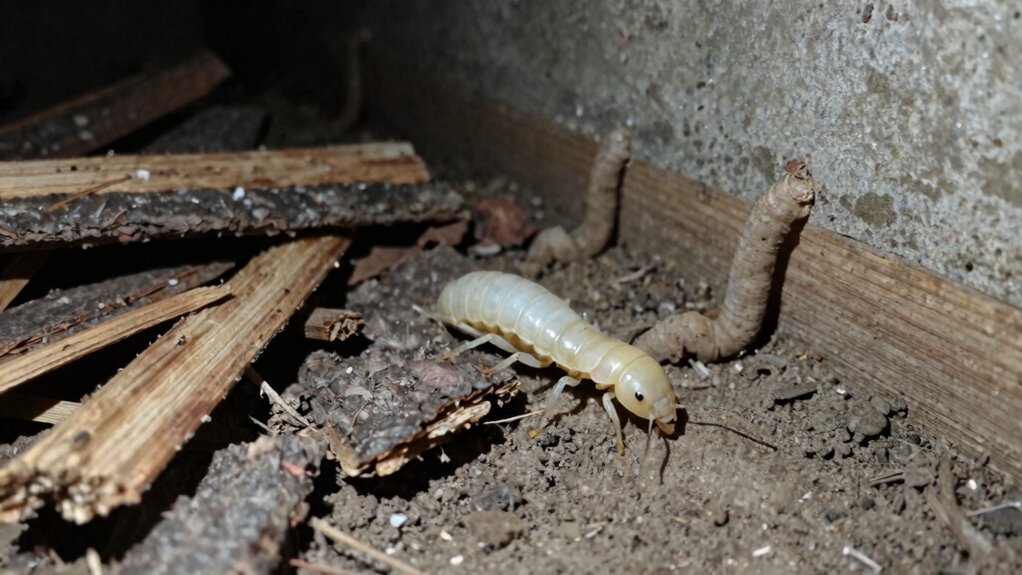
Vigilance is cheaper than extermination. Start with smart soil grading to slope the ground away from the foundation at least six inches over ten feet. That drainage slope keeps the dirt dry and less inviting for termites. Choose resistant wood species like pressure-treated pine or naturally durable cedar for any ground-contact timber. Pair that with thoughtful ventilation design. Space foundation vents every eight feet to keep air moving underneath. Add a dampness barrier with a simple six-mil plastic sheet laid over crawlspace soil to block humidity from below. Don’t forget to seal foundation gaps, as even a quarter-inch crack invites hungry termites. Caulk them tight for complete termite prevention. Control the environment first, and you’ll save a bundle on pest control later. Use a pinless moisture meter to scan walls and floors for hidden dampness that attracts termites, without damaging finished surfaces.
Cut Off Moisture and Drainage Around Your Home
Termites are basically moisture detectives with mandibles, so cutting off their water supply is half the battle won. Check your drainage slope first: soil should gently drop away from the foundation six inches over ten feet. Once indoor humidity is addressed, a quality dehumidifier can maintain humidity levels below 50 percent to prevent other pests like booklice from thriving.
Leaky pipes are a buffet invite for pests. Fix drips costing $10 in parts versus thousands in damage structure.
Gutters need cleaning twice yearly. A clogged downspout dumps 1,200 gallons against your home.
Grade with a simple level for $15 at a hardware store. Dry soil means termites move on.
You want a desert against your foundation, not a swamp. Dampness removal alone cuts infestation risk by 60%.
This is cheaper than any chemical treatment. Remember, moisture control is the smartest pest management investment you can make.
Seal Cracks and Pipes to Block Entry Points
Sealing cracks and pipes is like locking your doors against six legged burglars that squeeze through a credit card sized gap. Inspect the foundation line where utility lines enter, because termites love these handy shortcuts.
Use non toxic pipe sealing materials like silicone based caulk around plumbing penetrations. Eco friendly crack fillers made from soy or plant resins handle wider gaps in concrete without off gassing harmful fumes.
A tube costs around eight bucks, and a solid afternoon of work covers most homes. Fill every fissure you find, but skip the foam expanding stuff because it cracks over time. Flexible silicone seals resist weather and sun, ensuring a lasting barrier against pests.
Check outdoor faucets and meter boxes for hidden entry points. This is cheap insurance for effective pest control and termite prevention.
A tight house is a dry house, and a dry house is boring to termites. Keep your home protected with these simple home maintenance tips for long term results.
Install Physical Barriers and Sand Blocks the Right Way

Concrete foundations and steel mesh with the right aperture size create a dependable barrier against termites entering from the soil.
Sand barriers need particles between 2 and 3 millimeters, small enough to block tunneling but large enough to stay in place.
Getting the particle specifications wrong means you have built an expensive ant farm instead of a pest defense.
Proper installation from the start is the only way this termite control method works effectively.
Always check your sand particle size before applying it around your home’s foundation for reliable soil treatment results.
Snake fencing principles show that 1/4 inch mesh is the maximum opening that blocks most snakes, including tiny hatchlings.
Concrete and Steel Barriers
The best defense against termites is one they never see coming.
Concrete and steel barriers sit quietly beneath a home, turning a would-be feast into a dead end.
Concrete slabs work well, but they are not perfect.
Cracking from settling soil creates invisible highways for subterranean termites.
Steel mesh installed during construction blocks their path, but it rusts over time.
Watch for steel corrosion near damp points, which can weaken the barrier’s integrity.
It is a solid system for termite control, not a magic bullet.
Pour a continuous slab at least four inches thick with no expansion joints left exposed.
Use stainless steel mesh with apertures under 0.66 millimeters to stop even the smallest termite workers.
Seal every utility penetration, especially around pipes, with flexible termite proof caulk.
Keep the barrier fully visible during setup.
You are paying for complete coverage, not guesswork.
Inspect for cracks annually.
A two dollar tube of sealant beats a two thousand dollar repair bill.
Bottom line: installed right, these concrete and steel barriers starve the termite colony before it ever finds a way in.
For additional protection on wooden surfaces near the barrier, consider using borate-based sealants that kill termites on contact and prevent future invasions.
Sand Particle Size Matters
Sand, it turns out, can be a surprisingly picky gatekeeper for effective termite control. For tunneling prevention, sand particle size must be just right. Too small grains let termites push them aside. Too large particles allow termites to squeeze through.
The sweet spot for pest prevention is particles between 1.5 and 3.5 millimeters, typically crushed granite or quartz. Spread a 4 inch layer around foundations, maintaining a 15 degree slope outward. A 50 pound bag costs roughly 10 to 15 dollars from grounds suppliers. This works because termites cannot tunnel through grains that are too heavy to move and too tight to navigate. The physical barrier simply foils their engineering skills. For a low tech, chemical free fix, correct sand particle size delivers permanent termite protection. No batteries or messy treatments required for this home defense solution. For a similar natural material approach, homeowners can also seal gaps with copper mesh for long-term rustproof rodent exclusion.
Try Nematodes and Fungi: But Only Under the Right Conditions

Nematodes and fungi are natural termite predators, but they act like house guests that need perfect conditions to thrive. These beneficial organisms require damp soil to survive and hunt, which limits their use in dry climates or during droughts. Milky spore relies on a similar need for moist soil to spread and remain active.
For pest control targeting termites, this means field application can be tricky and often fails outside controlled lab settings. If you want reliable termite treatment, you might consider these organisms only when soil moisture is consistently high.
Natural Predators
Patience is key when enlisting nature’s hitmen, nematodes and fungi, against termites. These microscopic predators work slowly, often requiring weeks to see results, but they spare beneficial insects and avoid harming diverse ecosystems.
Nematodes, tiny roundworms, invade termite bodies and release bacteria. Fungi like *Metarhizium anisopliae* infect through spores.
Both need damp soil and temperatures between 60 and 90°F to thrive. Apply them near active colonies, not as a barrier.
They target only wood-destroying pests, leaving bees and ladybugs alone. Nematodes cost $15 to $30 per million; fungi kits run $20 to $40 for a 10 ounce packet.
Success depends on soil moisture, damp not soggy, and shade for survival. They are ideal for spot treating small infestations, not whole property coverage.
Results are slow but sustainable, reducing colonies over several seasons. The bottom line is that nematodes and fungi work, but they are patient tools for biological pest control, not quick fixes for termite removal. Unlike ant baits that use slow-acting poison to ensure colony spread, these biological agents require worker termites to carry the infection back to the nest over time.
Moisture Requirements
Moisture is the dealbreaker for biological termite control. Nematodes and fungi need ideal humidity to work. Think 70 to 90 percent soil dampness, not a puddle.
Too dry and they die. Too wet and they drown or rot.
Condensation control in crawlspaces helps keep surrounding soil from getting swampy. But you cannot fix the weather.
A homeowner in a rainy climate might succeed if they monitor soil wetness. A simple moisture meter costs only $15.
In arid zones, these critters vaporize before they kill termites. Only try nematodes or fungi if you are ready to irrigate and check humidity weekly.
Otherwise, you are just feeding the bugs a fancy snack.
For professional-grade solutions, expanding foam can provide deep infiltration into cracks and voids for targeted treatment.
Field Application Limits
Grab your humidity meter before you buy a single packet of nematodes. These microscopic worms need soil moisture above 70% to survive, and fungi require temperatures between 70°F and 85°F.
Most homeowners don’t realize field application limits make biological controls unreliable. They work great in labs, but termite tunneling behavior avoids treated soil entirely.
For these to work, you basically need perfect conditions. Nematodes cost $20 to $50 per 10 million but die if soil dries out, even temporarily.
Termite tunneling patterns often bypass surface-level nematode applications without deep moisture. Fungi need high humidity for weeks, which can actually attract more termites to your foundation.
Bait placement with baits costs less upfront at $10 to $30 per station and works in wider conditions. Biological controls require professional monitoring, whereas baits perform consistently across seasons.
Bottom line: save nematodes for science projects. Use bait placement for actual control. Outdoors, pyrethrin sprays degrade quickly within hours or a day due to light and air, so they are not a reliable long-term solution for termites either.
How Bait Systems Work Slowly to Reduce Colonies
Termite bait systems rely on patient strategy rather than instant chemical sprays. They place cellulose stations with insect growth regulators two to four feet from your foundation.
Foraging termites find the bait and share it with the colony. The IGR mechanisms disrupt molting, stopping immature termites from maturing.
This process starves the next generation, leading to colony elimination over weeks or months. Unlike a barrier, it does not block termite entry; it poisons the hive from inside.
This process starves the next generation, eliminating the colony from the inside out over weeks or months.
A single bait station costs around fifteen dollars. You will likely need a few, plus patience for effective termite control.
It is not instant gratification, but it offers low stress results. This solution targets the whole colony without harsh chemicals. Regular inspection of bait stations every three to six months ensures the bait remains fresh and effective.
Inspect Your Home Monthly to Stop a New Infestation
A monthly inspection isn’t glamorous, but it’s the cheapest insurance you’ll ever buy. It catches tiny mud tubes before they become a foundation problem for your home.
Think of it like checking your smoke detector. It’s annoying until it saves you from a major repair bill.
Seasonal variations matter because termite activity peaks in spring after heavy rains. Look along foundation walls for pencil sized mud tunnels that form a termite highway to your wood.
Check crawl spaces and basements for discarded wings near windows. This is a definite sign of swarmers entering your property.
Probe wood with a screwdriver. A hollow sound means they have been snacking on your structure.
Examine damp prone areas like leaky pipes or wet soil that invite pest infestations. For spot treatments in these areas, you can use a ready-to-use spray that kills on contact and provides residual control. Repeat these monthly inspections and adjust for seasonal changes to catch trouble early.
It takes ten minutes a month to prevent thousands in damage later. Do it to protect your home investment.
When to Switch to Chemical Treatments or Call a Pro
Your monthly inspections are working when you find a mud tube and handle it yourself. But a wall full of swarmers, thousands of winged termites, means it is time to shift gears.
Natural methods hit their limit here. You are no match for a colony deep inside your framing.
Harsh chemicals like liquid termiticides applied as a soil barrier become necessary. They cost between $4 and $12 per linear foot.
If termites have infested multiple rooms, professional intervention is the only sane route. A pro tent fumigation costs $500 to $3,000 and nukes the whole colony in one go.
You can fix a shed, not a house. Call a pro when damage is widespread or you find live termites indoors. Continuous monitoring of in-ground bait stations is also essential to ensure colony elimination through regular bait replacement.
Otherwise, you are just feeding them.
Frequently Asked Questions
Can Termites Eat Through Concrete or Steel Mesh?
Termites cannot chew through concrete or steel mesh, so your home’s foundation is safe from these pests. Concrete’s hard, mineral-based matrix is simply too tough for termite mandibles, since they lack the biology to bite through stone.
Steel mesh also holds up perfectly against termite attacks, and corrosion is only a concern after decades in wet soil, not from insect activity. For homeowners, this means concrete foundations and properly installed steel mesh act as permanent, low-maintenance termite barriers.
If you’re planning pest-proof construction, always ask for galvanized steel mesh to avoid premature rusting in damp crawl spaces. Don’t assume cheap mesh won’t fail; investing in corrosion-resistant materials now saves you from costly termite treatments later.
A quality termite barrier system combines slab concrete with welded wire mesh, and it works best when installed before pouring or during retrofitting. When you compare pest control products, look for mesh with a zinc coating that meets local building codes for subterranean termite prevention.
You can also seal expansion joints with a flexible termiticide to close any tiny gaps around pipes or utility lines. For complete peace of mind, pair physical barriers with a baiting system, since drywood termites can still enter through roof voids or wooden eaves.
Concrete blocks and steel mesh aren’t just for new builds; they’re also effective during kitchen remodels or patio extensions. If you’re buying termite-resistant building materials, prioritize stamped galvanized mesh and concrete with a low water-to-cement ratio to minimize cracks.
Remember that termites can exploit hairline fractures in concrete over time, so regularly inspect slab edges and control joints. A quick DIY check with a flashlight and screwdriver helps you spot moisture damage before pests establish a colony.
For the best value, order termite mesh as part of a full soil treatment bundle, especially if you live in a termite-heavy zone. Getting professional installation for both concrete barriers and steel mesh is smart, since gaps larger than a pencil eraser can let pests through.
You’ll sleep easier knowing your foundation is built to stop termites, not just slow them down. Choose hot-dipped galvanized mesh and high-density concrete, and you’ll meet the highest standards for termite-resistant home construction.
Do Nematodes and Fungi Work in Cold Climates?
Do nematodes and fungi work in cold climates? Not reliably, since both have strict temperature limits that usually require soil above 50°F to stay active.
Winter survival is poor: nematodes freeze out, while fungal spores simply go dormant until warmer days return.
Think of them as fair weather friends for pest control; they’re great for spring and fall cleanup, but they won’t carry you through a hard freeze.
If you’re managing grubs, root weevils, or fungus gnats in northern zones, you need a strategy that works below the frost line.
Baiting systems are your smarter buy for cold regions, since they work underground even when the topsoil is frozen solid.
A single bait station costs about $30, making it a low risk investment compared to reapplying biologicals that flop in winter.
For year round pest management in cold climates, focus on trapping and monitoring products that target overwintering larvae and adult insects.
Search for “winter pest control solutions” or “cold climate grub bait stations” to find options rated for sub freezing conditions.
Buyers who want guaranteed results in snow belt states should prioritize temperature tolerant traps over temperature sensitive organisms.
Check product labels for “active down to 32°F” or “frost proof” phrases, and pair baiting with exclusion tactics like sealing entry points.
You’ll save money and frustration by choosing tools designed for your local freeze thaw cycles, not biologicals that need a heat wave.
For a smart purchase, compare station refill costs and coverage area, then order a few units to test in your worst affected spots this winter.
How Long Does It Take for Baits to Kill an Entire Colony?
Termite baits don’t kill a colony overnight, colony elimination time usually spans three to six months or longer.
These bait stations work slowly, letting foragers share the poison before they die.
You’ll see activity drop steadily, but full eradication needs patience.
Regular bait station monitoring is key, skip it and you’re just feeding termites gourmet snacks.
For effective pest control, budget for a season not a weekend.
Choosing the right termite bait system speeds up colony elimination and saves you from repeat treatments.
Can Termites Return After Using Natural Control Methods?
Yes, termites can absolutely return after natural control methods like nematodes or baiting. The problem is that most natural treatments lack the long term residual barrier that chemical termiticides provide.
Nematodes and bait stations will kill active colonies, but they leave the soil completely open for new invaders. Nearby colonies can simply wander back into your property when conditions are right.
Baiting works slowly over eight weeks and doesn’t stop fresh termites from arriving. For homeowners looking for a permanent termite solution, this means natural methods require constant follow up treatments.
You will need to monitor bait consumption and reapply nematodes seasonally to keep the ground protected. If you want a set and forget pest control option, consider combining natural baits with a spot treatment of a liquid termiticide.
The trade off is clear: natural control offers eco friendly protection but demands your ongoing attention. For a true long term fix, talk to a licensed exterminator about a complete termite management plan.
What Is the Best Natural Way to Treat Active Termites?
Borates are the best natural treatment for active termites because they target the colony directly. You simply mix a borate powder with water and spray it on exposed wood in your home.
Termites ingest the borate, their digestive system shuts down, and the colony dies within weeks. This solution is budget friendly at around $20 per gallon mix and is safe for pets once the spray dries completely.
For smaller infestations, key oils like orange or neem oil work as a spot fix. They are great for a few termites but weak against a major swarm or widespread damage.
If you need to buy termite control for a real infestation, choose borates for reliable results. Just remember that this treatment is not a protective barrier, so you should reapply yearly.
That is the honest truth about a simple, effective solution for active termites.


