
Preventing bats from entering your home starts with finding gaps as small as a dime. A simple dusk watch—sitting outside and counting bats as they leave—reveals exactly where they’re getting in.
Once you know their entry points, a one-way door lets them exit but not return. For tiny cracks, use caulk; for vents, hardware cloth seals the gap.
Timing matters too—only exclude bats in spring or fall to avoid trapping them in winter or summer. Placing a bat house nearby gives them a new home so they don’t move next door.
Getting each step right is easier than you think, and the full guide below covers everything you need to do it safely and effectively.
At A Glance
- Seal all gaps larger than a dime with caulk, expanding foam, or stainless steel wool.
- Install quarter-inch galvanized hardware cloth over attic vents, louvers, and chimneys.
- Conduct a dusk watch from 50 feet away to identify all active bat entry points.
- Use a one-way exclusion door for 3-5 nights during spring or fall above 50°F.
- Mount a bat house facing south at least 15 feet high before sealing entry holes.
Spot the Signs: How to Tell If Bats Are Living in Your Home

Old houses creak, but not all creaks come from settling floors. You might hear scratching, rustling, or faint squeaks from attic walls at night, which signals a bat colony instead of a ghost.
Old houses creak, but not all creaks come from settling floors—sometimes it’s a bat colony.
Guano piles near entry points are dark, crumbly droppings that smell faintly of ammonia. Stains around small gaps, like greasy rub marks from bat oils, confirm pest control activity.
Professional bat removal often starts here, since sealing without detection fails completely. Chimney caps are metal covers blocking flues, but they only help when bats are already absent.
Before buying pest control gear, do a dusk watch to spot them exiting. Planning after seeing their flight path prevents sealing bats inside your home. A one-way exclusion device lets bats leave but prevents them from returning after your inspection.
Skipping this step means you risk trapping them inside, which nobody wants. If you need bat removal services, contact a wildlife specialist today for a safe inspection.
Where Bats Get In: Common Entry Points You Should Inspect Tonight
A bat can squeeze through a gap no wider than a dime, so inspecting for tiny cracks and structural gaps is essential to a successful bat exclusion.
Attic louvers and vents are prime real estate for entry, and these openings often have slats that bow or shift over time, creating inviting half‑inch holes.
Start with those two spots and check for daylight peeking through gaps or dark stains around the edges.
You will likely find your culprits and know exactly where to focus your pest control efforts for removal and repair, and once entry points are sealed, consider applying a weather-resistant repellent spray around the perimeter to deter returning bats.
Tiny Cracks and Gaps
Since bats can flatten themselves to slip through gaps no wider than a dime, the tiny cracks and gaps around your home are basically open invitations. Inspect attic gaps where siding meets rooflines, and check around window frames, vents, and utility lines.
Even a crack half an inch wide, about the size of a pencil eraser, is plenty of space for a bat to enter. Caulk is your best friend here. A standard tube runs about $5 and seals those tiny cracks fast, giving you an affordable pest control solution.
For larger gaps, expandable foam insulation works well, filling voids without much fuss. Don’t forget the chimney. A cap costs around $30 and keeps bats out permanently, a great investment for bat exclusion.
The bottom line is to walk your home’s exterior at dusk, flashlight in hand, and seal every crack you spot. Bats are persistent, but a dime’s worth of effort stops them cold. Schedule a home inspection to identify hidden entry points today. EPDM rubber stays flexible and won’t crack in freezing temperatures, making it an ideal weather-resistant material for sealing gaps around windows and doors.
Attic Louvers and Vents
Your attic louvers and vents are basically VIP entrances for bats. These openings, often hidden behind louvered slats, allow airflow but also invite winged squatters.
A bat needs just a half inch gap, and worn screening or loose frames practically roll out the welcome mat. Pest control pros spot these weak points quickly, but a simple dusk watch helps as well.
Check each vent’s mesh, seal cracks with caulk, and consider replacing flimsy plastic louvers with sturdy metal ones. Proper home insulation goes hand in hand here. It keeps bats out and energy bills down. For durable sealing, use stainless steel steel wool that is rust-proof and weather-resistant to block entry points.
| Vent Type | Bat Risk Level |
|---|---|
| Ridge vent | Low, if screened |
| Gable vent | High, if loose |
| Soffit vent | Medium, check gaps |
| Louvered attic | Very high, patch now |
Bottom line: inspect every vent tonight. Patch gaps with hardware cloth and you’ll sleep easier.
How to Confirm Their Exit Point Without Disturbing Them
Conducting a dusk watch is the most reliable way to find the bats’ exit point without disturbing them. Simply stand outside at sunset near suspected entry areas and watch where they emerge.
Spotting that exact narrow crack they squeeze through tells you precisely where to install a one-way door for effective bat removal. This pest control method ensures you target the right opening for exclusion.
By waiting for them to leave naturally, you avoid stress to the animals and focus on permanent bat exclusion. It is a friendly and helpful approach to confirming their roost exit.
Performing this simple dusk watch saves you time and money on future bat control efforts. You will know exactly where your one-way door goes for successful bat removal. This method also works best when you install a bat house at a height of 12 to 20 feet to provide a safe relocation spot.
Conduct a Dusk Watch
Patience is a virtue, especially when you need to find where bats sneak in. Dusk is the best time for a professional bat inspection to start.
Position yourself outside, about 50 feet from the suspected roost, and watch. Bats are creatures of routine and their dusk behavior reveals everything.
You will see emergence patterns, usually a steady trickle not a chaotic swarm, pouring from a single crack or gap. Do not shine lights or make noise.
Just observe quietly for 20 to 30 minutes and count them. A dozen bats exiting from one spot means that is your target.
This confirms the exit without disturbing them, which is key for effective bat removal. Stress can scatter a colony into harder to find hideouts.
Pro tip: bring coffee and a lawn chair. A dad quip: it is like birdwatching but with more squeaks.
Trust this simple zero cost method before buying any gadgets. The bottom line is a dusk watch gives you the exact entrance point for bat control.
You are not sealing random holes like a clueless handyman. This approach saves you time and money on pest control services.
Identify Entry Holes
Observation is the key to identifying bat entry points, not guesswork. A careful evening watch reveals their precise escape route, which is usually just one or two holes they use nightly.
Once spotted, approach the area during daylight when bats are inside. Look for telltale signs like bat droppings, small dark pellets that crumble when dry, accumulating directly below the entry point.
A strong guano smell often confirms a regularly used hole. Pest control experts know these odors mean an active roost nearby.
Stains around a crack indicate oily residue from bat fur entering repeatedly. Droppings on walls or ground signal an active entry point directly above.
Guano smell near a vent shows bats roosting close to that opening. Light fluttering sounds mean bats are moving inside just behind the hole.
No need to disturb them. Just mark the spot for later sealing after a safe ultrasonic repeller has been in continuous operation for at least three weeks to achieve effective bat deterrence.
You will eliminate the colony safely and permanently. Contact a professional bat removal service if you need help identifying all entry holes.
The Only Months You Can Safely Exclude Bats (With State Examples)
Timing a bat exclusion is like trying to schedule a dentist appointment. There are only a few windows that work, and missing them means trouble.
Scheduling a bat exclusion is like booking a dentist appointment—miss the right window, and you’re in for a world of trouble.
Excluding bats during hibernation harms their health because waking them burns critical fat reserves. Disturbing maternity season in June and July traps flightless pups, which can lead to colony relocation issues with dead pups rotting inside your walls.
Safe windows for removing bats are early spring in April and May and late summer from August to October. But you must check state laws before starting any exclusion work.
In New Jersey, legal evictions run from April 1 to May 14 and again from August 1 to October 15. Massachusetts only allows bat removal in May and from August 1 to mid October.
One way doors should stay installed for 3 to 5 consecutive nights of good weather. Conditions must be above 50°F with winds under 10 mph for a safe bat proofing job.
Miss these windows and you are stuck waiting months for the next chance. Bottom line, bat exclusion is seasonal surgery, not a quick fix for your pest control needs.
What to Use to Seal Cracks and Vents (Without Letting Bats Back In)
Sealing cracks and vents might sound straightforward, but bats have a knack for finding the one gap you missed. Use the right materials and tools to avoid accidentally trapping them inside or creating new escape routes.
For small cracks under half an inch, use silicone or acrylic latex caulk. It stays flexible and seals tight during home bat removal projects. For larger gaps, polyurethane expanding foam works better, but never use it near bat entry points during active exclusion. You will block one way doors that need to stay open. For long-term durability in gaps near vents or damp areas, consider using rust-resistant stainless steel or copper wool from rodent-proofing kits to create a chew-proof barrier.
Secure vents with quarter inch galvanized hardware cloth. Standard window screen is too fragile and bats will tear through it during pest control for bats. Staple it firmly over attic louvers, gable vents, and soffit gaps to prevent bat reentry after sealing.
Always do a dusk bat watch first, noting every exit hole. If you seal the main gap too early, bats may chew through weaker patches elsewhere in your home. Pick the right caulk types, use sturdy mesh, and never seal before one way doors are ready for bat proofing.
Install a One-Way Door for Bat Exclusion: Let Them Out for Good
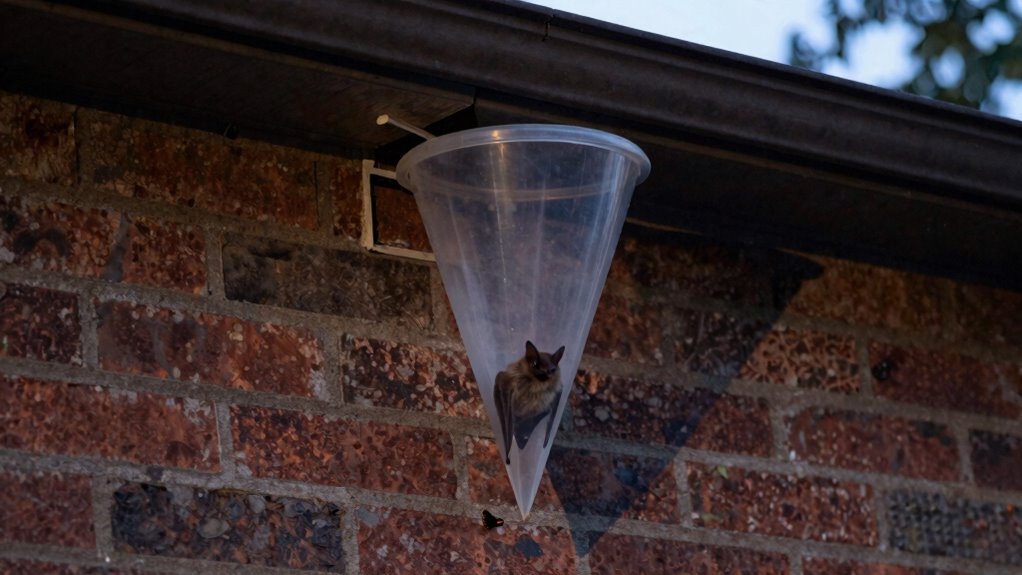
One way doors are the closest thing to a bouncer for bats. They allow a strict one way exit with no reentry allowed.
These exclusion methods rely on simple bat behavior. When bats leave to feed at dusk, they cannot squeeze back through the mesh funnel.
Attach quarter inch hardware cloth over the main entry hole. Extend it three feet down and angle it three to five inches out.
That awkward exit gap works like a one way valve for bat removal. Leave it in place for five consecutive nights of good weather.
Temps should stay above 50 degrees Fahrenheit. Winds must be under ten mph for effective bat proofing.
After confirming no bats remain, remove the door. Seal the opening permanently to prevent future bat infestations.
Cost runs about $20 to $40 for materials. This is cheaper than a colony camping in your attic.
Do not rush the process. Patience here beats patching later.
Why Excluding Bats in Winter or Summer Is Dangerous
Winter and summer are the worst times for bat exclusion, and you should avoid sealing any openings then.
Winter and summer are the worst times for bat exclusion—avoid sealing any openings then.
In summer, maternity season leaves flightless pups trapped inside if you exclude them, causing death and a terrible rotting odor.
In winter, disturbing hibernating bats makes them burn critical fat stores, often leading to fatal consequences.
Proper pest control timing focuses on spring and fall when bats are mobile and can leave safely.
Providing alternative roosts like bat houses nearby gives displaced colonies a safe spot, preventing them from moving into your neighbor’s attic.
For a successful exclusion, wait for mild weather above 50°F to install one-way doors, ensuring all bats exit before permanent sealing.
This approach avoids the dangerous risks of winter disturbance and summer pup entrapment.
Always hire a professional bat removal service to handle the process, keeping your home safe and odor free.
Consider using humane exclusion devices to let bats leave structures without harm.
How a Bat House Prevents the Colony From Moving Next Door
Installing a bat house gives bats a better option than your neighbor’s attic after you’ve evicted them from yours. Without this alternative, displaced colonies often scout nearby structures, which creates new pest problems. This approach is comparable to using milky spore as a targeted treatment for Japanese beetle grubs exclusively, rather than a broad-range solution. Place bat houses near your home, facing south and at least 15 feet high. This encourages colony relocation to your property for natural pest control. The proximity keeps bats close to control insects on your land. The safety of a bat house mimics natural roosts and reduces neighbor complaints. Year-round use makes bat houses a practical solution, unlike temporary exclusion devices. They last 10 to 15 years with minimal maintenance. A DIY bat house costs $30 to $50, while pre-built options run $70 to $150. This investment is worth avoiding neighbor feuds over unwanted bat colonies. A single box can house 50 to 100 bats, enough to handle a small colony. It is cheaper than a fence and provides free pest control. Install bat houses before sealing your attic to prevent bats from moving next door. That way, you keep the peace and enjoy effective insect management.
Frequently Asked Questions
What Kind of Bats Are Most Common in Homes?
The big brown bat and little brown bat top the list for home invaders across North America. Their small frames, under two inches long, slip through half inch gaps with ease.
Species identification often rests on size and fur tone. Big browns show dark, glossy coats, while little browns appear lighter and more matte.
Both share nocturnal habits, exiting at dusk to feed on insects. They prefer warm attics, especially near eaves or chimneys.
For homeowners, spotting either species means acting fast. Check cracks, seal openings, and time your exclusion carefully to avoid trapping pups.
Need effective bat removal solutions? Look for one way exclusion devices and professional grade sealants to protect your attic.
Buyer intent is key here. Choose a bat proofing kit that includes gloves, a respirator, and stainless steel mesh for permanent results.
Will Sealing Cracks in Winter Kill Trapped Bats?
Yes, sealing cracks in winter can absolutely kill trapped bats. The timing of sealing is critical to prevent winter mortality.
Bats hibernate, so blocking their exit forces them to starve or freeze. For example, a homeowner in Massachusetts who sealed a hole in January found 30 dead bats by March.
Avoid sealing during hibernation. Instead, wait for warmer months like early spring or late summer, when temperatures stay above 50°F.
Bottom line: never seal in winter. Always do a bat watch first to spot entry points without trapping roosts.
If you need bat exclusion services or bat proofing products, focus on summer installation. This protects your attic while respecting bat conservation laws.
For permanent results, use a one way exclusion device before sealing. This ensures bats leave safely before you apply caulk, foam, or mesh.
Searching for “bat removal near me” or “bat control solutions” can connect you with certified wildlife specialists. They know the right timing and safe bat exclusion methods.
Can Bat Guano Make You Sick From Inhalation?
Yes, inhaling airborne spores from dried bat guano can definitely make you sick. The fungus *Histoplasma* is the main culprit, and it causes histoplasmosis with symptoms like fever, chest pain, and a hacking cough.
This infection often mimics a bad flu, but it can be much more serious. In fact, 80% of histoplasmosis cases are linked to bat or bird droppings.
That is why you should never attempt direct cleanup of bat guano yourself. Calling a professional pest control service that uses HEPA masks and full containment gear is the safest route.
If you have an attic or crawl space infested with bats, you need expert removal and guano remediation. Look for a local pest control company that offers bat exclusion services and decontamination.
For your own safety, always search for “histoplasmosis cleanup near me” before tackling any bat waste. Your best investment is a professional assessment to avoid long term respiratory damage.
Bottom line: do not breathe that guano dust. Hire a certified pest control specialist to handle it, and protect your home and family.
How Long Does It Take Bats to Find a Bat House?
Bats usually find a bat house within weeks, but it can take a full season or longer. Location benefits matter most, so mount it 12 to 20 feet high facing south or east with 6 to 8 hours of direct sun.
Seasonal timing also plays a role. Installing in early spring before maternity season improves your odds of attracting a natural pest control colony.
A dark stain helps heat absorption, which is key for roosting bats. Patience is essential, but if the box is empty after two years, you should relocate it.
The bottom line is that proper placement beats luck. For effective mosquito and insect control, choosing the right bat house and mounting it correctly is your best buyer intent move.
Do Ultrasonic Repellents Actually Work to Deter Bats?
Short answer: no, ultrasonic repellents don’t really work for bat control. Most emit a frequency range that bats can’t hear or quickly get used to.
Sound quality also matters a lot in these pest control devices. Cheap units produce static noise, not targeted ultrasonic waves.
A thirty dollar ultrasonic bat repeller might stop bats for one night. But they’ll ignore it by dawn, like playing elevator music to a teenager.
For real bat removal and exclusion, you need to seal all entry holes and install one way doors. Ultrasonic devices are a gimmick that waste your money.
Bottom line: save your cash for caulk and hardware cloth. Invest in professional grade bat proofing materials instead.


