
Spiders around your home aren’t random—they’re following a simple, predictable trail of food and shelter. Outdoor lighting is a major culprit, since it pulls in moths and flies, turning your porch into an all-you-can-eat buffet that spiders can’t resist.
But that’s not the whole story; some spiders are actually evolving to prefer these artificial light zones, leaving their rural cousins behind. This shift means standard pest control tactics might miss the mark if you’re only targeting the insects.
In this guide, you’ll learn exactly what draws spiders into your living spaces—from chemical trails left by prey to the way UV light strengthens their webs. More importantly, you’ll find simple, non-cringe steps to break that attraction cycle and keep your home spider-free.
Let’s get straight into the practical fixes that actually work.
At A Glance
- Artificial lights attract insects, drawing spiders to build webs nearby.
- Spider webs near lights become stronger due to UV exposure.
- Genetic inheritance causes some spiders to prefer building near lights.
- Chemical cues from insect waste signal spiders to web in those spots.
- Spiders remember successful foraging locations and return to them.
Why Spiders Set Up Camp Near Outdoor Lights
You have probably noticed spider webs clustered around your porch light, and there is a straightforward reason. Spiders are not drawn to the light itself, but to the all you can eat buffet that shows up under it.
Night flying insects, especially moths and flies, swarm incandescent bulbs. This creates a high traffic zone that attracts spiders as opportunistic architects following the menu.
Some orb-weavers even add web ornamentation with conspicuous silk patterns that do not just look pretty. The patterns may exploit UV radiation from lights to lure more prey, making the webs more effective traps.
Some orb-weavers use UV-reflective silk patterns to turn their webs into high-tech insect traps.
This clever upgrade helps spiders maximize their catch with a well placed net. So if you see a web near your light, understand that spider is not a fan of your decor.
It is just a pest control ally working overtime to reduce the number of insects around your home. Using pest control services can help you manage both spiders and their food source more effectively. Spiders also benefit from plant-based pest control strategies that reduce the insects they prey on.
For homeowners looking to eliminate spiders or prevent infestations, targeting the lights and nearby insect populations is a smart first step. A professional exterminator can assess your property and recommend long term solutions.
How Insect Traffic Predicts Web Locations
Prey density near lights is the strongest predictor of where spiders build webs. Research tracking 8,887 insects and spiders confirmed that incandescent bulbs draw the heaviest insect traffic. This makes them prime real estate for orb-weavers, especially if you are dealing with a pest problem. Some orb-weaver species have even evolved a genetic preference for these bright spots. Urban spiderlings inherit this behavior more readily than rural ones, showing rapid adaptation to city lightscapes. To reduce web buildup around your home, try switching to bug-friendly bulbs or using professional pest control services. Consider using high-voltage bug zappers to instantly eliminate the insects that attract spiders.
Prey Density Near Lights
Spiders almost always set up shop near lights because of the insect traffic jam they create. The real draw is not the bulb itself, it is the dense buffet of nocturnal insects flocking to light fixtures.
This predictable prey density makes web placement a simple math problem. More bugs mean a better location for catching pest insects.
Light fixtures act as insect magnets. A single porch light can trap hundreds of moths per night, making pest control around lights essential.
Orb-weaver spiders choose spots where insect traffic peaks, often within two feet of the bulb. Incandescent bulbs outperform LEDs for attracting nocturnal insects, boosting web success rates.
Prey density directly predicts web reappearance. High-traffic lights see daily repairs and relocation by spiders.
Research on 8,887 insects and spiders confirmed that light type, not spider preference, drives location. Think of it as spider real estate: location, location, bug buffet. Using physical deterrents like holographic fans can reduce prey density around lights by disorienting flying insects without chemicals.
Web Placement Genetics
A curious evolutionary twist emerges when you look at how insect traffic shapes web placement. Some orb weaver spiders carry light avoidance genetics, a trait that steers them away from artificial glow.
This inherited preference can lead to web maladaptation. A spiderling that dodges a porch light might miss a feast of moths, harming its survival odds.
Captive tests reveal that spiderlings from urban lines choose lights, whereas rural ones avoid them. So insect traffic predicts web placement, but mostly for spiders whose genes say yes to the bulb.
For effective pest control, knowing this helps target webs where moth activity is highest. If you’re dealing with unwanted spiders, focus on outdoor lighting and seal dark corners.
For spidey, choosing a dark corner is a dead end. To manage pest problems, remove webs near lights and use insect traps to reduce moth populations. For reducing moth populations, consider using UV light traps that attract and capture insects near outdoor lighting.
Urban Light Adaptation
Though insect traffic is the real draw, urban spider populations have adapted in ways that make the connection even tighter. Their brains, if you could call them that, have genetically wired them to prefer artificial light, even when no bugs are present.
This urban evolution exploits two key factors. Light disruption scrambles their natural UV-based communication, but they tolerate it since food is guaranteed.
Chemical signals from insect waste act like dinner bells, telling spiders to build here. Orb weaver spiderlings from cities, with zero hunting experience, still choose glow over darkness.
Streetlights act as stable, repeating anchor points, making nightly web reconstruction easy. Prey density near lights is up to 10x higher than unlit areas, sealing the deal.
If you are dealing with a spider infestation near your home, this adaptation means pest control strategies must target both the lights and the insect waste. For effective prevention, consider professional pest removal or natural spider repellents to break the cycle of web rebuilding and high prey attraction.
Why Some Spiders Are Born to Build Near Lights
Some orb weaver spiders are born already preferring to build near lights, as if they inherited a real estate guide for prime insect real estate. Captive spiderlings with zero hunting experience still chose lamp lit web sites, showing a genetic preference rather than a learned habit.
Over generations, this inherited urban behavior spread since spiders near lights simply caught more prey. This slow but steady selection for light loving web builders shows how natural pest control adapts to human environments.
If you notice webs near your outdoor fixtures, those spiders are likely targeting flying pests around your home. Understanding this genetic drive can help you manage spiders without harsh pest control treatments.
Simply turning off unnecessary lights at night may reduce web building near your doors and windows. For persistent issues, targeted pest control services can address the root insect attractants rather than the spiders themselves.
For instance, using a Mosquito Head Net can provide a chemical-free physical barrier against biting insects that spiders prey on.
Genetic Light Preference
Not every spider that builds near a light is just following its stomach. Some are born with the urge to seek out that glow.
For these arachnids, it is a genetic hardwiring, an instinctive attraction to the weird, bug‑luring lantern itself. This light seeking behavior isn’t learned. Lab‑raised spiderlings with zero hunting experience still choose to web near artificial lights. It is that baked in.
Captive spiderlings with no prey experience still build webs near lights. This means even a pest control service can’t change their inherited wiring. Over generations, spiders near lights have passed down this genetic preference. Urban evolution makes them a permanent fixture around your home’s exterior fixtures.
Even without a full belly, they are drawn to the light’s promise of future food. This prey bonus is why you see webs on your porch lamps every night. Controlled tests show inexperienced spiders choose lit spots over dark ones. Lab proof confirms this is a deeply ingrained urge.
For some, it is not about the bugs. It is about a born urge to camp where the world glows.
If you need to manage stubborn spiders, a targeted pest control plan can disrupt their preferred light zones. Consider switching to yellow bug lights or motion sensors to reduce the nightly attraction. Spiders drawn to lights may also be affected by UV bug traps that attract insects using specific wavelengths like 365nm and 395nm.
Inherited Urban Behavior
This genetic hardwiring takes on a distinctly urban twist. Some orb-weaver spiderlings, even raised in labs with zero hunting experience, will instinctively build webs near a light.
That is not a choice. It is a behavioral inheritance passed down through generations.
Spiders from urban areas are far more likely to show this trait than their rural cousins. This proves it is a true urban adaptation, much like the pest control instincts we see in cities.
Generations of easy meals near streetlamps selected for it. The spiders do not see the light or love the bulb.
They simply inherit a drive to build where insects swarm. A classic case of evolution favoring the lazy but well-fed.
For a porch light spider, success is not about skill. It is about being born in the right neighborhood.
That inherited shortcut is often all it takes to manage pests without lifting a leg. If you notice web buildup near your outdoor lights, you are seeing urban adaptation in action. Meanwhile, for indoor spider control, non-toxic glue traps provide safe, pesticide-free capture for families with children and pets.
How Prey Chemicals Guide Web Placement
Crickets leave chemical footprints that spiders read like a menu. In experiments, 44 percent of black widows chose rocks previously housing crickets, nearly double the expected rate.
Wolf spiders likewise use these cues to pick hunting patches. Prey chemicals beat body condition when deciding where to build.
Even clean rocks get ignored if they lack that buggy scent. Understanding this can help with spider pest control near homes.
Property owners can use these chemical clues to disrupt web placement. Targeting cricket populations with yard treatment naturally reduces black widow and wolf spider infestations.
Property owners can use chemical clues to disrupt web placement and reduce spider infestations.
Simple scent blocking barriers keep these pests from settling in. For effective pest control, focus on removing the prey that attracts the spiders. Natural plant-based repellents with cedarwood oil or lemon balm provide pet-safe cricket control.
What Black Widows Look For in a Good Hideout
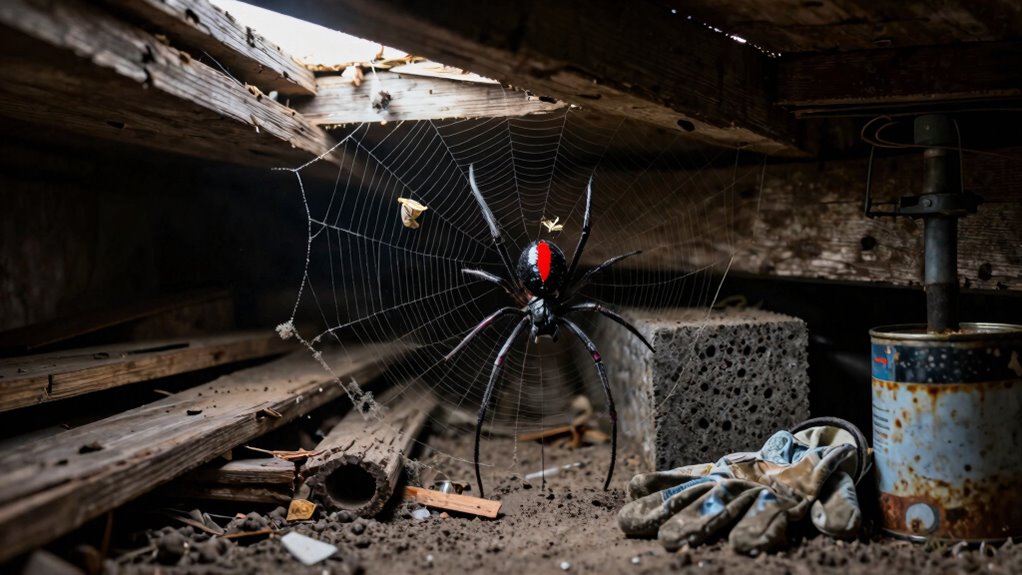
Black widows are surprisingly selective about their hiding spots, relying on chemical cues like cricket droppings and body oils to find areas with reliable food sources.
This means effective pest control starts with eliminating those scent trails that attract spiders to your home.
To prevent an infestation, focus on reducing cricket populations and cleaning up organic debris around your property.
Sealing cracks and crevices is a top priority for keeping these spiders out, as they seek dark, undisturbed spaces near potential prey.
If you need help managing these pests, professional spider removal services can pinpoint high-risk zones.
Regular home pest inspections ensure that hidden attractants are dealt with before black widows settle in.
Using electronic traps provides a quick, no-touch disposal method for capturing these spiders and their prey indoors.
Prey Scent Signals
Prey waste and body oils act like a dinner bell for black widows. These scent signals are more effective than spider hunger or size alone.
Scent-covered rocks are chosen over clean ones by a two to one margin. Smell guides their hunting more than visual or touch clues.
This is a lazy hunter’s dream: let the scent do the work. The bottom line is that if your yard reeks of cricket leftovers, you are running a black widow bed and breakfast.
Effective pest control means eliminating those odors to reduce spider attraction. Homeowners seeking spider prevention should focus on cleaning up excreta and oils. A thin, dry layer of food-grade diatomaceous earth applied along entry points can also help control the crawling insects that attract spiders.
Microhabitat Selection
Black widows follow their noses to find the perfect hiding spot, so pest control starts with understanding what smells attract them. They look for rocks or crevices that hold prey chemical cues, like kairomones from cricket leftovers.
In experiments, 44 percent of black widows chose rocks that previously housed crickets, versus just 25 percent by chance. A good spot also needs predator avoidance, so they avoid open areas and prefer dark, tight spaces under logs or debris.
This balances food access with hiding from birds or larger spiders. If you want to reduce black widow habitat around your home, clear away clutter and make sure no dark crevices smell like a cricket buffet.
For effective spider prevention, keep your yard free of prey attractants like food scraps and standing water. You can also use plant-based repellent pouches in attic corners and entryways to disrupt their scent trails without chemicals. The bottom line for a black widow is simple: if it smells like prey and is dark, it is home.
Why Stable Anchors Make Lights Ideal Web Sites
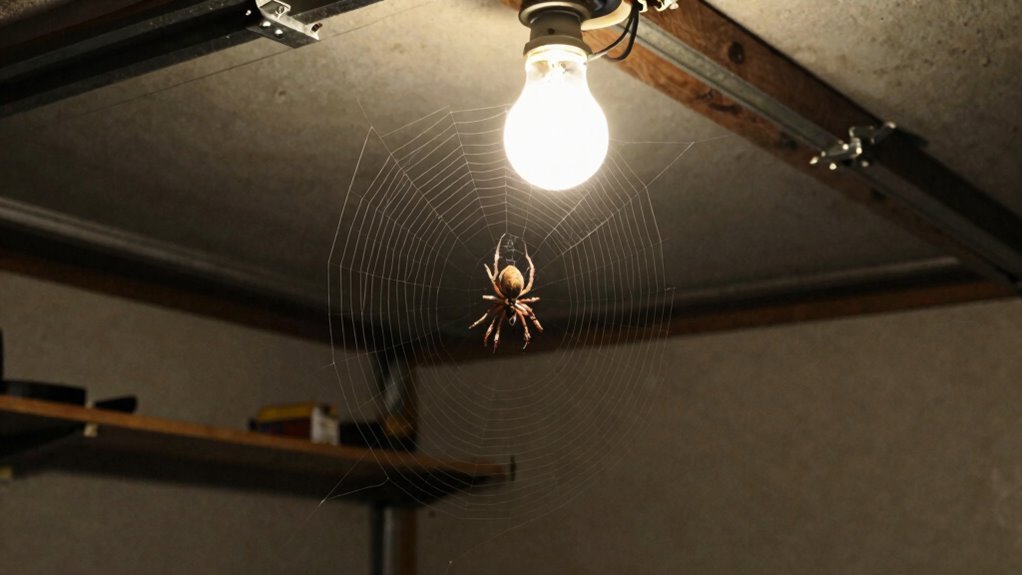
Beyond offering a bug buffet, artificial lights provide rock solid real estate that spiders truly value. A stable anchor point like a porch light or eave is a structural necessity for web building.
Spiders lack strong web photoreceptors or keen visual acuity, so they rely on tactile feedback instead. A fixed framework on rigid surfaces gives webs a steady foundation.
Daily reuse lets spiders rebuild nightly at the same spot without recalibrating. Low vibration from solid anchors reduces false prey alerts from wind or leaves.
Predator shelter under eaves and fixtures offers cover from birds or wasps during web construction. Consistent geometry from a stable frame lets spiders spin rounder, more effective orb webs.
These physical perks, not just the insects, explain why lights become spider mini mansions. It is the architectural equivalent of a rental with good bones and included utilities. Applying products like Ortho Home Defense can help manage these persistent household spiders.
How UV Light Strengthens Silk and Attracts Prey
Spiders can’t sunbathe to tan their webs, but ultraviolet light actually hardens their silk and lures in insects. UV exposure triggers a chemical reaction that boosts silk strength, which helps you reduce pest damage around your home by supporting natural pest control.
Diurnal spiders benefit most from this process, as their webs become tougher and stay sticky longer. This means fewer insects escape, making your property’s pest management more effective without harsh chemicals.
Beyond web quality, UV light acts as a signal that many insects see. They are drawn to it like a moth to a flame, and spiders exploit this reflection like an invisible dinner menu.
Some spider species even adjust web angles to catch more UV rays, giving you an organic pest control strategy. For daytime hunters, UV exposure offers a double win: stronger silk and fresher prey.
It is like upgrading your fishing net while baiting the hook at the same time. Nocturnal spiders care less, but for your yard’s daytime pest control needs, this is a game changer.
UV light acts as a signal that many insects see, which is why solar bug zappers use dual-wavelength UV LEDs (365–395 nm) to attract pests naturally.
How City Spiders Differ From Their Rural Cousins
City spiders inherit a genetic preference for placing webs near lights, while rural spiders do not. Urban spiders also shift their hunting to follow chemical cues from human drawn insects rather than natural foliage.
They evolve a tolerance for constant artificial glow, whereas rural spiders flee from it. Eaves and lamp posts replace trees as anchor points for urban orb weavers.
These feeding advantages near lights get passed down as behavioral inheritance, unlike rural random hunting. If you need pest control solutions for urban spider populations, understanding these adaptations helps target effective treatments. For example, applying diatomaceous earth in cracks and crevices near light sources can dehydrate and eliminate spiders without harsh chemicals.
Urban spiders are mini engineers, not just transplants. Their evolved traits make them persistent in man made structures, which is why professional pest management often focuses on light sources and eaves.
What Spiders Learn From Successful Foraging Spots
Experience matters, even for a creature with eight eyes and not much of a brain. Spiders learn from successful foraging spots, a key example of spider cognition.
Experience matters, even for a spider with eight eyes and not much of a brain.
When a black widow finds a rock with cricket leftovers, it remembers the location. Foraging memory then kicks in next time, guiding the spider back to that same chemical rich spot.
Orb weavers do the same with light fixtures, returning nightly since web placement paid off. They don’t just wander around your home; they recall what worked for catching prey.
This learning, simple as it is, boosts survival without a big brain. So a spider’s next web isn’t random. It is a smart bet based on past snacks.
That means pest control efforts need to disrupt these memory patterns to break the cycle. Understanding spider behavior helps homeowners target removal more effectively.
If you notice webs near your outdoor lights or porch fixtures, that is a learned foraging spot. Professional pest control can treat these high traffic areas to discourage return visits.
No philosophy degree is required to see this practical evolution at work. A little knowledge about spider cognition goes a long way in protecting your property.
Homeowners can also use natural peppermint oil solutions to create a strong scent barrier that disrupts a spider’s ability to recall and return to those successful spots.
The Indirect Role of Artificial Light in Spider Evolution
By feeding near artificial lights, spiders have accidentally started an evolutionary process. This is not about attraction to lamps, but about prey-driven changes in their DNA.
Inherited web site preference is now a genetically hardwired behavior. Captive orb weavers with no hunting experience still choose to build webs near lights.
Urban and rural spider populations are diverging quickly. Spiderlings from city areas are more likely to select illuminated sites than their rural cousins.
Artificial light scrambles the UV signals spiders use for communication. This creates a fuzzy signal problem for mate attraction and territorial displays.
Constant light also disrupts their circadian rhythms, altering when they hunt, mate, or molt. This is like keeping a night owl awake indefinitely.
Despite these hiccups, the steady insect buffet near lights outweighs the drawbacks. Light adapted spiders win this weird urban evolution game, which can create challenges for pest control professionals. Repellers that use variable frequency ultrasonic technology prevent pest adaptation to these changing conditions.
Understanding this evolution helps homeowners manage spider populations around outdoor lighting. Installing motion sensor lights or yellow bug lights can reduce the prey buffet near your home.
For effective pest control, consider shifting light sources away from entry points. This simple change can naturally lower spider web density around doors and windows.
The bottom line is that artificial light acts as a genetic sculptor. It shapes spider behavior for better or worse, and smart pest control strategies can use this knowledge to keep your property spider free.
Frequently Asked Questions
Do Spiders Get Tangled in Their Own Webs?
No, spiders rarely get tangled in their own webs. They have evolved special oils on their legs to prevent sticking.
They know exactly which strands are sticky or not, so they walk safely. Web strength and silk stickiness are finely tuned for catching prey, not the spider.
If you find a spider web inside your home, it may signal a larger pest problem. A spider might slip on a wet web, but that is a clumsy mistake, not a design flaw.
For effective pest control, target the insects that spiders hunt, not the spiders themselves. Use a trusted indoor spray to eliminate flies, ants, and other prey.
If you want to buy a long lasting spider repellent, look for products that break the web cycle. Professional grade treatments keep webs from forming in corners and eaves.
Are All Spider Webs the Same Shape and Size?
Not all spider webs are the same shape and size; silk composition and web architecture vary dramatically by species. Orb weavers craft classic spirals, whereas funnel weavers build messy tunnels and cobweb spiders create tangled sheets.
Some webs are tiny, while others stretch several feet. It all depends on the spider’s hunting strategy and the pest control approach you may need.
Think of it like houses: not every home looks alike, and not every web signals the same severity of infestation. If you have web buildup in corners, you might be dealing with cobweb spiders or funnel weavers, which often indicate a steady food supply of flies or ants.
The bottom line is that web design is species specific, so never assume one shape fits all. For effective spider control, you want to identify the web type first and then choose the right spider killer or exclusion method to match.
Targeting the web structure often leads to faster results, whether you need long lasting sprays or residual dust treatments. Your smart purchase decision starts with knowing which spider you are up against and what product will disrupt its web building cycle.
How Long Do Most Spiders Live in the Wild?
Most spiders in the wild live just one year, though some reach two. This short lifespan varies greatly, with small house spiders often surviving only a few months.
For effective pest control, knowing that these short lived spiders die off naturally can help you time your treatment. However, tarantulas are the exception, with some females hitting 20 years, making them a unique challenge if they invade your space.
Predators, weather, and food supply all impact spider survival. This is why a professional pest control service recommends regular inspections to prevent spider infestations from taking hold.
A permanent looking web often means a fragile architect. Think of it as nature’s short term lease, with no renewal guarantee, so buying a quality spider repellent can give you peace of mind.
Can Spiders Regrow Lost Legs?
Yes, spiders can regrow lost legs through a process called spider molting. When a spider sheds its exoskeleton, it often regenerates a missing limb, smaller and paler at first, but fully functional after a few molts.
This leg regeneration is a neat evolutionary trick, like a built in spare parts kit. It’s not instant, though; younger spiders, which molt frequently, recover faster than adults.
So losing a leg is a setback, not a permanent loss. If you spot a spider missing a leg in your home, that might be a sign they have molted recently and are still active.
For effective pest control around your property, focus on sealing entry points and removing webs regularly. Many homeowners buy spider sprays or glue traps to manage infestations before they grow.
Call a professional pest control service if you notice multiple spiders with missing legs or heavy webbing. A targeted treatment can eliminate both spiders and their food sources, keeping your space safe.
What Eats Spiders Besides Birds and Lizards?
Plenty of creatures hunt spiders, using sly hunting strategies. Wasps paralyze them and stuff eggs inside live bodies for a grim nursery.
Frogs, toads, and small mammals like shrews snack on spiders too. Even praying mantises ambush spiders right on their own webs.
Spider predators include centipedes, scorpions, and other spiders like the cellar spider. This spider stealthily invades webs to target its prey.
It’s a spider eat spider world, really. If you hate spiders, remember that nature has a vast, hungry fan club.
For homeowners looking for pest control solutions, understanding these predators helps you choose the right spider killer or repellent. Look for professional grade pest control products like sticky traps or insecticide sprays to break the cycle.
Buyer intent phrases like “best spider exterminator” or “spider prevention tips” can guide you toward effective treatments. A thorough home pest inspection is your first step toward a spider free zone.


