
What Is the Difference Between Black Ants and Carpenter Ants? If you spot a large ant crawling through your kitchen after midnight, you’re likely dealing with a carpenter ant—not just a harmless black ant. Getting the ID wrong could mean missing costly structural damage hidden in your walls.
This guide breaks down the key differences in size, behavior, and nesting signs so you can act fast and call the right pro. Stick with us to learn exactly what to look for before you pick up the phone.
At A Glance
- Carpenter ants are larger, reaching 13 mm, while black ants max out at 4 mm.
- Carpenter ants have a single waist node; black ants have two nodes creating an hourglass shape.
- Carpenter ants nest in damp wood, causing structural damage; black ants nest in soil mounds.
- Carpenter ants are nocturnal foragers; black ants are active during the day.
- Carpenter ants leave sawdust-like frass; black ants do not damage wood.
Start Here: Why Getting the Ant Wrong Costs You Money
A discarded doorframe swollen with dampness looks like an ideal home to a carpenter ant, but a black ant sees only waste. Misidentifying these pests can cost you thousands in repairs, so professional pest control starts with knowing the difference.
Carpenter ants hollow out wood, causing structural damage that requires expensive treatments. Black ants just want your crumbs and are a simple nuisance to manage.
Carpenter ants swarm in late spring, signaling an established colony nearby. A carpenter ant queen can live up to a decade, hiding a persistent nest deep in your walls.
Black ant queens have shorter, flitting lives, so their colonies are easier to eradicate. The bottom line is to check the nesting spot first.
Effective baiting strategies are key since soil-based bait gels and delayed-action formulas are particularly useful for black ant colonies outside, whereas carpenter ants often require targeted dusts and sprays near wood damage.
Carpenter Ants vs. Black Ants: Size and Shape at a Glance
The most obvious difference is body length. Carpenter ants are significantly larger, with workers ranging from 6 to 13 millimeters, while black ants barely reach 4 millimeters. A quick look at the waist and thorax offers another clue. Carpenter ants have a smoothly rounded thorax, unlike the black ant’s narrower, more constricted shape. These two features alone can often settle the identification question. That means you can quickly decide if you need professional pest control for carpenter ants or just a basic black ant treatment. Identifying the pest correctly saves you time and money on your ant control strategy. Paying attention to ant species differences and their physical traits ensures you choose the most effective treatment approach before infestation problems escalate.
Body Length Comparison
Carpenter ants are much larger than black ants, so don’t assume a big ant is just a large black ant. Carpenter ant workers measure 6 to 13 mm, roughly ¼ to ½ inch, while black ants like pavement ants are only 2 to 4 mm.
This size difference helps you spot potential structural damage and moisture issues. Think of carpenter ants as the linebackers of the ant world, with majors reaching 13 mm, while black ants stay under a tiny 4 mm.
Their larger size hints at hidden costs, since they chew through wood and leave sawdust piles. In contrast, smaller black ants mostly dig in soil and rarely cause structural harm.
For moisture preference, carpenter ants thrive in damp wood above 15% moisture. A big ant near wet wood is a strong sign you need a pest inspection.
Black ants prefer dry ground and are just a nuisance. So a ½ inch ant near your foundation may mean costly repairs, while a tiny one is simply a pest control call for minor annoyance.
Waist and Thorax Shape
The carpenter ant has a thorax that is evenly rounded with no indentation, while the black ant’s thorax is segmented and visibly pinched. For the waist, the carpenter ant shows a single node with a smooth connection, whereas the black ant has two nodes and a narrow constriction. Bait effectiveness can vary depending on which species is present, so identifying the ant correctly is crucial for choosing the right pest control method.
From a side view, the carpenter ant looks like a uniform arch, which makes it easier to mistake for other large ants. The black ant’s body features an hourglass-like middle section, giving it a distinct shape for quick identification.
If you spot ants indoors, checking the thorax and waist will help you confirm the species and decide on pest control methods. A carpenter ant infestation often requires professional treatment to protect your home’s wood structures.
Next time you see ants, look for that single node waist on a carpenter ant versus the two nodes on a black ant. This visual clue can guide your next steps, whether you need to bait or call an exterminator for inspection.
Where Each Ant Builds Its Nest: And Which One Damages Wood
Nests are where these ants truly part ways. One is a woodworker, the other a dirt dweller.
Carpenter ants excavate smooth galleries inside damp, decaying wood. This is often triggered by high wood dampness from leaks or poor ventilation.
They never eat the timber. They just hollow it out for living space.
Black ants build modest soil mounds outside in lawns or under pavement. They rely on scent trails to guide their colony to food.
Here is the damage breakdown. Carpenter ants pose a structural threat by tunneling into beams, stumps, or wall voids.
Black ants are harmless to wood. They are strictly a nuisance pest for homeowners.
Do a dampness check first. Fix leaks before treating, or carpenter ants will keep returning.
The bottom line is simple. If you see fine sawdust near wood, suspect a carpenter ant infestation.
The dirt dweller just annoys your picnic. Professional pest control can confirm which type has invaded your home. Additionally, understanding pest behavior can help prevent future infestations.
Quick Visual Check: Waist Shape, Antennae, and Abdominal Hair
A quick visual check of waist shape can confirm your six-legged intruder. Carpenter ants have a single node between thorax and abdomen, creating a pinched waist.
Black ants show a more slender two-part constriction instead. Black ants have elbowed antennae but lack the fine fringe of hairs on the rear.
That fringe of abdominal hair is a key sign for carpenter ant control. If you see this hair, you likely need professional pest treatment.
Identifying the waist and antennae helps with ant inspection and removal. This quick check can guide your next step for pest control services.
Using a residual barrier of powders around entry points can help prevent future infestations once you’ve identified the type of ant.
Waist Shape Comparison
The fastest way to tell carpenter ants from black ants is by looking at their waist. Carpenter ants have a single rounded node between the thorax and abdomen, giving them a thicker midsection.
Black ants show a distinctly pinched narrow waist that looks like an hourglass. This structural difference affects their behavior and nocturnal activity patterns.
Use this quick cheat code for pest identification. If the waist appears severely constricted, it is likely a black ant.
If the waist looks more uniform with one noticeable bump, think carpenter ant. This visual clue helps you choose the right ant control treatment.
The pinched waist of black ants suggests they need immediate pest management. Carpenter ants with their thicker waist require different removal strategies for home protection.
Additionally, recognizing these physical traits can aid in selecting the appropriate pest control products, such as boric acid powders or bait stations, for effective elimination.
Antennae Structure Differences
Carpenter ants have antennae that curve smoothly without a bulbous tip, like a bent straw. Black ants show a clear, three-segmented club at the tip, like a tiny baseball bat.
To confirm which pest you are dealing with, hold a specimen steady. If the tip looks swollen, it is likely a black ant, and professional ant control may be needed.
If the tip is not swollen, you have a carpenter ant, which often requires targeted pest management. This key difference saves guesswork during identification for effective pest treatment.
Abdominal Hair Presence
Since most people need a magnifying glass to check for abdominal hairs, this final test is more about knowing what to look for than actually seeing it. The real giveaway isn’t the hair itself but the node count: carpenter ants have a single, tiny node between thorax and abdomen, whereas black ants have two.
Here’s your pest control cheat sheet for fast identification. Carpenter ants have a fine fringe of abdominal hair around the rear tip, almost like a tiny beard, while black ants stay smooth with no fringe at all.
Count the bumps on the waist to confirm the species. One bump means carpenter ant, two bumps means black ant, and this node check is your most reliable step for a quick answer.
If you’re inspecting an infestation, use the combo test: large ant plus elbowed antennae plus one waist node plus a hair-fringed abdomen equals carpenter ant. No fringe and two nodes? That’s your black ant, so treat accordingly.
Bottom line: spot the single node and you’ve got your answer for targeted pest control. For any removal plan, knowing this difference helps you choose the right bait and treatment.
Additionally, species-specific identification can significantly improve your pest management effectiveness by ensuring you select the appropriate control methods for each ant type.
Do Black Ants Destroy Wood Like Carpenter Ants Do?
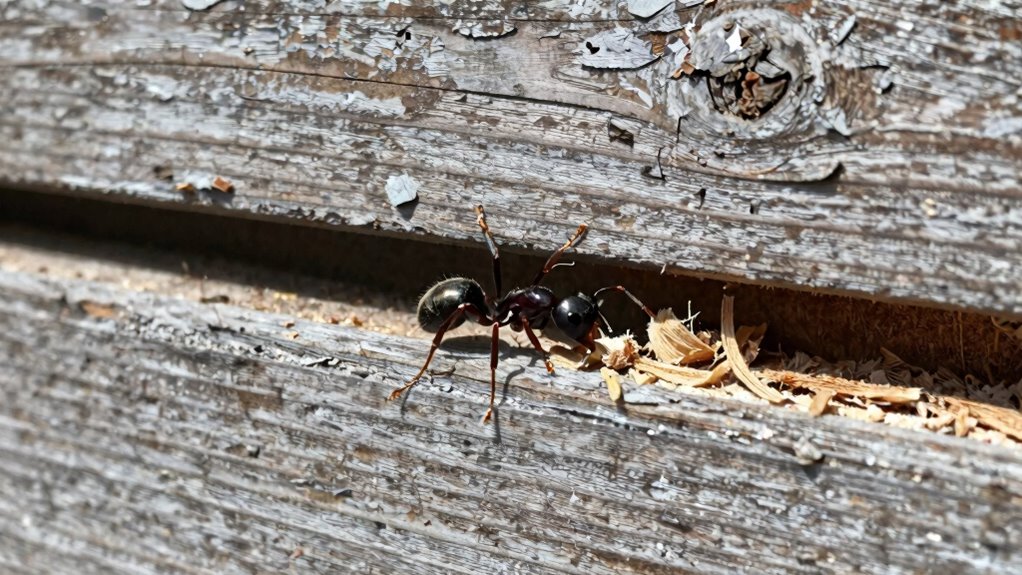
No, black ants do not destroy wood like carpenter ants do. This key distinction can save homeowners from expensive repair bills.
Carpenter ants excavate smooth, clean wood galleries for nesting. They leave behind sawdust like frass as a clear sign of structural damage.
Black ants simply march through your kitchen looking for crumbs. They create scent trails but do not cause wood damage.
If you spot hollow sounding beams or small piles of debris, you may need pest control treatment. Use baits or sprays for targeted ant removal, but only for carpenter ants.
Inspect damp areas around your home to prevent wood destroying pests. Sealing entry points with caulk or weatherstripping is a preventive measure for long-term pest prevention.
When Are Carpenter Ants vs. Black Ants Most Active?
The daily schedules of these two ants could not be more different. Knowing them is your first step toward winning the war on your countertops.
Carpenter ants, the night owls of the ant world, keep strictly nocturnal habits. They emerge after dark to forage for food and expand their wooden galleries.
Conversely, black ants or pavement ants are diurnal. They scurry about in broad daylight, often following scent trails to your kitchen.
This timing matters since if you see ants at noon, you are likely dealing with black ants. But if you spot them during a midnight snack run, it is carpenter ants.
Carpenter ants are most active from dusk to dawn. This nocturnal habit helps them avoid daytime heat and predators.
Black ants work best in sunny, warm conditions. They forage from morning to late afternoon.
A carpenter ant colony can live for years. In contrast, black ant colonies typically die off each winter and are naturally requeened each spring.
For effective pest control, focus your treatments around these active times. Placing baits at dusk targets carpenter ants, while daytime barriers stop black ants from reaching your kitchen.
Colony Size and Structure: Why Carpenter Ants Are Harder to Kill
A mature carpenter ant colony numbers 2,000 to 4,000 individuals, often with multiple queens, whereas black ants stick to a simpler, smaller setup. That sheer size is daunting, but what makes carpenter ants murder to eliminate is their clever strategy of establishing several satellite nests separate from the parent colony.
You might poison one nest, only to find the survivors regrouping in another remote location, making a single treatment solution laughably optimistic. For effective carpenter ant control, you need a plan that targets the parent colony and every satellite site with targeted ant baits and residual insecticide sprays.
Professional pest management services often use a combination of dusting, gel baits, and moisture correction to break the reproductive cycle. If you’re searching for a do it yourself carpenter ant extermination, remember that locating all nesting points is the real battle.
The good news is that with a thorough inspection and repeat applications over a few weeks, you can shift from frustrating spot treatments to a full colony elimination strategy. Focus on sealing entry points, fixing leaks, and removing wood debris to make your property less inviting.
That multi site structure is exactly why homeowners ask for a carpenter ant inspection before buying a treatment plan. A targeted approach that includes both immediate knockdown and long term baiting will outperform any quick fix.
Mature Colony Size
A black ant colony might peak at a few hundred, while carpenter ants field thousands. They can outnumber and outwork smaller rivals, making pest control treatment essential early on.
The massive carpenter ant queen produces workers for years, steadily growing the colony’s size. This increases the structural damage potential, so homeowners should schedule an inspection to protect their property.
Unlike black ants that swarm within months, carpenter ants delay swarming for years. They wait until their colony is huge before reproducing, which means a bigger headache and a larger infestation that requires professional removal.
Multiple Satellite Nests
Unlike black ants, which keep everything in one tidy underground nest, carpenter ants spread their operation across multiple locations.
A parent nest, housing the queen and her eggs, sits in damp wood, while drier satellite nests hold larvae and pupae.
This split structure is why they are so hard to kill. Spraying one nest leaves the others thriving, so a professional pest control treatment is often necessary for full colony removal.
Swarmer identification matters too, because their winged reproductives emerge from different satellites.
This confuses standard treatments, making targeted ant baiting and inspection critical for effective carpenter ant control.
Queen size, often overlooked, means the main reproductive isn’t always where you think.
An adult carpenter ant queen can reach up to one inch, and she may remain hidden in a separate satellite nest.
The disruption impact is also key. Black ants suffer full colony collapse, but carpenter ants only face partial survival after a single attack.
Bottom line: expect a multi-front war, not a single ambush.
For complete eradication, you need a thorough inspection of both the parent nest and all satellite nests.
Can Carpenter Ants or Black Ants Sting or Bite?
When it comes to bites and stings, carpenter ants are the ones to watch out for. Black ants are mostly just annoying and rarely cause real harm.
Carpenter ants deliver a sharp pinch with their strong mandibles and spray formic acid into the wound. This creates a burning sensation and can leave red welts or trigger mild allergic reactions.
Carpenter ants deliver a sharp pinch, spray formic acid, and leave burning welts or allergic reactions.
Black ants like pavement ants have weak mandibles and rarely break the skin. Their bite feels like a tiny pinprick and is hardly painful.
Odorous house ants emit a rotten coconut smell when crushed but do not bite hard. Pest control professionals often target carpenter ants first because they cause structural damage and painful reactions.
If you need ant pest control, focus on carpenter ants as the real threat. The rest just want your sugar and are more of a nuisance.
Bottom line: only carpenter ants pose any real threat to your comfort and health. For effective ant removal, call a local exterminator to inspect and treat infestations.
What Each Ant Eats: And What That Tells You About Your Home

What ants eat can tell you a lot about what is happening inside your walls.
Carpenter ants are omnivores, but they have a strong sweet tooth.
They will hunt insects for protein, but their real craving is honeydew, that sticky stuff aphids leave behind.
These ants travel a surprisingly large foraging range, sometimes over 100 yards, to find it.
Black ants are simpler scavengers, eating dead bugs, crumbs, and sweets they pick up indoors.
They are the ones you see marching along obvious scent trails to your kitchen counter.
Carpenter ants follow scent trails too, but theirs lead to damp wood or satellite nests inside your walls, not your sugar bowl.
If you find ants consistently drawn to damp, rotten spots, that is a structural warning, not just a pest problem.
Spotting carpenter ants near moisture might mean you need professional pest control to inspect for water damage.
Hiring a pest control service early can prevent costly structural repairs later.
How to Confirm the Infestation (Before Calling an Exterminator)
So you have spotted a big ant and worried it is a carpenter ant planning to eat your house from the inside.
Before calling an exterminator for a treatment estimate, confirm the culprit with some careful detective work.
Accurate insect identification relies on subtle clues, not panic.
Start your pest inspection by checking for these three signs.
Tap the wood gently along baseboards or window sills. A hollow, papery rustling sound confirms carpenter ant activity inside the wall.
Look for sawdust piles that are fine wood debris mixed with insect parts. Black ants leave no such trail, only dirt mounds outside your foundation.
Check the night shift with a flashlight after dark. Seeing large ants scurrying along beams is a strong sign of an active infestation.
If you find hollow wood and nightly visitors, hire a professional for removal.
Otherwise, you might just be hosting a bigger than usual picnic guest.
Frequently Asked Questions
How Long Do Carpenter Ants Live Compared to Black Ants?
A carpenter ant lifespan comparison shows queens living up to 10 years, whereas workers survive a few months. In contrast, the black ant living duration is shorter, with queens lasting around one year and workers merely weeks.
Carpenter ants take longer to mature, but both species’ workers die off quickly. So if you’re rooting for longevity, bet on the carpenter queen. She’s in it for the long haul, just not in your house beams.
For effective ant pest control, focus on locating and destroying the queen colony. This strategy ensures your home remains protected from costly structural damage.
When shopping for ant baits and sprays, look for products specifically labeled for carpenter ants. These treatments are designed to reach deep nests and eliminate the queen.
Black ants are easier to control with standard perimeter sprays and gel baits. Yet ignoring a carpenter ant infestation can lead to expensive repairs down the line.
If you spot sawdust piles or hear rustling in walls, it’s time to call a pest control pro. They can recommend the best termite and ant treatment for your situation.
Always read product labels to match the ant species before buying. Choosing the wrong bait wastes money and leaves your home at risk.
Do Carpenter Ants or Black Ants Infest Food Pantries?
Carpenter ants do not typically infest food pantries, as they prefer damp wood for nesting and feed on protein and sweets elsewhere. Black ants, by contrast, are pantry pests, leaving infestation signs like scent trails and small soil mounds nearby.
Their colony size is smaller, often under a few thousand, but they raid open containers for crumbs. So, black ants are the mischief-makers in your cupboards, so check for them, not the wood-chewing kind.
Can Carpenter Ants Fly Like Black Ant Swarmers Do?
Yes, carpenter ants can fly, just like black ant swarmers. Both species produce winged reproductives, but their swarm timing often differs.
Carpenter ants typically swarm in spring, whereas black ants may swarm at various times of year. A key difference lies in wing venation: carpenter ant wings have a distinct, prominent vein pattern, and their forewings are noticeably larger than hindwings.
Black ant wings are more uniform in size and vein structure. So, although both fly, their flight characteristics provide identification clues that are handy for pest detectives.
Are Black Ants or Carpenter Ants More Aggressive to Pets?
Carpenter ants are typically more aggressive to pets because their strong mandibles deliver painful bites. They can also inject formic acid, causing skin irritation that bothers dogs and cats.
Black ants are less confrontational, usually avoiding pets unless their nest is disturbed. For effective pet safety, focus your ant deterrents on carpenter ant prone areas like damp wood.
Seal cracks and reduce moisture around your home to discourage these aggressive pests. Carpenter ants hate dry lumber almost as much as a bored dog hates a quiet afternoon, so controlling humidity is a smart move.
If you are looking for the best pest control products to protect your furry friends, choose bait stations and sprays labeled for carpenter ants. The bottom line is that you should protect your pets from the biters, not the scavengers.
Do Either Ant Species Hibernate During Winter Months?
No, neither species truly hibernates, but they do slow way down.
Both use winter survival strategies like seeking warmth, though their indoor nesting behavior differs.
Carpenter ants bunker deep inside wood, often near heat, staying active if temps rise.
Black ants cluster in soil, below frost line, dormant but alive.
Carpenter ants may enter your home’s structure as their winter hideout, but that’s not an invite to a party.
Black ants rarely come indoors except it’s super cold.
Bottom line: keep an eye on damp wood, not the ants themselves.
For effective pest control, focus on sealing cracks and eliminating moisture sources to prevent winter infestations.


