
Peppermint oil repels some spiders—but not all. A 2018 study found it drove off brown widows and cross orbweavers over 75% of the time, but the false black widow completely ignored it.
So before you spray every crack in your home, you need to know if it’ll actually work on the spiders you’re dealing with. The short answer: it’s a decent barrier for entry points like windowsills and baseboards, but it won’t clear out existing webs or heavy infestations.
In this guide, I’ll break down which spiders it stops, how to apply it correctly, and why reapplication every 2–4 weeks matters. I’ll also cover a simple trick—combining it with chestnuts—to boost coverage around your home.
Stick with me, and you’ll get a practical, no-nonsense plan for using peppermint oil without wasting your time or money.
At A Glance
- Peppermint oil repels over 75% of brown widow and cross orbweaver spiders.
- It is ineffective against false black widow spiders, which show no reaction.
- The oil prevents entry but does not remove established spider infestations.
- Natural repellents require reapplication every two to four weeks.
- Combine with physical sealing and removal for best spider prevention results.
Peppermint Oil Repels Two of Three Spider Species, Science Confirms
Hope springs eternal, and so does the wish that mint oil will banish spiders forever. Science confirms it works, but only for some pests.
A 2018 study tested three spider species using a Y tube olfactometer, a fancy maze that measures which way spiders crawl. Peppermint oil repelled two out of three: brown widows and cross orbweavers, with over 75 percent success.
The brown widows even huddled and fled the area. However, the false black widow simply shrugged off the repellent.
The oil prevented entry but did not kick spiders out of webs they already built. So, peppermint oil works as a decent deterrent for home pest control, not a permanent banishment.
If you want long term repellency, you may need to reapply often or combine with other methods, such as ultrasonic pest repellers that provide non-chemical, continuous deterrence over a large area. For now, buy a bottle and hope it keeps your space spider free.
Which Spider Species Does Peppermint Oil Actually Repel?
Peppermint oil actually repels two spider species, not all. Brown widow spiders and cross orbweavers avoided it in over 75% of tests.
They showed huddling and rapid escape moves during these repellent trials. But the false black widow basically shrugged off mint, showing no significant response.
For effective pest control targeting spiders, peppermint oil works best against these two specific species. If you need a natural spider repellent, focus on brown widow and cross orbweaver infestations.
Other pest management strategies may be needed for false black widows. Always test your chosen deterrent on the species you are actually dealing with.
However, most natural repellents like peppermint-based sprays require reapplying every few days due to fading scent.
Specific Species Repelled
Research into peppermint oil’s spider-repelling reputation has finally put some names to the claim, and the results are a mixed bag.
A 2018 study found the oil effectively repelled two species, the brown widow and the cross orbweaver.
In over 75% of tests, these spiders avoided treated areas, showing huddling or rapid escape behaviors.
This suggests spider physiology plays a role, with some species more sensitive to mint’s compounds.
Still, the repellency seems to be about deterring entry, not evicting web-dwellers.
Critically, the study only tested during one season, leaving questions about seasonal repellency unanswered.
For now, if you’re dealing with brown widows or orbweavers, peppermint oil is a decent first try for spider prevention.
But don’t expect it to clear out established webs, as it works more like a “keep out” sign than an eviction notice.
For long term pest control solutions, consider combining it with exclusion methods like sealing cracks and reducing clutter.
This natural deterrent is a helpful tool but not a standalone fix for serious infestations.
For those seeking additional options, peppermint sachets also provide up to 90 days of protection against roach nests.
Species Resistant to Mint
Not every spider gets the memo about peppermint oil. The false black widow, *Steatoda grossa*, is a resistant species showing no significant aversion in controlled tests.
While brown widows and cross orbweavers fled from mint oil, the false black widow just ignored it like a teenager at a family dinner. This species barely reacted to peppermint oil or chestnuts in a 2018 study.
They did not huddle, run, or avoid treated areas. They just sat there, unimpressed.
So if your home hosts *Steatoda grossa*, do not expect mint repellent to work. It is a reminder that pest control repellents are not universal.
For most spiders, peppermint oil is a good first try. But not for this stubborn, resistant crew.
Keep expectations realistic and choose professional spider control if needed. Using targeted pest management ensures you do not rely on ineffective remedies. For broader protection against resistant species, consider a chemical spray with residual effects that kill on contact and last for weeks, unlike natural options that require frequent reapplications.
Why Some Spiders: Like the False Black Widow: Ignore Peppermint Oil
You might wonder why a false black widow spider, *Steatoda grossa*, completely ignores peppermint oil while its close relatives scurry away. The answer lies in molecular mechanisms, specifically sensory receptor variation.
Each spider species has unique proteins on its sensory hairs that detect chemicals. In *S. grossa*, these receptors simply do not bind to peppermint’s active compounds like menthol.
Think of it as a lock and key system. In one spider, a receptor opens an alarm response, but in another it fails to fit.
This variation explains why lab tests showed *S. grossa* unmoved with no signal and no panic. So while peppermint oil works for brown widows, it is useless against false black widows for pest control.
Different receptors mean different results, a case where nature’s design does not care about your home remedy. For effective spider prevention, rely on professional pest control solutions rather than DIY oils, such as long-lasting residual barrier sprays that provide up to 12 months of protection.
What Behavioral Changes Do Spiders Show Around Peppermint Oil?
When peppermint oil touches a spider’s sensory hairs, the reaction is less dramatic than a horror movie but more telling than a shrug. Spider navigation goes haywire; they turn and flee from treated zones, showing rapid leg movements and huddling. For brown widows, it is a clear escape response. They run into control arms of Y-tube olfactometers, proving repellent effectiveness for pest control. Cross orbweavers avoid mint oil at statistically significant levels, with a P value of 0.035. False black widows just shrug it off, not caring one bit. It is not about killing spiders; it is about blocking entry. Mint oil deters them from entering areas but will not make them abandon webs. So do not expect a magic wand for eviction. For entry prevention, it works as a reliable barrier. For removal of active infestations, it is a no go. The bottom line from a pest management perspective is to use mint oil as a barrier treatment. It is a helpful, friendly tool for exclusion, not a weapon against established spiders. For a more direct approach, combining mint oil with diatomaceous earth dust can help dehydrate and kill spiders that do not flee.
Peppermint Oil vs. Lemon Oil vs. Chestnuts: Which Works Best?

Which household remedy works best for spider control: peppermint oil, lemon oil, or chestnuts? Science says peppermint wins, with chestnuts close behind, and lemon oil fails completely.
A 2018 study used a Y-tube olfactometer to test spider repellents. Mint repelled brown widows and cross orbweavers over 75% of the time on that test.
Lemon oil did not deter spiders on any trial. Chestnuts matched mint’s performance as a natural deterrent.
For whole home fogging or nest fumigation, skip all three options. No spray penetrates egg sacs or deep crevices to remove an established pest problem.
These remedies repel entry, not remove existing spiders. For practical spider prevention, use peppermint oil at doorways and windowsills. Natural repellents require reapplication every 2-4 weeks to maintain a pest-free environment.
For heavy infestations, call professional pest control experts. The bottom line is that lemon oil is a myth, chestnuts are bulky, and mint is your cheap, effective pick for keeping spiders out.
Can Peppermint Oil Force Spiders Out of Their Webs?
False black widows ignore it entirely with zero effect. No study shows webs being vacated after application.
One homeowner sprayed a web daily for a week. The spider just moved to the other side of the orb.
Dry joke: mint tea is not a spider eviction warrant. Use a natural pest repellent for prevention, not removal.
Bottom line: It keeps new spiders from building near treated spots. But for a carpenter’s pricing of $8 per bottle, don’t expect existing web-dwellers to pack up.
Accept this limitation, or use a broom for immediate web removal. For serious spider control, combine barrier sprays with physical removal or use non-toxic glue traps to capture wandering spiders already present.
What the Peppermint Oil Studies Still Don’t Tell Us
Science’s current peppermint oil data set is a three species, lab only snapshot. It tells us mint works on some sedentary web builders, but leaves gaping questions.
The biggest issue is lab condition limits. Those Y tube tests are clean, calm, and spider sized tiny, nothing like your dusty basement.
Then there is the home replication gap. Will a spider that avoided mint in a tube ignore it beside your fridge?
Studies don’t say, and pest control shoppers need real world answers. Here is what is still unknown.
Does it work on hunters like wolf spiders or jumping spiders? None of those have been tested.
Does it last? The test measured minutes, not days, so you cannot rely on it for long term spider prevention.
Does it repel webs or just entry? No clue if mint makes an established spider pack up and leave.
That matters if you are looking for an indoor spider repellent that actually clears existing problem spots. Bottom line: science has a start, not an answer.
Don’t bet your broom on it yet, and keep your spider spray or natural deterrent options ready. For now, treat peppermint oil as a possible supplement, not a proven home pest solution. For those seeking a chemical-free alternative, plant-based repellent pouches provide a slow-release mint scent that may last 30 to 60 days in an attic.
When Should You Use Peppermint Oil for Spider Control at Home?
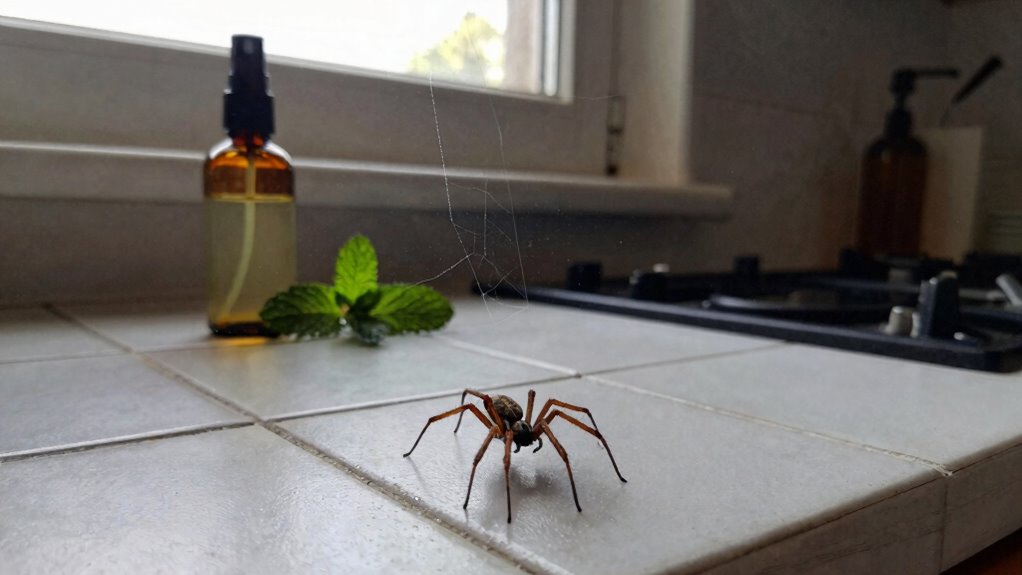
Peppermint oil works best as a door policy, not an eviction notice, so use it to block entry points like windowsills and baseboards. It won’t budge a spider already camped out in a web since studies only show it deters new arrivals, not settled residents.
Skip spraying established webs and focus your spider repellent on gaps and cracks instead. For a stronger pest control strategy, pair peppermint with chestnuts, which matched its repellency in tests to cover more ground. You can also apply plant-based repellent balls in closets or garages for passive, long-lasting coverage around those entry points.
This natural spider deterrent combo is an easy way to defend your home without much extra effort.
Best Entry Point Prevention
A good bug-out bag for spiders starts with a tube of caulk, not a giant bottle of mint oil. Peppermint oil works best as a final barrier, not the first line of defense.
Seal cracks around windows, doors, and pipes. These are the most common entry point types for pest control.
Use peppermint oil only after caulking is done. Focus on seasonal application in early spring and fall when spiders seek shelter.
Seal gaps first with caulk. It costs about $5 per tube and blocks 90% of spider entry, while mint oil just adds a scent layer.
Target specific entry point types like foundation cracks, utility penetrations, and window frames.
Apply oil after sealing by spraying a 2% peppermint solution along sealed areas. This deters persistent species like brown widows.
For more stubborn pests, an adjustable powder duster can help apply diatomaceous earth into cracks as a supplementary barrier.
Bottom line: Caulk is the hero. Mint oil is the backup performer.
Avoid Established Spider Webs
Entrenched spider webs present a defining limitation: peppermint oil deters spiders from entering treated areas but does not drive them from existing webs. Think of it as a “keep out” sign, not an eviction notice for spider control.
The 2018 study tested only sedentary web-building species, like the cross orbweaver. So for active hunters, like wolf spiders, results are unknown. If you already see webs, spraying peppermint oil will not clear them.
The spiders inside simply huddle or ignore the scent. You must physically remove the web first, then spray the area to prevent re-entry.
Use peppermint oil as a post-cleaning barrier, not a cleanup tool. It stops new web building, but old webs are a stubborn problem. This requires manual removal before the oil can do its job for effective pest prevention. For ongoing infestations, residual-effect sprays provide longer-lasting protection up to 12 months on non-porous surfaces.
Combine With Chestnut Repellents
A dual deterrent approach works well against certain spiders. Use crushed chestnuts around windowsills and peppermint spray near entry points.
This combo covers sedentary web builders effectively based on behavioral ecology insight. But the study tested only those spiders, so active hunters like wolf spiders may not be fazed.
For a cost effective test, a bag of chestnuts costs about five dollars and peppermint oil runs eight dollars. This beats commercial sprays but still leaves false black widows unimpressed.
The bottom line is to combine them for a low risk, low cost shot at deterring specific pests. Keep your expectations room temperature and remember this is not a complete pest control solution.
Consider that reapplication every three to five days maintains the barrier strength for maximum effectiveness against common household spiders.
Frequently Asked Questions
How Often Should I Reapply Peppermint Oil for It to Work?
Reapply peppermint oil every three to five days because its scent fades fast. Think of it as a light cologne for your baseboards, not a permanent forcefield against pests.
The application method matters for effective spider repellent results. Spray lightly on cotton balls or corners instead of soaking surfaces.
Stick to a safe dilution of about 15 drops per cup of water. Too strong stings your nose, but too weak fails to deter ants and mice.
One guy tested weekly application, but spiders laughed at the effort. Daily use is overkill, while weekly upkeep leaves gaps in your pest control routine.
Bottom line is a midweek refresh keeps your barrier effective. For best rodent deterrent and insect repellent results, plan that simple refresh and you are covered.
Does Peppermint Oil Repel Spider Species Other Than Web-Builders?
Peppermint oil’s effects on non web building spiders remain largely untested. Most research has focused on web weavers, not active hunters like wolf spiders or jumping spiders.
The potential to repel cellar spiders is unknown, since they were never studied. A 2018 paper only tested sedentary species, so results don’t apply to roamers who chase prey.
Bottom line: don’t bet on peppermint oil for hunters or cellar dwellers. Stick to proven pest control products or try exclusion tactics like sealing cracks.
For reliable spider repellent for active species, consider a professional grade solution. Right now, peppermint oil is really a web spinner’s game.
Will Peppermint Oil Affect Beneficial Insects Like Bees or Ladybugs?
Peppermint oil toxicity varies wildly between bugs. For bees and ladybugs, beneficial insects, it is definitely a risk.
High concentrations act like a chemical smother, clogging their breathing tubes. A 2019 study found peppermint oil killed 30% of ladybug larvae in lab tests.
So spraying it around flowers is a bad idea. Stick to indoor use, away from gardens.
That way you repel spiders without accidentally turning your yard into a bug graveyard. Your local bees will thank you.
For the best pest control results, choose a commercial peppermint oil spray labeled for indoor use only. This protects your garden pollinators while keeping your home spider free.
Can Peppermint Oil Be Safely Used Around Pets Like Cats and Dogs?
The short answer is proceed with caution. Peppermint oil can pose pet toxicity risks, especially to cats.
Feline sensitivity is real since their livers lack an enzyme to break down volatile oils. Dogs may likewise react, particularly if the oil is undiluted.
For cats, even small amounts can cause drooling, vomiting, or worse. Dogs might get skin irritation if sprayed on bedding.
Safer alternatives exist for natural pest control around your home. For example, use a spray with less than 1% peppermint oil, or try a pet safe spider repellent like Victor M230B for about $12.
Always test a tiny area first before applying any pest control product. Bottom line: dilute heavily or avoid, especially around cats.
Better safe than sorry, your vet likely agrees with that smart purchase strategy.
Is Peppermint Oil More Effective in Liquid Spray or Diffuser Form?
Liquid spray wins for most people, hands down. The diffuser placement matters, but a spray lets you control the exact concentration of peppermint oil for targeted pest control.
Mix 20 drops per cup of water for a cheap, effective bug spray that costs pennies per batch. Sprays hit entry points directly, while diffusers just scent the air that spiders might ignore.
Spraying baseboards and cracks works better for keeping ants, spiders, and roaches out. Diffusers are fine for whole room vibes, not for targeted bug duty.
For the best spider repellent results, buy a cheap spray bottle and mix fresh each week. Reapply weekly around doors and windows to maintain a pest barrier that works.


