
Why is ant bait not working? Because the ants aren’t just dying—they’re learning to avoid it. Within three hours of tasting a slow poison, they feel sick, blame that exact spot, and reroute the entire colony around it.
That full bait station you see? It’s a ghost town, not a sign of success. To outsmart them, you need to switch up pure sugar baits weekly and skip protein additives that trigger their alarm. This guide breaks down the three-hour chemical clock behind their boycott, then shows you the best bait picks to finally crack it—starting with the roundup below.
At A Glance
- Ants learn to avoid bait locations after feeling sick, not dying, causing abandonment.
- Protein additives trigger strong rejection; pure sugar baits ensure much higher acceptance.
- Baits placed too far from active trails are abandoned first; keep stations close.
- A full bait station can be a false sign; ants may be boycotting it.
- Rotating bait matrices weekly and using non-toxic pre-feeds prevents taste aversions.
Why Do Ants Reject Bait Based on Smell and Taste Alone?
Two reasons explain why ants don’t reject bait based on smell and taste alone. First, olfactory masking occurs when a bait’s scent blends with familiar food odors and fools ant scouts. They simply cannot smell the toxicant hidden in plain sight. Second, the toxicant sits below the ants’ gustatory threshold, the minimum concentration needed to taste something bad. Ants sip and do not notice it, like adding a pinch of salt to soda.
Studies show Argentine ants fed similarly on pure sucrose and sucrose toxicant mixes, with survival rates plummeting to 3% for fipronil. So if ants reject bait, it is not the smell or taste. Look elsewhere for the real culprit, such as post ingestion effects or improper placement.
Choosing the right professional pest control bait ensures ants cannot detect the active ingredient. For effective ant control, focus on bait formulation and application rather than ant scent detection.
The Real Reason Ants Abandon Bait Trails After 3 Hours
Ant abandonment starts with a chemical clock, not a preference change. Within three hours, sublethal effects from the toxicant kick in. Ants feel sick but don’t die. They don’t blame the bait’s taste, they blame the location. This triggers spatial repellency, a fancy way of saying that spot is bad news. Foragers stop using the trail leading to the bait.
Even nearby sugar feeders stay busy. It’s not mortality, it’s a neighborhood ban. The colony reroutes and avoids the area for days. This explains why bait stations go quiet fast. You’re not killing them, you’re just making them move. If ants ghost your bait after three hours, it’s working against itself.
Switch to a slower acting poison that delays the sickness signal. This keeps the bait attractive longer and improves colony control.
Why Full Bait Stations Don’t Mean Ants Are Dying
A full bait station is a great visual lie, especially when you’re trying to get rid of ants fast. You see it and think victory, but ants may simply be practicing behavioral avoidance after that first nasty sip.
That full station does not mean a population decline is happening. It often means they have abandoned the area, not the food source.
In fact, bridge activity drops 70-80% within six hours of bait placement. However, trunk trails remain packed with active ants.
That is not death, that is a clever boycott. So do not trust the full station alone when inspecting for ant control results.
Check for active foraging elsewhere in your home or yard. If ants are still thriving nearby, your bait is just a well-stocked ghost town.
This means you likely need to rotate bait types or target the colony directly. A professional pest control inspection can confirm whether the infestation is truly shrinking.
Additionally, using species-specific bait can improve effectiveness for resistant ant species that do not respond well to common bait formulations.
How Protein Additives Trigger Bait Rejection in Ants
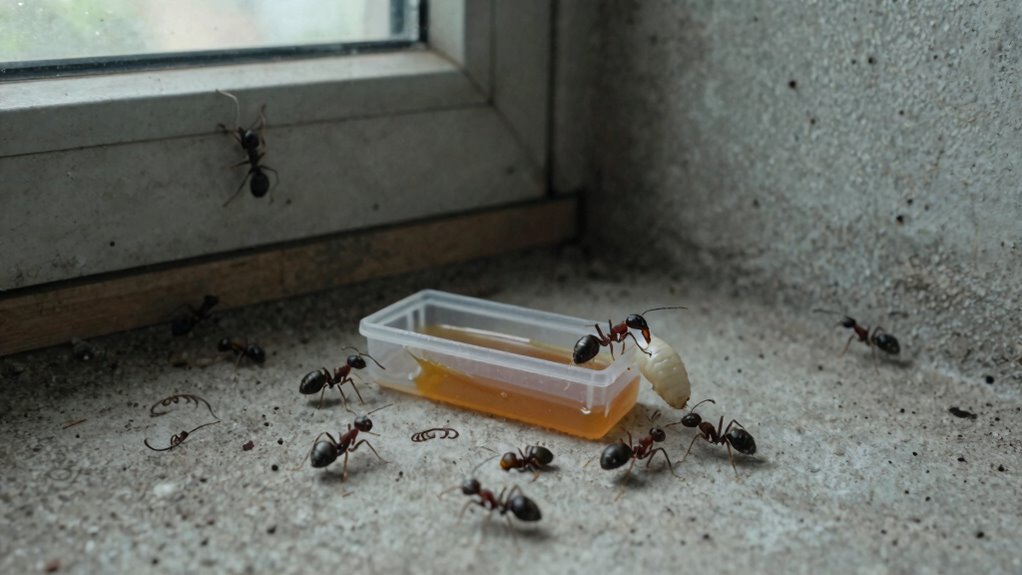
Adding protein to ant bait may seem like a smart idea, since ants need protein to grow their colony. However, lab tests with Argentine ants show they strongly prefer plain sucrose over a sucrose egg white mix.
This means protein additives can actually make your bait less effective. For professional pest control, it is crucial to avoid protein triggers that cause bait rejection.
If you are looking to buy effective ant bait, choose a formulation focused on carbohydrates. A plain sugar base will attract more foraging ants than a protein laced alternative.
That extra nutrition in your bait is likely convincing ants to walk away. Using bait formulations that are weatherproof and odor-free can further improve bait acceptance and success.
For best results in your pest control plan, stick with simple sugar baits.
Protein Additives Unpalatable
Why would a bait that seems scientifically perfect still be rejected by a hungry ant colony? The culprit is often the protein additive, not the poison itself.
Adding egg white to sucrose makes ants walk away, even when the sugar is otherwise irresistible. This rejection is purely about taste, not toxicity.
Foraging ants will simply skip a bait that smells or tastes off, because they have other food options. A protein additive, even one that boosts colony growth, shrinks your bait’s reach quickly.
Acceptance dies fast, no matter how long the trail or where you place the bait. A larger colony size does not override this dislike.
The bottom line is to skip protein entirely and stick with pure sugar baits. They win, ants lose.
Sucrose Preference Over Protein
Pure sucrose achieved an excellent 97.8% ant feeding rate in our test. Adding egg protein dropped acceptance to just 15.7%, the same poor result as adding quinine.
Protein additives clearly ruin bait acceptance for effective pest control. For reliable ant control, stick to simple sugar-based bait formulations.
Additionally, using borax-based formulas ensures the bait remains attractive to ants while effectively eliminating colonies.
If your current ant bait product is not working, check the ingredient list. You are probably serving steak to a dessert crowd when they need pure sucrose.
Choosing a Toxicant That Avoids Causing Bait Avoidance

Fipronil works at 0.0001 percent and kills within 72 hours, but its delayed onset helps avoid bait rejection. Spinosad at 0.015 percent achieves zero percent survival, and ants cannot taste it at all. Imidacloprid at 0.005 percent leaves 18 percent survival, which is enough for delayed transfer through the colony. Skip protein additives because they nosedive acceptance and reduce feeding to only 15.7 percent. Imidacloprid bait relies on the colony’s natural foraging behavior, increasing the chances of successful elimination. Choose liquid sucrose carriers, as they match natural foraging preferences for your pest control bait. The bottom line is to pick a slow acting toxicant, dose low, and let the colony do the heavy lifting for effective elimination.
Why Long-Term Ant Control Fails Even When Bait Works
The previous subtopic covered how to pick a toxicant that won’t scare ants off before they eat it, but getting them to take the bait is only half the battle. Toxicant efficacy, the poison’s actual kill power, is rarely the issue.
Even at low concentration effects like 0.0001% fipronil killing 61% of ants in 72 hours, the bait works. The real problem is behavior.
Within hours, ants abandon the bait station. They do this not as they’re dead, but as they learn to avoid the area.
Activity drops 80% by six hours. This isn’t a population crash; it’s a smart retreat.
Additionally, bait resistance can develop when ants are repeatedly exposed to the same toxicant without interruption, leading to diminished long-term effectiveness.
How to Fix a Bait Strategy That Ants Keep Outsmarting
Fixing a bait strategy requires outsmarting ants before they avoid your treatment entirely. The focus must shift to preventing bait abandonment and matching toxicant palatability to what ants prefer.
Research shows ants do not reject toxicants because of taste alone. They abandon the area after a few hours, which is a behavioral quirk that sweeter syrup cannot fix.
The real trick involves delivering a lethal dose fast while keeping the bait appealing. Avoid protein additives that turn ants off and place bait where foraging trails stay active.
This pest control approach targets current ant activity and future infestations. For effective ant baiting, focus on extending bait acceptance through careful placement and timing.
Professional pest management relies on understanding ant behavior to achieve long term elimination. Your bait strategy must adapt to how ants forage and avoid treated areas.
Additionally, understanding the mechanism of action of boric acid helps in designing programs that maximize residual effectiveness and prevent resistance buildup.
Reducing Bait Abandonment
Reducing bait abandonment starts with a simple, humble admission. The ants are smarter than the poison.
They abandon toxic bait within hours, not because they die but because they learn to avoid it. Fixing this requires outsmarting their behavior, not just their taste buds for effective pest control.
Place baits within foraging range limits. Ants abandon far-off stations first, so keep them close to active trails for better ant control.
Use smart bait station design that mimics natural food sources. Small, refillable liquid reservoirs work better than giant, scary traps.
Rotate bait locations every few days. This prevents ants from learning the poison zone and avoiding it entirely during your pest management efforts.
Offer multiple, identical baits so no single station becomes a danger signal. Spreading the risk across the colony improves your pest treatment results.
Keep bait fresh and consistent. Stale, crystallized, or smelly bait screams stay away louder than any toxicant.
The bottom line is to stop playing defense and start thinking like an ant. Use these ant baiting tips to solve your infestation problem quickly.
Matching Toxicant Palatability
| Palatability Factor | Ant Response |
|---|---|
| Sucrose alone | High feeding |
| Sucrose + toxicant | No aversion |
| Sucrose + protein | Strong rejection |
Bottom line: choose a bait where the toxicant blends in, not stands out.
For effective ant baiting, match the toxicant palatability to the target pest. Sucrose alone triggers high feeding, but adding a toxicant should not cause aversion.
A bait with sucrose and protein leads to strong rejection. So pick a bait formulation where the toxicant is masked by sweetness.
Ants will keep feeding when the poison is hidden. This helps you achieve complete colony elimination with fewer bait stations.
Additionally, selecting effective bait formulas that are designed for high palatability ensures faster and more thorough elimination.
Extending Bait Acceptance
A crumbling bait station full of dead ants is not a failure of poison. It is a lesson in ant psychology and learned avoidance.
To extend bait acceptance and achieve colony elimination, you must outsmart their memory. Rotate bait matrices every week to prevent taste aversions.
Switch between a liquid bait and a gel, keeping them guessing what is safe. Offer a non toxic pre feed first for two to three days.
Let them feast on pure sugar water, then swap it for the poison. They will trust the source and carry the toxic bait back to the nest.
Place multiple small stations spaced three to five feet apart. Ants avoid crowded, decaying bait piles, so spread the risk.
Clear away dead ants daily to remove danger signals. A clean station looks like a fresh grocery store, not a graveyard.
Combine with protein based bait after one week. Ants craving protein will ignore old carbohydrate traps and restart the cycle.
Beat their memory, not their stomach. This strategy ensures long term pest control success and complete colony elimination.
Maintaining bait stations in a resistance management approach helps prevent ants from developing bait aversions over time.
Frequently Asked Questions
Can Ants Develop Resistance to Common Bait Toxicants?
Ants do not develop genetic resistance to common bait toxicants like fipronil or spinosad. Instead, bait toxicity thresholds remain effective and ants die at tested concentrations.
The real pest control challenge is ant bait preference shifts. Ants learn to avoid a bait after a bad meal, not because the poison fails.
Think of it like a picky eater refusing burned toast. The toxicant itself is lethal, but ants simply abandon that bait and redirect their foraging trails elsewhere.
So genetic resistance is not the problem. Behavioral avoidance is what drives treatment failure in residential and commercial ant control.
The bottom line for smart pest management is to swap bait types or placements. This outsmarts their colony memory instead of reaching for stronger toxins.
Rotating between gel baits, granular baits, and liquid bait stations keeps ants from developing avoidance. Pair this with targeted spot treatments for long term ant elimination.
For best results, choose a professional grade ant bait with multiple active ingredients. Then change the bait station location every few weeks to stay ahead of their foraging patterns.
How Long Should I Wait Before Reapplying Bait?
Wait at least three days before reapplying bait. Reapplying too fast ignores bait freshness issues, and old bait might still be effective.
Placement strategy matters more than the amount of bait you use. Ants often abandon toxic bait within hours, not because it goes bad, but because they learn to avoid it.
Check if the bait station is still full before adding more. If ants are gone from that spot, move the bait to a fresh trail instead of piling on extra product.
Focus on finding active ant trails for the best pest control results. Smart bait placement is a key buying decision for any ant control strategy.
Do Weather Conditions Affect Ant Bait Effectiveness?
Weather absolutely flips ant bait results. Humidity impact is huge, damp air dilutes liquid baits and makes them less appealing.
Dry heat turns gel baits crusty and ignored by ants. Temperature fluctuations slow ant metabolism, worker traffic drops below 60°F.
This means less toxicant spreads back to the colony. Think of it like a cold car engine, ants just don’t move fast.
For outdoor pest control, reapply after rain or shifts above 80°F. Match your baiting schedule with active foraging times.
Bottom line, ant bait products work but mother nature dictates the schedule. Check product labels, then adapt to weather conditions.
Buy bait that matches your climate and application needs. Smart pest control buyers plan around these weather factors.
What Bait Works Best for Multiple Ant Species?
When you’re dealing with multiple ant species, a liquid sucrose bait with a fast acting toxicant like spinosad works best. Gel bait preferences vary too much by ant type, so stick with liquids for consistent results.
Place your bait stations directly along foraging trails instead of targeting nests. Spinosad at 0.015% concentration kills a broad range of ants with 0% survival in controlled tests.
Skip protein additives because they actually reduce palatability and make baits less effective. For homeowners looking to buy pest control products, liquid spinosad bait is the versatile winner.
Are Homemade Baits More Effective Than Commercial Ones?
Homemade baits are not really more effective than commercial ones. Ingredient availability is a plus since sugar, borax, and water are cheap.
But when you do a cost analysis, you’ll find you waste time and ants on homemade recipes. Commercial ant baits win because they are lab tested for palatability, unlike egg protein mixes that ants hate.
Homemade baits only work if you nail the exact toxicant concentration, like 0.0001% fipronil. Otherwise, you are just feeding the colony and making the infestation worse.
For a smart purchase that stops ant activity fast, stick with a commercial liquid sucrose bait. It is less hassle, more reliable, and gives you the best pest control results.


