
Getting rid of sugar ants doesn’t require spraying—it requires baiting. Sprays only kill the visible scouts, while the hidden queen keeps replenishing the colony.
Slow-acting borax baits let workers carry the poison back to the nest, wiping out the source. You also need to seal entry gaps with caulk and clean trails with soapy water.
It takes patience for a few weeks, but the payoff is a colony that collapses from the inside out. Keep reading for the full step-by-step strategy and product picks to make it happen.
At A Glance
- Eliminate food, water, and entry points using caulk and airtight containers.
- Deploy slow-acting baits like borax to poison the queen and colony.
- Seal gaps as small as 1/32 inch with silicone caulk or steel wool.
- Avoid sprays that kill only foragers and cause colony fragmentation.
- Use peppermint oil or soapy water to disrupt ant trails safely.
Why Do Sugar Ants Keep Coming Back?
Sugar ants keep coming back because they have three needs: food, water, and a hidden nest. The real problem is their supercolony size, which can hold thousands of queens in urban areas.
A single queen can live up to seven years, laying eggs season after season, which means a decade of new workers. That steady reproduction creates a constant stream of hungry ants that never stop searching your kitchen.
These ants are nomadic, so they relocate their nest every three weeks. When you think you’ve wiped them out, they’ve simply moved behind a baseboard or under a slab.
They also share resources with other colonies, swapping food and workers like one giant cooperative family. This makes local treatments less effective because new ants can repopulate from nearby nests.
To stop them for good, you need to eliminate all three attractants: food crumbs, standing moisture, and potential nesting spots. Professional pest control can identify hidden entry points and apply a targeted ant bait strategy, such as using a slow-acting poison like borax to ensure workers carry the bait back to the colony before dying.
Baits work, but they take time because workers must carry the poison back to the queens. Patience is critical, and consistent monitoring is your best friend in this marathon, not a sprint.
If you want a permanent fix, schedule a home inspection and ask about seasonal barrier treatments. That’s how you break the cycle and keep sugar ants from ever returning.
Where Are the Ants Entering Your Home? (Start Here)
Finding where sugar ants enter is the first and most critical step. Check along baseboards, window frames, and where pipes come through walls for tiny cracks or gaps.
These gaps can be as small as 1/32 of an inch, about the thickness of a dime. Sealing these entry points with caulk or petroleum jelly cuts off their highway into your kitchen.
You should do this before you even start baiting. This simple pest control method stops the ants from finding new trails. For a durable, long-term fix in damp or outdoor areas, consider using rust-resistant stainless steel wool to plug these small openings, as it blocks chewing while withstanding moisture.
Common Entry Points
The average home is less a fortress than a screen door with a mortgage. Sugar ants exploit this by finding entry through utility lines, pipes, and vents.
They trail from outside nests while tracking moisture and crumbs. Colony relocation is their key survival move.
When a nest is disturbed, they simply pick up and move queens to new spots inside your walls. Given a queen lifespan of up to seven years, one colony can plague a home for a long time.
Check where pipes enter under sinks. Ants love damp wood near dishwashers.
Likewise inspect window frames. They squeeze through gaps as thin as a credit card edge.
Start here before grabbing ant bait. Knowing where they come in halves the battle.
For effective elimination, consider using a delayed-action formula that allows worker ants to carry the poison back to the colony, targeting the queen and disrupting reproduction.
Cracks and Gaps
Those entry points near pipes and windows are just the beginning. The real problem hides in tiny cracks and gaps along your home’s foundation.
A foundation gap inspection shows where the structure meets the ground. You might find spaces wide enough for a credit card to slide through.
Sugar ants squeeze into gaps as thin as a nickel’s edge. Crack sealing techniques matter for keeping these pests out.
Use silicone caulk at about five dollars per tube. For larger openings, try a foam backer rod instead.
If you ignore these gaps, ants treat your home like a highway rest stop. They will show up uninvited and leave a mess.
Inspect every corner where concrete meets siding. Look for any separation that could become an ant superhighway.
Seal them within an afternoon to stop an infestation before it starts. Your reward will be fewer ant trails and less frustration.
You will have fewer reasons to curse your contractor’s sloppy foundation work. A quick inspection and sealing job gives you lasting pest control results.
Apply boric acid powder into these sealed cracks for long-lasting residual protection.
Why Spraying Visible Ants Makes the Problem Worse
Spraying visible ants is like putting a band-aid on a leaky pipe. It feels productive but makes the mess worse.
The real problem is that killing a few scouts sends a distress signal. The ant colony can then split into several smaller, angrier groups.
This colony splitting risk, along with the disruption of their pheromone trails, simply means you will have ants popping up in new, unexpected places.
For effective ant control, you need a professional pest extermination service to target the entire infestation.
Colony Splitting Risk
So you’ve spotted a few ants parading across the kitchen counter, and your first instinct is to grab a can of spray and blast them into oblivion.
But here’s the problem: that spray only kills the foragers, about 10% of the colony.
The other 90%, including the queen, remain hidden.
Proper colony identification matters since odorous ants form supercolonies with thousands of queens.
And queen longevity is a killer fact: a single queen can live up to seven years, laying eggs for five generations annually.
Spraying those visible ants triggers a survival response.
The colony fragments, or splits, into multiple satellite nests inside your walls, under floors, or near dampness.
Now you’ve got ants in three rooms instead of one.
The bottom line: spraying is a short-term fix that creates a long-term headache.
Avoid it and consider using delayed-action baits containing abamectin to kill the queen and brood before resistance develops.
Avoid it and consider targeted baiting or professional pest control for complete colony elimination.
Pheromone Trail Disruption
Why does killing a few visible ants often bring more later? It triggers colony fragmentation and releases a panic pheromone from dying workers.
This alerts the hidden supercolony, which then splits into multiple satellite nests. Those scattered groups send out even more foragers to search for food.
You see only the scouts, but the queen can live up to seven years while laying eggs continuously. The global ant population outnumbers humans, so a few dozen casualties mean nothing to a queen.
| Ant Type | Role & Lifespan | Impact of Spraying |
|---|---|---|
| Workers | Forage, live ~5 weeks | Dying scouts cause colony split. |
| Queen | Egg-layer, lives up to 7 years | She remains safe underground. |
| Males | Mate, live <1 week | They are never foraging. |
| Brood | Eggs, larvae, pupae | Unharmed inside wall voids. |
Spraying kills surface ants but leaves the queen, brood, and nest untouched. It is like cutting weeds at the top, the roots grow stronger instead.
For effective ant control, use slow acting baits instead of sprays. Workers carry poison back to the queen, which ensures the colony starves from within.
This method provides long term relief and targets the root of the infestation. Stop spraying and use bait stations to eliminate the colony.
The bottom line is simple, target the queen not the scouts. For lasting pest control, choose baiting over surface spraying. Slow-acting baits provide a longer residual effect compared to fast-kill sprays, giving the poison more time to spread through the colony.
The Right Way to Clean Ant Trails (Soapy Water Works Best)
If you see a line of tiny ants marching across your counter, resist the urge to grab a spray and go full action hero. Killing visible scouts only triggers the colony to split and send out more ants. Instead, use soapy water for effective ant control. It destroys the chemical trail they follow and suffocates them on contact. But more significantly, this home remedy attacks the communication system that keeps the colony united. The real goal is to erase the path, not just the ants. Here is the correct approach for ant removal. Mix one part liquid soap with two parts water in a spray bottle. Spray the entire trail from entry point to destination, soaking it completely. Wipe the residue away with a damp paper towel, breaking the scent connection. Understanding why soap works helps with long-term pest prevention. It breaks down the waxy coating on their exoskeleton and the pheromone trail. Since a worker ant’s colony life is only a few weeks, removing their navigational maps starves the nest. This stops new recruits from finding your kitchen and solves your infestation problem. For more persistent problems, consider using a spray with plant-powered ingredients that kills on contact and remains effective for weeks.
Why Baits Kill the Colony Better Than Sprays
When a spray kills the ants you see, it only eliminates the 10% that forage, missing the real threat hidden away.
Baits work on a different tactic, a Trojan horse approach, where workers carry the poison back to the nest and feed it to the queens and larvae.
The colony collapses from the inside out, giving you effective long term pest control.
Contact sprays often scare the survivors into splitting, scattering them into multiple new colonies around your home.
For complete ant removal, choose a baiting strategy that targets the entire infestation.
This method ensures the colony cannot rebound or spread, keeping your home protected.
Many effective baits use a borax-based formula that ants carry back to eliminate the queen and colony.
Worker Ants Transport Bait
Their survival instinct drives them to share the poisoned food, believing they are helping the colony survive. You watch them carry it away, unknowingly sealing the colony’s fate over several weeks.
Finally, the nest crumples, not from one spray, but from a delivered load of bait. The point is that baits turn worker ants into unwitting assassins.
They reach the hidden 90 percent of ants that sprays miss.
For long term ant control, baiting is the most effective pest control method.
Professional grade bait stations work slowly to ensure the colony is fully eliminated. This targeted approach kills the queen and all her workers without risky spraying.
If you want complete colony elimination, choose bait over aerosol sprays. It is the smarter, more reliable solution for ant problems.
For quick, total colony impact, choose a bait with a fresh sugar or protein formula placed well.
Queens and Larvae Consume Bait
Baits eliminate the whole colony because queens and larvae eat the poisoned food directly. Worker ants carry the bait back, and the queen feeds it to her young for years.
This stops new colony founding in its tracks, since larvae that eat the poison never mature. Sprays only kill the ants you see, but baits hit the reproductive heart of the pest problem.
The queen, the larvae, and hidden nurse ants all share the poisoned meal together. It is a family dinner no one survives, which is why baiting takes weeks but works permanently.
Sprays just kill the scouts you spot, leaving the real colony untouched underground. Baits deliver the final course, and the colony eats itself to death. Some gel baits use growth regulators to prevent any surviving young roaches from ever reproducing.
Sprays Cause Colony Splitting
Sprays might seem like a quick fix, but they often make the problem worse. Killing visible sugar ant foragers triggers a frantic panic, causing the colony to fragment into satellite nests.
This colony relocation spreads the infestation, not eradicates it. Baits, by contrast, work slowly, letting workers carry poison back to the queen.
False victory: Sprays kill a few dozen ants, but thousands remain, hidden and undeterred. Splintering chaos: A stressed supercolony grows into multiple smaller, harder-to-find outposts.
Wasted money: You buy $8 of spray, yet the ant parade just moves to the kitchen. Baits cost roughly the same but deliver a terminal dose.
Bottom line: skip the spray, let the bait do the dirty work. Your pantry will thank you.
For best results, choose baits containing Spinosad from soil bacteria to ensure fast colony elimination.
How to Place Ant Baits Correctly (Near Trails, Not Nests)
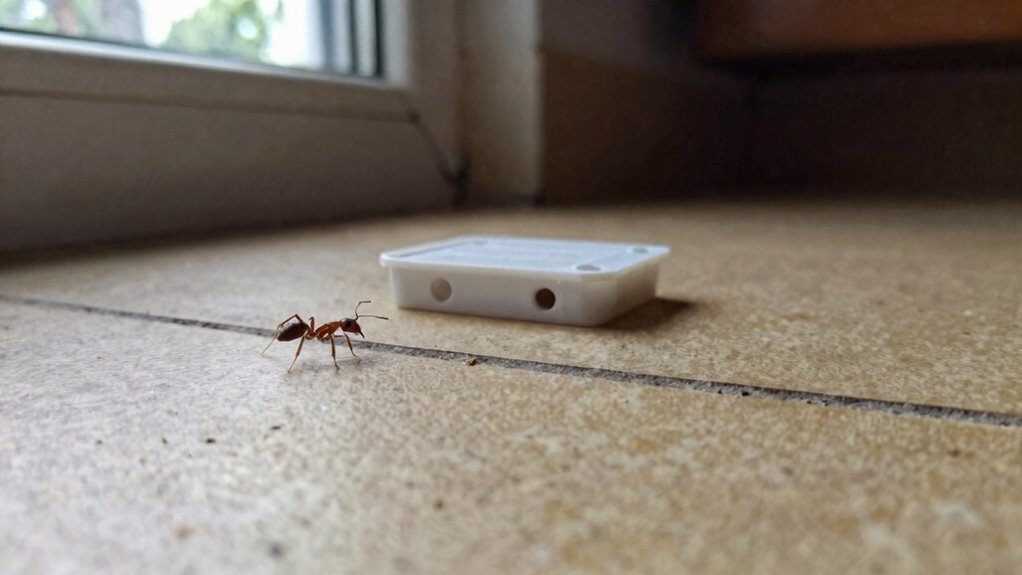
Finding the nest itself is about as hard as spotting a polite relative at a family reunion, so your best move is to place ant baits directly along the worker trails.
Sugar ants follow pheromone paths, so setting a gel bait or granular bait near those high-traffic zones gives you the best shot at control.
A slow acting bait is key because it lets foraging workers carry the poison back to feed the queen and the rest of the colony, including any satellite nests tucked inside wall voids.
Skip spray repellents entirely; they scramble ant behavior and cause colony fragmentation, pushing the problem into new corners of your home.
Instead, use bait stations or liquid bait along window gaps, door sweeps, and foundation cracks where ant trails keep showing up.
You will need patience, since killing an entire ant colony can take a few weeks, but effective baiting wipes out the whole supercolony, including multiple queens and the polydomous structure typical of urban infestations.
For long term pest control results, reapply fresh bait every few days until you stop seeing new ants on the trail.
This targeted approach not only eliminates the current generation but also disrupts future breeding, which is why professional exterminators rely on it for complete ant removal.
For lasting results, consider using non-toxic sticky traps in high-traffic areas to monitor activity and catch any stragglers without harmful chemicals.
Peppermint Oil and Vinegar: Natural Sprays That Repel Ants
Patience is your secret weapon when dealing with sugar ants. Peppermint oil and vinegar create simple, natural sprays that disrupt ant trails without harsh chemicals.
Patience is your secret weapon when dealing with sugar ants.
Diluted peppermint oil overwhelms their scent receptors, making them flee immediately. For vinegar safety, mix equal parts vinegar and water and test on a hidden spot first.
Spray along baseboards and windowsills for maximum ant control. These solutions work best when applied consistently over time.
You feel satisfaction watching ants scatter from a scent they can’t stand. You feel relief knowing your kitchen smells minty, not like poison.
You feel empowered skipping expensive sprays for a five‑minute mix. Spray daily for a week, then every few days.
Reapply after cleaning to maintain the ant repellent barrier. Simple, cheap, and oddly satisfying for any pest control routine. For heavy infestations, consider supplementing your spray routine with bait stations that carry poison back to the colony, eliminating ants within days.
Simple Prevention Steps That Stop Sugar Ants Before They Get In
The peppermint spray routine works, but it works even better when ants never find a reason to come inside in the first place.
Home maintenance here is the real star, and it’s dirt cheap for effective ant prevention.
Trim branches touching the house. Ants use them like bridges, so you’re basically handing them a welcome mat for a sugar ant infestation.
Seal cracks around windows and doors with caulk. It costs under five bucks and stops whole colonies cold from entering your home.
Spring rains push ants indoors, so check for damp spots under sinks. Fix leaky faucets fast to eliminate moisture that attracts pests.
Store honey, sugar, and pet food in airtight containers. Wipe counters nightly for crumbs, because sweet spills are basically ant billboards.
Do this and they’ll stay outside where they belong. No mystery, just dry, tidy logic for pest control.
For added outdoor protection, apply perimeter bait like TERRO granules around your home’s foundation to intercept foraging ants before they find a way inside.
When Sugar Ants Keep Returning After Two Weeks (Try This)

Two weeks of reappearing ant trails means the colony is laughing at you, and honestly, it’s earned the right. You’re feeding surface workers, not the nest.
After two weeks of trails, the colony isn’t just surviving—it’s mocking you.
For colony elimination, you must force bait back to the queen. Here’s what changes the outcome.
Wrong bait placement drops on counters only. Place gel baits along baseboards and behind appliances where trails vanish into walls.
Too fast a kill with contact sprays scatters the colony. Use slow-acting bait gels for effective pest control, allowing workers one to two days to share the poison.
Ignoring satellite nests is a common mistake. A single queen isn’t your enemy, so multiple queens mean multiple bait stations are needed.
Use one bait station per room for two weeks. Achieving colony elimination requires patience and the right ant bait application.
Reapply bait placement weekly for best results. Let the workers do the delivery and watch trails shrink like a bad memory.
Why Ants Are Worse in Spring (and How to Prepare)
Spring doesn’t just bring flowers. It brings marching columns of sugar ants into your kitchen, and that’s no accident.
As temperatures rise, ants break out of their winter slowdown called diapause. They go into full foraging mode with a serious pest control problem for homeowners.
Two big reasons explain the spring surge: spring dampness and aphid honeydew. Melting snow, rain, and damp soil push ants indoors seeking dry shelter.
Trees and shrubs produce aphids, tiny bugs that excrete honeydew. This sweet, sticky substance is a sugar buffet ants absolutely love.
Spring Factor | Why Ants Go Wild
Spring dampness drives ants inside for dry nesting spots. Warmer temps end diapause and boost ant metabolism.
Aphid honeydew provides a sugar buffet ants can’t resist. New colony growth means queens lay eggs after winter dormancy.
Foraging urgency forces ants to find food fast to feed new broods. To prepare for this seasonal ant invasion, seal cracks around doors and windows.
Trim branches that touch your home to eliminate ant highways. Wipe counters daily to remove crumbs and sweet residues.
A little spring prevention now beats a full‑scale bait war later. Stay ahead of the problem with these simple home pest control steps.
When to Call a Pro for a Sugar Ant Infestation
You can handle many ant problems on your own. But when DIY efforts fail after two weeks, it is time to call a professional exterminator.
If ants appear in multiple rooms or you spot satellite colonies inside, store-bought baits will miss the hidden nests. A pest control expert locates the queen and her thousands of workers through targeted colony treatment.
That is the only way to eliminate a supercolony, not just scatter it. Your kitchen turns into an all-you-can-eat buffet for an army that never leaves.
You are sealing cracks and spraying trails, yet ants still march in from every direction. You have wasted weeks on baits that only made the infestation worse by splitting colonies apart.
Calling a pro is the effective final step for a long term solution. It is the difference between a temporary fix and real ant control.
Frequently Asked Questions
Can Sugar Ants Damage My Home’s Structure?
Sugar ants, also known as odorous house ants, rarely cause structural damage to your home.
Unlike carpenter ants or termites, they do not chew wood or compromise support beams.
However, a colony infestation inside walls can become a real nuisance.
They often nest in insulation, near pipes, or under floors.
Their presence signals underlying dampness or accessible food sources, not a collapsing home.
The real damage from sugar ants is annoyance, not architecture.
So no need to panic about your home’s structure.
Your walls are safe, but you should seal up snacks and address moisture issues.
For effective ant control, look for gel baits and granular treatments designed for odorous house ants.
A targeted pest control treatment can eliminate the colony without harming your property.
Are Odorous House Ants Harmful to Humans or Pets?
Odorous house ants are not harmful to humans or pets. They don’t sting and they don’t transmit diseases.
Their crushed bodies release a rotten coconut smell, which is more of a nuisance than a danger. These ants often nest in walls or under floors, where they can contaminate your stored food.
Thankfully, they rarely cause structural damage to your home. Think of them as messy roommates, not dangerous invaders.
For effective pest control, focus on sealing entry points and eliminating food sources. Using ant baits and gel treatments can target colonies without the need for harsh sprays.
If you want long term ant prevention, address moisture issues and keep your kitchen spotless. No need for panic, just patience and the right pest management strategy.
Will Sugar Ants Eventually Leave on Their Own?
No, sugar ants will not leave on their own. Their colony migration is driven by food and dampness, so if those vanish, they stay.
Food disappearance—say, after you seal all sweets and clean up—might encourage them to scout elsewhere, but the main nest outside remains active. Think of them as stubborn tenants: they don’t pack up until the pantry is empty and the leaky pipe is fixed.
Call a pro if baits fail after two weeks; it’s worth the peace of mind. For lasting control, invest in gel baits and a thorough crack-and-crevice treatment.
Do Sugar Ants Bite or Sting When Provoked?
Sugar ants do not bite or sting in any meaningful way. These tiny creatures lack the equipment for ant sting pain, being more interested in sugar than a fight.
Sugar ant bites are fundamentally nonexistent because their jaws are too weak to break human skin. If provoked, they may attempt a pinch that feels like nothing, followed by that weird rotten coconut smell.
Their defense is fleeing, not fighting. They would rather raid your pantry than pick a battle, so there is no real threat there.
That said, an infestation still requires professional pest control treatment to protect your home. For effective ant control, consider using gel baits or granule insecticides that target the colony directly.
If you are searching for ant extermination services or DIY pest control solutions, focus on products that attract and eliminate the queen. The right ant bait is your best purchase for lasting results.
How Long Does a Sugar Ant Colony Typically Live?
A sugar ant colony doesn’t really die; instead, it operates as a continuous, living system. Workers live only a few weeks, but the queen’s longevity is the real anchor, with some queens surviving up to seven years while laying eggs constantly.
In urban areas, what you’re dealing with is often a supercolony, which can contain thousands of queens and hundreds of thousands of workers. That means individual ants may come and go, but the colony itself is practically immortal unless you actively eliminate every single queen.
If you’re facing recurring sugar ant invasions, your smartest move is targeted baiting and residual sprays that specifically reach nesting queens. For effective pest control, look for gel baits with slow-acting toxins like fipronil or borate, which workers carry back to the colony.
Buying a professional-grade ant killer, rather than a quick-kill aerosol, is essential for long-term relief from these persistent urban pests. You’ll also want to seal entry points and remove moisture sources, since sugar ants thrive near kitchens, pet bowls, and leaky pipes.
When you compare products, prioritize those labeled for “sugar ants” or “odorous house ants,” and check reviews for queen-killing success stories. A single treatment won’t break the cycle; expect to reapply in 2 to 3 weeks to catch newly hatched workers.
For a guaranteed knockout, consider using an outdoor perimeter barrier around your foundation, combined with indoor stations placed along ant trails. That two-pronged approach is your best purchase for protecting your home year-round, not just for a temporary fix.


