
Getting rid of cockroaches without an exterminator is simpler than you think. A few pantry items can replace those harsh chemical sprays for good.
You only need a sticky trap and a dab of peanut butter. The 1-hexanol smell lures them in, while a baking soda mix delivers a delayed, colony-ending punch.
This method costs pennies, works fast, and keeps your counters clean. Stick with it, and you’ll soon see the graveyard grow—right where you want it.
Below is the simple supply list to start your roach-free kitchen today.
At A Glance
- Use peanut butter on sticky traps to monitor and capture roaches without poisons.
- Apply baking soda mixed with peanut butter as a slow-acting bait to eliminate colonies.
- Rotate baits with different active ingredients to prevent roach resistance.
- Place baits along baseboards, under sinks, and near appliances for best results.
- Seal gaps with caulk and wipe surfaces with vinegar solution to prevent re-infestation.
Why DIY Cockroach Control Beats Sprays and Exterminators
Deciding to tackle a cockroach problem solo isn’t just about saving a few bucks, though that helps. It means avoiding the spray and pray approach that ignores basic toxicology, like how residues linger on counters and expose kids and pets.
Deciding to tackle a cockroach problem solo isn’t just about saving a few bucks, though that helps.
DIY pest control systems let you observe where roaches roam, then target them with food based baits. Unlike foggers that just push bugs deeper, this method uses roach bait stations for precise elimination.
Resistance monitoring becomes doable at home, a key part of integrated pest management. When a homeowner sees bait being ignored, they switch tactics to avoid creating super roaches that laugh at professional poisons. Use bait rotations with different active ingredients, such as switching from abamectin to thiamethoxam, to prevent cockroaches from developing resistance abilities.
It is a slower, smarter grind, checking sticky traps weekly and rotating baits. This approach respects that cockroach pest control requires adapting to rapid evolution, while a spray does not.
The low toxicity route, using boric acid or baking soda as cockroach killer ingredients, keeps your family safer. It also leaves the environment cleaner and your wallet happier with professional pest control alternatives.
Calm, persistent observation beats panic spraying every time. For effective roach control, patience and targeted treatments win the battle for a pest free home.
Build a $1 Sticky Trap That Catches Roaches All Night
A simple sticky trap is your cheapest, effective first move in any roach control plan. Use duct tape, sticky side up, on a 4-by-6-inch cardboard piece, taped flat to the floor.
Peanut butter works like magic as a bait, with its 1-hexanol smell drawing roaches straight in. Place these pest control traps under cabinets, near baseboards, or wherever you’ve spotted droppings.
Check them each morning; you’ll likely find a sticky graveyard of trapped roaches. No poisons, no fuss, and a single trap costs about a buck to catch roaches all night long.
It’s also a smart monitoring tool for your infestation level: lots of catches means you have a serious problem, while few means you’re winning the battle. This makes it perfect for home pest prevention and early detection.
Bottom line: this sticky trap is your first, cheapest, and least toxic weapon against roaches. Pair it with gel bait later for heavy infestations, but for now, stick with sticky.
If you need quick roach control solutions, this DIY trap delivers immediate results without harsh chemicals. Just remember to replace the cardboard and tape every few nights for consistent action.
Many commercial traps use a food-grade, eco-friendly adhesive that is safe for pets and children, making them a reliable alternative to the DIY version.
The One Ingredient That Makes Roaches Walk Into Your Trap
Peanut butter is the single ingredient that makes roaches walk right into your trap. Its 1-hexanol compound acts as a powerful scent lure, drawing cockroaches far more effectively than plain sugar or other baits. Simply smear a dab of peanut butter in the center of a sticky card for a highly effective pest control solution. The roaches will come marching in, and you can keep your home free of these common household pests, with boric acid powder acting as a stomach poison that kills them within hours after they groom it from their bodies.
Peanut Butter Attractant
Why does peanut butter work so well as a cockroach attractant? Its strong, greasy scent, particularly 1-hexanol, mimics food signals roaches can’t ignore.
This creates a clever baiting strategy: place a dollop in the center of a DIY sticky trap, and roaches march right in.
Interestingly, peanut butter’s aroma also causes a form of mating disruption, confusing males who follow scent trails intended for females.
They end up stuck instead of reproducing, so for about $3 a jar, you get a non-toxic lure that outperforms many commercial options.
Just remember: no poison needed, just patience and a little sticky ingenuity.
Bottom line: peanut butter turns your trap into a roach magnet, no exterminator required for effective pest control. For a truly comprehensive approach, professional-grade options like Advion bait stations offer systematic colony elimination when used alongside DIY traps.
Scent Lure Effectiveness
Skip the pheromone hype and try a simple household trick. A smear of peanut butter on cardboard is cheaper and scientifically proven to work. This slow-acting approach mimics how delayed-action bait allows worker roaches to carry poison back to the nest, sharing it with the colony for complete elimination. Your roaches will march right in, lured by something already in your pantry. This roach bait method saves you money on expensive pest control products. Your wallet thanks you for choosing this effective roach control tip.
Why Baking Soda Mixed With Peanut Butter Kills Roaches Better
Baking soda mixed with peanut butter kills cockroaches better than many expect, and the science behind it is surprisingly simple. The baking soda expands inside the roach’s stomach after ingestion, causing fatal internal pressure, a gruesome but effective end.
Peanut butter is not just tasty. Its 1‑hexanol compound acts as a powerful semiochemical attractant, luring roaches from hiding.
Roach colony collapse occurs faster as the bait spreads through the population when foraging roaches share it with nest mates. Bait longevity testing shows this DIY mix stays potent for three to five days in cool, dry spots, outperforming many store-bought gels that dry out or lose appeal.
The bottom line is this homemade bait costs pennies, works fast, and triggers systematic die‑offs. It is simple, cheap, and a bit diabolically clever. 395nm wavelength UV lights can also help reveal hidden roach trails and droppings during inspections to target bait placement more effectively.
DIY Baits vs. Store-Bought Gels: Which Works Faster?
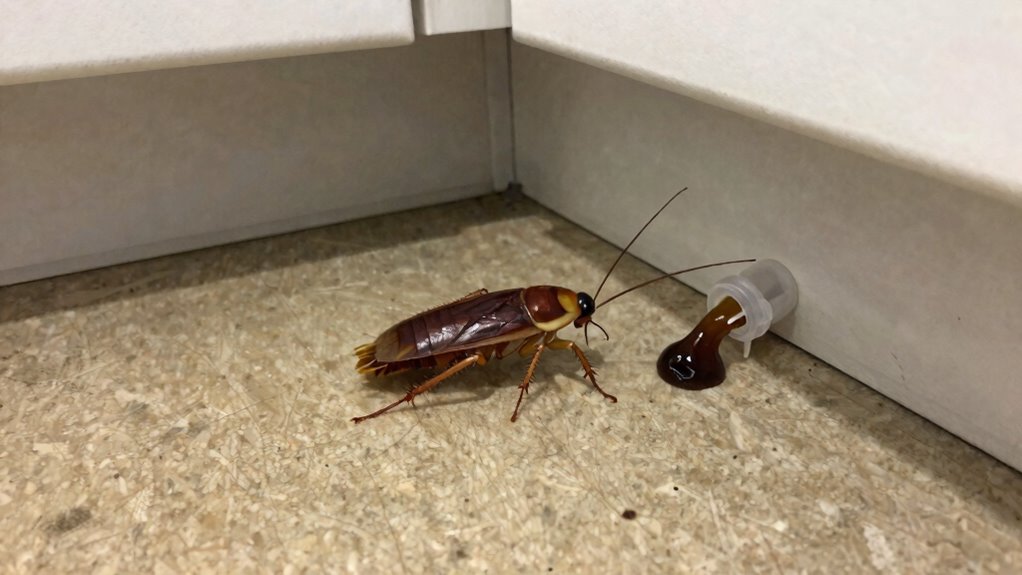
Homemade baits are cheap and fun to watch, but store-bought gels work much faster for roach control. A roach’s fast metabolism responds quickly to gel formulas like Maxforce, which kills over 93% in just 24 hours.
DIY baking soda and peanut butter mixes rely on slow ingestion, taking days to work. Store gels are engineered to be irresistible, so roaches eat them instead of crumbs.
Gels also last for weeks even in humidity and heat, while baking soda paste dries out fast. For cost, DIY is pennies per batch, but a $10 to $15 gel tube covers more ground.
If you need a quick knockdown for an active infestation, buy a gel. For cheap and patient pest control, DIY works but expect slower results.
The bottom line is speed favors the store-bought route for fast roach elimination.
Where to Place Baits in Kitchens and Bathrooms for Best Results
Place baits where cockroaches actually travel, not where you think they should go. In kitchens, that means along baseboards, under the sink, behind the fridge, and near the dishwasher.
These are prime spots for kitchen warmth and roach activity. Target those appliance gaps to maximize your cockroach bait placement effectiveness.
In bathrooms, focus on corners near pipes and under the toilet. Bathroom humidity is a magnet for pests, so place bait close to damp zones.
Avoid placing bait directly in standing water. Use small dabs, about pea sized, in cracks and along edges.
Avoid open countertops because roaches avoid open spaces. Think like a roach: dark, warm, damp, and tight.
To win against roaches, think like one: dark, warm, damp, and tight.
That is where baits win for pest control success. Follow these kitchen and bathroom baiting tips for the best results. Active ingredient fipronil works quickly after ingestion and spreads through the colony.
Add Slow-Acting Baits to Your DIY Arsenal for Lasting Control
Slow acting baits are your secret weapon for lasting cockroach control. These baits use a delayed toxin that cockroaches take back to the nest, poisoning the colony.
The Hot Shot liquid stations cost about five dollars for six, making them an affordable DIY pest control option. Maxforce FC Magnum gel costs around fifteen dollars per tube and delivers over 93 percent lab mortality.
Cockroaches survive long enough to share the poison, so the hidden breeding population gets eliminated. This approach guarantees long term control, not just a quick fix for visible bugs.
Place baits near baseboards, under sinks, and behind appliances where roaches travel. The key benefit is that they target the entire colony, not just surface feeders.
Patience beats panic with this strategy for lasting cockroach management. These baits are your DIY arsenal for ongoing control, not a temporary solution. A slow-acting formula with colony elimination properties prevents the quick return of roaches.
Are Slow-Acting Baits Safe for Kids and Pets?

Safety first, right? Slow acting toxicity makes these baits safer for homes with kids and pets.
Safety first, right? Slow acting toxicity makes these baits safer for homes with kids and pets.
A roach eats the bait, returns to its nest, and dies later. This keeps the poison contained in bait stations or gel placements, not sprayed across counters.
Most commercial baits, like Hot Shot liquid stations at about four dollars for six, use low dose active ingredients. These pose minimal risk if accidentally touched.
For extra peace of mind, practice pet proof placement. Tuck stations under refrigerators, behind stoves, or inside cabinets away from curious paws and tiny hands.
The bait’s bittering agents further deter ingestion. That controlled, delayed action keeps the whole household safer than instant kill sprays.
Bottom line? These baits mean fewer worries, fewer dead roaches in plain sight, and fewer panicked calls. This is due to the MetaActive effect, where indoxacarb affects insect enzymes differently from human enzymes, increasing targeted safety.
How to Keep Roaches Away After You’ve Eliminated Them
So you have won the war. Roaches are gone, counters are clean, and the midnight kitchen raids are history.
Now the trick is keeping them out. Structural exclusion is your first line of defense. Seal gaps around pipes, doors, and windows with caulk or copper mesh. This costs about $15 and takes an afternoon. For doors and windows with uneven gaps, a brush seal strip made of nylon bristles provides a flexible fit that blocks pests effectively.
Roaches cannot waltz in through a crack they cannot fit through. Residual repellency matters too.
After cleanup, wipe surfaces with a vinegar solution (one part water to one part vinegar). This removes pheromone trails that invite new infestations.
Place glue boards monthly in dark corners to monitor any stray scouts. This proactive pest control step costs between $2 and $5.
| Action | Cost | Frequency |
|---|---|---|
| Seal gaps | $10 to $20 | One-time |
| Vinegar wipe | Less than $1 | Weekly |
| Glue board check | $2 to $5 | Monthly |
| Declutter | $0 | Seasonal |
The bottom line is block entry, erase scent maps, and stay vigilant. Roaches are persistent houseguests.
Why Your Sticky Traps Are Empty: Fix Bait and Placement First
A sticky trap sitting empty for days is not a victory. It is a sign something is off in your pest control strategy.
First, check bait freshness. Stale peanut butter won’t pull roaches from hidden harborages, so replace it weekly.
Mind trap hygiene too. Dusty or greasy surfaces lose stickiness fast, reducing your roach bait effectiveness.
Placement matters more than luck. Toss traps along baseboards, under sinks, and near appliance motors, not in open floors.
Use a weekly rotation pattern to cover new paths as populations shift. If traps stay bare, scout for water sources.
Roaches often ignore bait when humidity is easier to find. That is a common oversight in cockroach control.
Bottom line: refresh bait, reposition traps, and rotate zones. Empty traps aren’t clean. They are a clue you are guessing, not targeting.
For larger infestations, consider whether your chosen product offers residual protection up to two weeks to prevent reinfestation from hidden egg hatches.
Frequently Asked Questions
Can I Use Multiple Baits at the Same Time?
Yes, you can use multiple baits at the same time, but you need to be cautious.
Bait competition is a real risk because cockroaches won’t sample everything.
Overlapping baits can split their attention and reduce effectiveness.
Worse, ingredient interference happens when active compounds clash, sometimes canceling each other out.
Stick to one bait type per week for best results.
Then rotate to a different formula if your current bait seems to stall.
For example, start with a liquid station like Hot Shot, which costs around $8 for six.
Later, switch to a gel bait such as Maxforce for about $15.
The key is using baits sequentially, not simultaneously.
This sequential approach wins the battle against roach infestations more reliably.
How Often Should I Replace Homemade Sticky Traps?
Check homemade sticky traps at least once a week to monitor pest activity.
The glue’s longevity depends on dust and humidity, which can dull its stickiness over time.
Once a trap shows saturation, meaning it is covered in bugs or debris, replace it immediately.
A full trap loses its holding power and stops working effectively.
Think of it like a busy parking lot with no room for newcomers.
For best results, swap your traps every 7 to 10 days, or sooner if they look crowded.
If you want to control flies, gnats, or other household pests, a clean trap will catch more.
Replacing traps regularly also helps you spot an infestation early and choose the right pest control products for your home.
Do Roaches Become Immune to Baking Soda Baits?
No, roaches do not become immune to baking soda baits. This is not a poison they can adapt to over time.
Baking soda expands in their gut, creating fatal gas rather than a chemical attack. That means resistance is completely off the table for this pest control method.
Bait freshness is what really matters for cockroach bait effectiveness. Stale peanut butter or sugar loses its 1-hexanol allure, dropping roach visits from 578 to nearly zero.
Replace your homemade roach bait mix every 3 days for consistent kills. Dead roaches are another problem you will need to handle.
Will Boric Acid Harm My Plumbing or Drains?
No, boric acid will not harm your plumbing or drains. It dissolves poorly in water, so it doesn’t corrode pipes like harsh chemicals.
Boric acid toxicity is low for humans and pets but lethal for roaches. Think of it as a sleepy powder for them, making it a safe, effective roach killer for your home.
Drain residue removal is easy, just flush with hot water later. For best results, sprinkle it in dry spots like under sinks for ongoing cockroach control.
A $5 box works for months, making it a budget friendly pest control solution. Use bait stations for targeted effect, but avoid pouring mixtures down drains.
This simple, non toxic approach helps you manage indoor pest infestations without costly repairs. Buy boric acid powder today for a smart, long lasting roach treatment.
Can Sticky Traps Catch Roach Eggs and Nymphs?
Sticky traps can catch nymphs, but not eggs. Cockroach eggs are protected inside a hard case called an ootheca, which won’t stick to glue.
Sticky traps help with egg detection, since finding nymphs means eggs are likely nearby. These traps are a solid first step for monitoring your home for pests.
They won’t solve the problem alone, so think of them as a friendly heads up, not a wholesale solution. For complete cockroach control, you’ll need to pair glue boards with bait stations and insect growth regulators.
If you see nymphs, it’s a clear sign to buy a quality roach killer spray or gel bait. Monitor with sticky traps, then target the nest to stop the infestation cycle.


