
Ant Bait vs. Ant Spray: Which Works Better? If ants are staging a takeover in your kitchen or yard, you want a fix that actually ends the invasion, not just delays it.
Spray offers fast knockdown and a 12-week barrier for about $10, while bait takes days and may only reach a fraction of the colony. This guide breaks down the 2025 reality of both methods, so you can pick what fits your home and budget.
We’ll cover the best supplies, key notes on where each works, and what’s genuinely worth buying.
Keep reading for the full comparison and our top product picks.
At A Glance
- Spray kills entire colonies within 24 hours; baits take days and reach few ants.
- Spray costs as low as $10 per yard; bait stations can cost $800.
- Spray leaves residual perimeter protection for up to 12 weeks; baits degrade quickly.
- Baits are ignored when competing foods like honeydew or trash are plentiful.
- Spray provides immediate ant knockdown; baits require slow poison transfer.
Bait vs. Spray: Are You Managing or Eliminating Ants?
Sprays offer complete colony elimination, while baits only reduce the active workforce. That is management, not a true solution for ant control.
Consider the cost. A popular spray’s active ingredient costs about $1.50 per gram. The same ingredient in gel bait runs $557 per gram. Bait chemistry is fussier, and that complexity shows in the price tag.
Baits require species identification upfront. Ants do not all fall for the same recipe. Miss one detail and bait becomes an expensive snack. Only a tenth of the colony forages at any time, so poison reaches few.
Sprays are forgiving. Baits are not. Unlike sprays, slow-acting baits let foragers return to the colony and share the poison, killing the queen and brood. Want ants gone for good? Spray. Prefer fewer ants with gold bar prices for the privilege? Bait away.
Spray Treatments Eliminate Colonies in 24 Hours
Spray treatments deliver a knockout punch, killing entire ant colonies within 24 hours. No waiting around for bait to spread.
This speed comes from contact knockdown, where the insecticide drops ants on the spot. A residual barrier then keeps working for up to twelve weeks along perimeters. For carpenter ants, pyrethroid sprays are recommended when wood damage is involved.
Rapid Colony Knockdown
A 24 hour mark is all it takes for a liquid insecticide to deliver a knockout punch to an entire ant colony. That is not marketing fluff, it is a measured outcome from field trials.
For odorous house ants and black carpenter ants, spray treatments hit 100% colony mortality within a day. That is elimination speed to set a watch by.
Baits crawl along at 82% by day eight. They often shuffle the nest elsewhere instead of wiping it out. Unlike baits, broadcast treatments block new mounds for up to six months.
Cost efficiency is another win for ant control. The active ingredient in a spray runs about $1.50 per gram.
The same stuff in gel bait costs a jaw dropping $557 per gram. That is over 370 times pricier for slower results.
So if a colony needs to go, spray wins for rapid knockdown. Bottom line, spray for fast complete elimination.
Choose bait only for slow partial management. For total pest removal, professional spray treatments are the smart buy.
Residual Perimeter Defense
Why gamble on a slow bait when a perimeter spray can wipe out the whole colony in one day? Spray treatments hit 100% colony mortality within 24 hours for odorous house ants and carpenter ants.
Baits stall at 82% by day eight, and that is optimistic. See, bait works by being carried back to the nest, but only 10% of ants forage at once.
If they find competing resources like honeydew, they ignore the bait. Worse, a bait can trigger nest relocation.
A perimeter spray leaves a residual barrier lasting 4 to 12 weeks. It kills on contact, no ingestion needed. For instance, Ortho BugClear connects directly to a garden hose for easy perimeter treatment.
For outside defense, spray wins the perimeter pest control battle. It costs pennies per gram and works in rain.
Bottom line for ant control: spray the perimeter. That is not hype, just chemistry.
Try it once for fast results.
Why Bait Treatments Take Days and Still Leave Ants Behind
After a few days of baiting, the truth emerges: most colonies are still thriving.
Baits are slow because only 10% of ants forage at once, so the poison barely reaches the nest.
Competing food sources reduce bait intake, and dominant ants can cause bait monopolization.
That disturbance may even trigger colony relocation, wasting your pest control efforts.
Unlike slow baits, stomach poison acts directly, killing ants within 24 to 72 hours, though colony-wide elimination still takes weeks.
| Factor | Bait Reality | Impact |
|---|---|---|
| Speed | Slow | Nest safe |
| Reach | Few foragers | Nest intact |
| Competition | Food wins | Bait ignored |
| Monopoly | One species hogs | None |
| Relocation | Colony moves | Bait wasted |
You are not killing the colony, just managing what you see.
Patience rarely pays off, as bait can cost $26,667 per gram, like paying gold prices for a snack that nobody eats.
If your goal is no more ants, bait will leave you waiting and still watching them march.
For effective ant elimination, consider professional pest control or targeted colony treatments instead of relying on slow bait products.
Spray + Bait Combos: Do They Beat Spray Alone?
The short answer is no, and the data is pretty clear about it.
Combo treatments like spray plus bait show zero benefit over spray alone for house and carpenter ants.
Spray saturation limits already knock out every foraging ant on contact.
Bait synergy myths suggest baits finish the job, but studies show bait adds nothing.
Baits only manage colonies by reducing counts maybe 80 percent, whereas sprays eliminate them.
One popular bait costs $557 per gram versus $1.50 for spray.
Why waste money on pricey peanut butter for ants?
For practical pest control, use outdoor perimeter spray and skip the combo.
You will save cash and nuke the colony faster.
Pick a good insecticide spray, apply it correctly, and ignore the combo hype.
Your wallet will thank you for this simple ant treatment approach.
If you need to treat hidden voids or damp areas, a waterproof deltamethrin dust can provide long-lasting residual control in those hard-to-reach spots.
Speed of Action: Sprays Work in Hours, Baits in Days
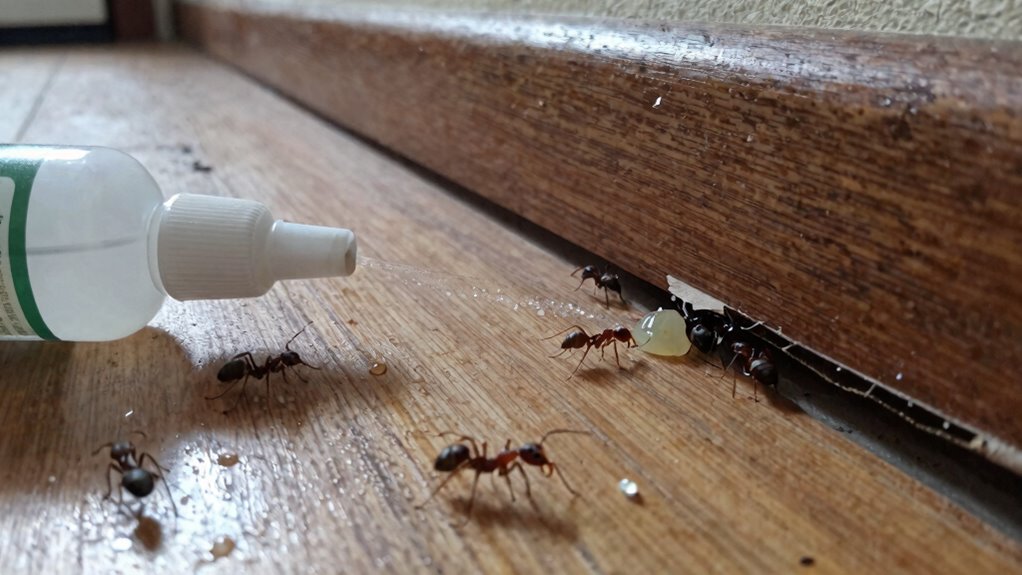
Sprays knock ants down within hours, but baits take days to affect a colony and success is uncertain. Sprays nuke foragers instantly, while baits rely on a tiny workforce to spread the poison.
Sprays nuke foragers instantly; baits take days and rely on a tiny workforce.
Bait consumption lag is the problem: ants eat slowly and then carry the poison home. Nest coverage delay means only about 10% of the colony is out foraging at any time.
In studies, sprays wiped out 100% of odorous house ants within a day. Baits killed 82% by day eight, and that was the best result. Even effective borax bait stations, which target the queen and entire colony, take two to four weeks to finish the job.
Speed is not bait’s strength, plain and simple. For immediate ant control, spray wins every time without question.
For long term pest management, bait can work but it is a slow gamble. When hours matter, do not wait on ants, just spray.
Spray Barriers Last 12 Weeks; Baits Degrade in Days
Spray treatments hold their ground for up to twelve weeks. This creates a perimeter of persistent poison that keeps working long after you have moved on. Rain, microbial activity, and soil temperature can shorten that window, but moderate, dry weather extends the residual effect.
Baits are a fast-food meal, gone in days. They get consumed, rained on, or stolen by a squirrel with no respect for your ant problem.
That longevity gap means sprays win the outdoor war of attrition. Baits become a fading memory before the colony even finishes its appetizer.
Sprays are the better choice for lasting outdoor pest control. Baits work best for quick knockdowns in tight indoor spots.
Spray’s Extended Persistence
Any homeowner battling an ant colony quickly learns that persistence matters as much as power. The spray wins clearly for long lasting residual pest control.
A bait might disappear before the weekend, but a perimeter barrier strategy keeps working for up to 12 weeks. That is like having a tiny, grumpy bouncer at your foundation line.
The chemical clings to surfaces and rain and sun don’t break it down as fast. You spray once, then forget it for a whole season.
A professional-grade spray, like a pyrethroid, costs about $1.50 per gram versus pricier bait options. Realistically, the spray’s value is in the delayed knockout effect. Professional-grade options offer enhanced residual performance for even longer-lasting coverage with fewer reapplications.
If you want a low effort guard for your home, spray wins every time. Your only job is not stepping in it.
Bait’s Rapid Degradation
The bait’s charm fades fast, literally. Unlike spray barriers that hold for twelve weeks, gel baits suffer rapid decomposition into useless goo within days. Synthetic pyrethroid concentrates last up to three months on sealed surfaces like concrete or wood.
Environmental breakdown from sun, rain, and heat is brutal. Your investment literally evaporates.
Here is what you are really buying. Sunlight bleaches the gel and zaps its active ingredient.
Rain washes it away, diluting the poison to nothing. Heat melts it into a puddle that attracts dust and debris.
Non-targets chomp it down, leaving crumbs for ants. That is why field trials show bait losing half its punch after two weeks outdoors.
For perimeter pest control, spray’s residual barrier is a fortress. Bait is a soggy paper towel.
For outdoor perimeter duty, do not bother with gel. Spray’s stubbornness wins for long lasting outdoor bug spray.
Bottom line. If you want a one time fix that laughs at weather for ant control or roach treatment, spray is your guy.
Bait is only fair indoors where it stays fresh. Choose spray for dependable exterminator grade outdoor defense.
Why Bait Costs Up to 480x More Than Spray
Why does a gel bait cost more per gram than gold, while the spray version of the same active ingredient costs about as much as a candy bar? The answer comes down to formulation complexity, not raw toxicity.
Spray is essentially diluted poison, cheap to mix with solvents and propellants. Bait, on the other hand, is an ant gourmet meal engineered to be irresistible and slow-acting for colony-wide elimination.
Active ingredient cost gets weird when you compare pest control products side by side. Spray uses a tiny amount of AI, so you pay mostly for liquid filler.
Bait packs the same AI into a concentrated paste, which means precision dosing and targeted delivery. You are paying for precision, not poison: spray runs about $1.50 per gram of AI, while bait jumps to $557 per gram.
That bait price is 480 times higher than gold, which sits near $55 per gram. But baits reach hidden nests and cracks where sprays can’t penetrate, making them essential for severe infestations. Baits also achieve secondary kill through contaminated droppings, which spreads the active ingredient to other roaches and decimates the population from within.
Bottom line: you are not paying for more poison, you are paying for smarter delivery that tackles the queen and the whole colony. If budget’s tight, use spray for quick knockdown; if results matter, buy bait for long-term control.
When Non-Selective Sprays Beat Species-Specific Baits
For complete colony elimination, non-selective sprays kill 100 percent of odorous house ants within a day. Baits take eight days and still leave nearly a fifth of the nest alive.
That rapid knockdown of visible foragers matters for immediate ant control. Sprays cost only $1.50 per gram of active ingredient, compared to $557 per gram for bait.
Baits require ants to haul poison back bit by bit over a week. So if you want the whole colony gone fast without spending gold-bar money per gram, the non-selective spray wins.
Honestly, who doesn’t like saving a few hundred bucks on ant extermination? Choose the spray for quick, total colony elimination and better value. Non-selective sprays often feature residual active ingredients like Lambda-Cyhalothrin or Deltamethrin for lasting protection.
Complete Colony Elimination
Want the ants gone by dinner? For complete colony elimination, non selective sprays crush the colony structure fast. Baits, though clever, often miss the queen and cause nest relocation, scattering the problem.
Sprays are the blunt instrument that actually works, no waiting for a slow acting meal. Here is what complete elimination looks like.
Spray reaches every crack and crevice, killing on contact. It wipes out the nest core, not just the foragers parading on your counter.
No bait shyness; ants cannot refuse a spray. Within a day, the whole colony structure is gone.
Sprays deliver total colony death, all within 24 hours. Baits take eight days and only hit 82 percent. Even the best slow-acting baits like Amdro Fire Ant Bait require patience and reapplication.
If you want the whole colony gone tonight, spray wins. Just do not ask about the smell.
Rapid Knockdown Action
Sprays deliver the fastest visible knockdown, hitting foraging ants on contact within minutes.
That quick action leaves a residual perimeter barrier that stays active for weeks after application.
Baits, however, rely on a slower digestive chain where ants must eat, carry, and share the toxic dose.
This colony-wide transfer often takes days and can fail if the bait isn’t palatable or if foraging stops. To improve success, species-specific bait selection is crucial, as standard formulas remain ineffective against carpenter or fire ants.
The real catch is that spray transfer never reaches the hidden nest, where roughly 90% of resident ants stay underground.
So while spray gives you instant relief, it misses the core population that will keep emerging.
Baits theoretically cover the entire colony, but their delayed mode of action needs about a week before you see die-off.
That’s not a quick fix, it’s a waiting game for long-term suppression.
For fast, visible pest control results, choose a spray treatment for immediate knockdown.
For patient, long-term colony elimination, reserve bait stations for the full structural treatment plan.
Lower Cost Per Gram
Price tags tell a wild story here, and it’s not even close. Spray cost analysis reveals a dramatic gap for pest control buyers.
One popular spray’s ingredient costs $1.50 per gram, but the same chemical in bait costs $557 per gram. That is 371 times more for bait cost inefficiency.
Some bait formulations hit $26,667 per gram, over 480 times gold’s price. Gold costs less per gram, so consider that for your pest control budget.
Here is what that buys. A yard wide spray bottle covering everything costs just $10.
One bait station holding 1.5 grams costs $800. One hundred grams of bait costs the same as a used sedan.
Sprays kill thousands of ants instantly, while baits feed only a few. Yikes right everyone?
Bottom line, spray wins on value every single time. So buy the spray and keep your gold in the bank.
Why Outdoor Food Sources Ruin Bait Efficacy

Since bait is a poisoned appetizer, it competes with the outdoor buffet found everywhere. Ants will always choose the tastiest natural calorie source over a single toxin.laced granule.
Honeydew, fallen fruit, and excess crumbs all outweigh your bait’s appeal. Poor sanitation outside instantly undermines any pest control effort you make.
Competing food sources literally drown out the poison. Placing bait near a trash can seems smart until ants pick the fresher meal nearby.
| Factor | Why Bait Fails |
|---|---|
| Honeydew | Sweet, abundant, zero poison. |
| Trash | High protein, easily accessible. |
| Fallen fruit | Sugary, rapidly fermenting. |
| Birdseed | High fat, very attractive. |
To improve bait efficacy, eliminate these outdoor food sources first. Remove birdseed, clean up fallen fruit, and store trash in sealed bins.
When to Choose Spray vs. Bait for Your Ant Problem
Once the outdoor buffet is cleared, the real fork in the road appears: spray or bait. Spray wins outdoors; bait shines indoors.
Sprays knock out foragers in seconds, leaving a residual barrier for weeks, great for patios. Baits are slow, but they target the colony’s core, though bait selectivity means they only work if ants eat them.
Spray residue safety matters; it dries, so kids and pets are safe, but it won’t reach deep nests. Baits sit in tiny stations, safer for toddlers, but they degrade fast in rain and sun.
Choose spray for immediate relief and long-lasting perimeter defense. Choose bait only for indoor, hard-to-reach cracks.
Bottom line: except you’re dealing with clean indoor job, grab the spray. Wallet and patience thank you.
Frequently Asked Questions
Are Spray Residues Harmful to Children or Pets?
Spray residues can be harmful, but it depends on which pest control product you choose and how you apply it.
The risk from spray drift is real, so never blast these treatments near food prep zones or pet dishes.
Evaporation toxicity also matters, since some chemical solvents linger in the air long after application.
For a safer option, opt for low toxicity active ingredients like pyrethrins, which degrade quickly in sunlight.
Always apply your pest spray outdoors whenever possible, and allow the treated area to dry completely.
Keep kids and pets away from the sprayed zone for at least a few hours as a smart precaution.
The bottom line is that sprays beat baits for speed and immediate results against active infestations.
But you must read the product label seriously, because that label tells you exactly how to use it safely.
When shopping for home pest control, look for fast drying formulas that list pyrethrins or botanical oils.
This way you get effective pest elimination without worrying about harmful residue exposure to your family.
Do Baits Lose Effectiveness in Humid Weather?
Yes, humidity impacts gel bait efficacy. Moisture makes gels dry out, crack, or wash away, cutting their active life to days, not weeks.
Sprays last 4 to 12 weeks in drizzle. Baits are a soggy mess in damp conditions.
One study shows aged baits lose half their punch by day 14. Even a light mist hurts performance.
So for damp climates, sprays win for long term pest control. If rain is forecast, skipping bait is wise.
The gel turns to goo quickly. Choose a waterproof spray option instead and get smarter results for your money.
Can I Use Spray on Edible Plants?
You cannot use ant spray on edible plants. Most products lack a food crop safety label, so chemical residues linger on leaves and fruit.
This creates a real risk of contaminating your harvest. Timing your picking to avoid toxicity becomes nearly impossible.
Organic pest control options like neem oil or insecticidal soap work on aphids and ants, though they act more slowly. Those commercial sprays are non selective, so they will zap bees and beneficial insects too.
If you absolutely must spray, reading the label is your only safeguard. Look for a food crop tolerance statement before you buy.
For edible gardens, bait stations are a much safer approach. They target the colony without coating your salad.
The bottom line is simple: keep spray off the food you eat. Choose a selective, organic solution to protect your plants and your health.
What Should I Do if Ants Survive the Spray?
If ants survive the spray, you are dealing with a stubborn infestation and hidden colonies. Sprays only eliminate the foraging ants you see, while the real nest remains safe deep inside walls or underground.
Switch to bait instead, because it works differently and gets to the root cause. Baits are slower, but worker ants carry the toxic bait back to the nest and eventually kill the queen and the entire colony.
Yes, the price can sting, and some professional baits cost more per gram than gold, but that cost buys effectiveness. For persistent ant problems, bait is the smart investment over repeatedly buying sprays that only give you a temporary win.
Place bait stations or gel bait near visible ant trails, under counters, and along baseboards where ants travel. Wait at least one week without spraying, because spray residue will contaminate the bait and ruin the treatment.
Use spray only for quick surface cleanup when you need immediate relief, like before guests arrive. For a real solution that stops ants from coming back, bait is what pest control pros recommend and what buyers searching for “best ant killer for colony” should choose.
Check bait stations after three days and refresh them if they are empty or dried out. If ants still survive after two weeks of baiting, you likely need a liquid insecticide barrier or professional pest control service for structural treatments.
Look for bait with a slow-acting ingredient like fipronil, indoxacarb, or borax, because fast killers never reach the queen. Read product labels for indoor versus outdoor use, and pair bait with sealing cracks and fixing moisture issues to keep ants from returning.
In short, don’t keep spraying if ants survive; your money is better spent on granular bait, gel bait, or bait traps that target the colony. For severe cases, search for “exterminator for ant infestation” and get a free inspection, because hidden nests often require professional equipment and follow-up visits.
Your goal is colony elimination, not just dead ants on the floor. Bait gives you that lasting control, so switch your strategy today and stop buying spray that only treats the symptom.
How Do I Safely Dispose of Unused Ant Bait?
Don’t toss unused ant bait in the trash, because landfill disposal can harm the environment and local wildlife. Instead, seal the bait in a plastic bag, then mix it with coffee grounds inside a tightly sealed jar for safe storage.
Label that jar clearly so no one mistakes it for something edible, and keep it away from curious hands and paws. For gel baits, squeeze the entire contents onto a paper towel, then double-bag it before disposal.
Liquid ant killers? Absorb them with kitty litter or sawdust, then seal that mixture in a sturdy container. This method keeps pets, kids, and raccoons thoroughly bored, so they never get a chance to investigate.
Yes, this takes a few extra minutes, but future-you will feel smug knowing you handled pest control products responsibly. Treat leftover bait like the very mild poison it is, because that’s exactly what it is.
Always check your local waste guidelines for household hazardous waste options, especially if you have a large amount of bait. For small amounts, this home-sealing trick works well, but for bulk disposal, consider a community collection event near you.
When buying ant bait next time, choose products with child-resistant packaging and clear disposal instructions on the label. Look for brands that list active ingredients like borax or fipronil, so you know exactly what you’re handling.
If you prefer ready-to-use stations over loose gels or liquids, they’re easier to secure and discard after use. Remember, smart pest control means managing the product from purchase to disposal, not just the ants themselves.


