
Flying ants vs. termites—it’s the classic pest control mix-up, and mistaking one for the other can cost you. The fastest way to tell them apart is the waist: a flying ant has a narrow, pinched waist like a tiny wasp, while a termite looks like a straight, seamless tube.
Check the antennae next: ants have a sharp, bent elbow, termites have straight, bead-like strings. Wings are the clincher—termites have four equal-length, pale wings that shed in neat piles, whereas ants have mismatched pairs with larger front wings. This guide breaks down every difference, from swarming habits to damage signs, so you can act fast.
At A Glance
- Flying ants have a narrow, pinched waist; termites have a broad, straight body.
- Antennae on ants are bent like an elbow; termite antennae are straight and beaded.
- Termite wings are equal in length and pale; ant front wings are larger with brownish tint.
- Termites feel soft and fragile; ants have a tough, hard exoskeleton.
- Termites swarm after rain; flying ants prefer hot, dry midsummer weather.
Waist Shape: The Definitive Termite vs. Flying Ant Test
Look at the waist to tell termites apart from flying ants.
A termite has a thick, straight body with no visible waist constriction.
Their body looks like a single continuous tube without any pinch.
Flying ants have a narrow, pinched waist similar to a tiny wasp.
You can see this difference without a magnifying lens.
For pest control identification, this is the most reliable feature to check.
Termites have a broad, uniform width with no waist.
Flying ants show clear segmentation with a pinched middle section.
A termite looks like a solid unbroken line from head to tail.
An ant looks like someone pinched it in the middle.
If you see a waisted insect, it is never a termite.
To avoid misidentification during your pest inspection, check the waist first.
This simple test will help you choose the right pest treatment.
The bottom line is to look for that pinch to make a quick ID.
Check the Antennae: Bent Elbow vs. Bead String
A quick look at the antennae settles the ID game. Flying ants sport a sharp antennae joint angle, bent like an elbow mid-air, imagine a tiny frantic gymnast.
A quick look at the antennae settles the ID game. Flying ants sport a sharp, elbow-like bend.
Termites give you a straight, beaded string with a higher bead segment count. This structure reads like a fleshy necklace and is a key pest control identifier.
That bend is your clue for ant treatment decisions. It is a decisive feature for your inspection, honestly.
If you see that crisp elbow, you are dealing with an ant and need a proper ant control plan. A termite’s antennae have no such bend, just a uniform, delicate stack of segments.
When you spot the straight string during a termite inspection, you should call for professional pest management, but for ongoing monitoring, consider chemical-free wood inserts that rely on termites’ natural foraging instincts for early detection. This reliable difference makes identification quick for any homeowner.
Compare the Wings: Equal Length vs. Mismatched Pairs
Wing size is the quickest way to tell these insects apart. Flying ants have mismatched pairs, with front wings noticeably larger than the hind ones and often a brownish tint.
Termite swarmers have four wings of equal length, pale and translucent like frosted glass. This difference is easy to spot without a magnifying lens. For reliable control of returning termite or ant populations, reapplication every 4 weeks is recommended if pest activity persists after bifenthrin treatment.
For pest control identification, this is a reliable first clue before checking other features. If you see swarmers near your home, it is time to consider professional treatment options.
Wing Size Comparison
Two pairs of wings are the key to identifying termite swarmers from flying ants, but they are not the same size. In termite swarmers, all four wings are equal in length, which is a clear sign of a pest control problem.
Flying ants have mismatched wings, with front wings noticeably larger than the hind ones, making wing length ratio a reliable clue for homeowner inspection. For a closer look at wing vein patterns, termite wings show a dense, intricate mesh, while ant wings have simpler, straighter veins.
When you spot shed wings near a window, measure their size. Equal lengths point to termites and signal the need for professional pest control services.
Termite wings are pale and translucent, often linked to termite infestation. Ant wings often have a brownish tint, hinting at a common ant problem.
This comparison helps you take action against termite damage. If you find equal wings, call a pest control expert for termite treatment. A pinless moisture meter can detect the excess dampness that attracts termites, aiding in home inspection.
Front Wing Dominance
The fastest way to tell a flying ant from a termite swarmer is to look at their wings. In termites, all four wings are the same length, a trait called front wing dominance.
Flying ants have clearly mismatched pairs, with larger front wings and smaller hind wings. This difference is easy to spot, even without a magnifying glass.
Termite wings also have a simple, straight vein pattern, unlike the ant’s more complex, branching veins. For pest control identification, this is a reliable clue when inspecting homes.
Termites are famous for shedding all four wings at once after their mating flight. You will often find tidy little piles of identical wings near windows or light sources.
Ants rarely drop all their wings at once, so scattered mismatched wings mean ants are just having a rough day. If you see matching wings in a neat heap, suspect a termite problem that needs immediate pest control attention.
This double-check saves time and worry, helping you decide if you need professional treatment.
Transparency and Color
While wing length difference is a reliable starting point, the transparency and color of those wings offer a second, just-as-handy clue. Termite wings are pale, milky, and almost see-through, whereas flying ant wings have a noticeable brownish tint.
That tint is a quick giveaway, and ants aren’t trying to be invisible. Termite wings, on the other hand, are fragile and shed easily, leaving telltale shed piles near windowsills and light fixtures.
Termite wings are translucent, like a ghost’s laundry. Flying ant wings are tinted brown, like weak tea.
Termite wings fall off quickly, so shed piles are a dead giveaway for a pest control inspection. Ant wings hold on longer, staying attached after landing.
Both insects have four wings, but termite pairs are equal length. Unlike these flying pests, some outdoor repellent products like deer fly patches physically block insects without relying on scents or wing comparisons. The wing color and the mess they leave behind are your easiest clues for identifying a termite infestation or an ant swarm.
Swarm Timing: Termites After Rain, Flying Ants in Dry Heat
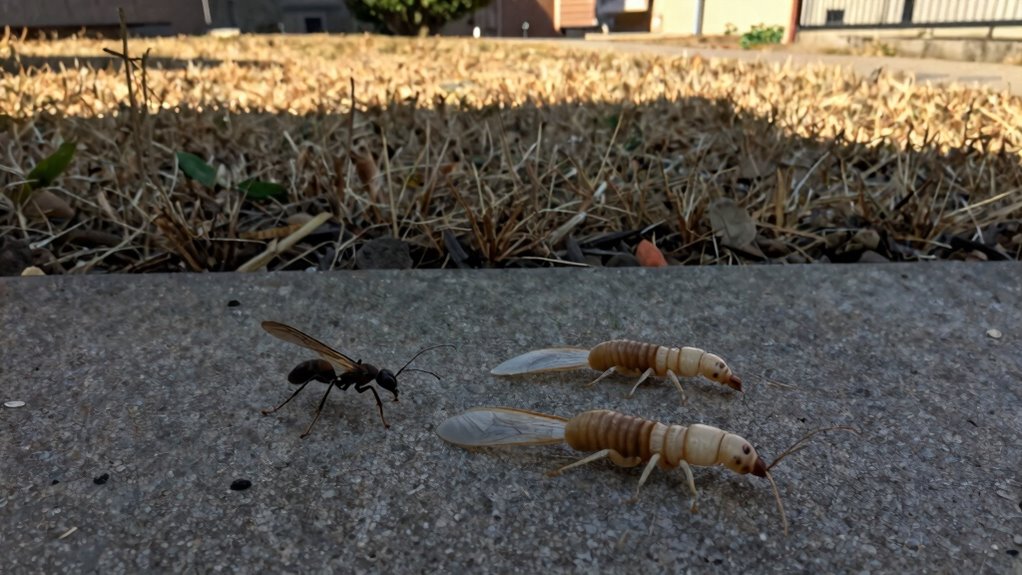
A swarm after rain is a classic termite giveaway. These insect flight patterns emerge on warm, sunny afternoons following spring or fall showers, often piling up near windows.
Wing shed locations become obvious fast. Pale, translucent wings drop in heaps, a clear sign of termites that requires professional pest control.
Flying ants, by contrast, prefer hot, dry midsummer heat. Their swarms are smaller, more scattered, and typically happen in the open, not clustered around lights.
Watch the timing: if it’s muggy and wet, termites are likely. If it’s a scorcher, ants are your culprit. Using non-repellent active ingredients like fipronil or dinotefuran in termite foams can kill these pests on contact and through ingestion for colony-wide control.
Check the Body: Soft Shell vs. Hard Armor and Color Clues
Termite bodies feel soft and fragile, like a pressed flower, whereas ants wear tough, hard armor that gives them a “don’t mess with me” vibe. Color alone won’t seal the ID deal, but it’s a helpful nudge for anyone scouting pest control options.
Ants lean toward black, brown, or reddish shades, while termites stick to a uniform, pale-to-dark palette. The real trick is pairing shell hardness with that pinched ant waist versus the termite’s straight, broad sides.
This quick visual check helps you decide if you need professional termite treatment or just a simple ant bait. It saves you from mistaking a harmless nuisance for a wood-munching troublemaker that threatens your home’s structure.
For effective pest prevention, inspect for mud tubes, discarded wings, or frass near baseboards. If you spot soft-bodied insects with straight waists, contact a local exterminator for a termite inspection right away. Slow-acting poison ensures worker ants carry bait back to the nest, sharing it with the colony to achieve complete elimination.
Your fast action on termite control can stop costly damage before it spreads, while ant issues often resolve with sealing cracks and removing food sources. Compare the body feel and waist shape first, then you’ll know which pest control service fits your needs.
Body Shape Differences
Let’s get physical, and the waist is your first clue. Flying ants have a narrow, pinched waist, just like a wasp’s.
Termite swarmers have a broad, straight body with no waist at all, which makes them look like one solid piece. This visual difference is easy to spot without any magnification.
Check the chest area too, since ants have three distinct body parts while termites have two fused sections. That pinched waist helps ants twist and feed their young, which supports their rapid colony growth.
Termites, on the other hand, are built like little brown cigars, uniform, soft, and clumsy. For pest control, identifying this waist shape is your best first step before calling in a professional.
Shell Hardness Comparison
Regarding shell hardness, think of a knight in armor versus a squishy cigar. A flying ant sports a tough, armored shell, thanks to a thicker cuticle and impressive exoskeleton durability.
This makes them resilient to crushing. Try squishing one and it takes effort.
On the other hand, termite swarmers have a noticeably softer body. Their exoskeleton is far more delicate and less sclerotized.
You can easily puncture a termite’s side with a gentle pinch. Their cuticle thickness is minimal.
This shell hardness directly impacts their survival. A flying ant’s armor protects it from minor impacts and predators, allowing it to scurry away.
A termite’s soft shell is a liability. They are fragile and vulnerable.
So if you capture a swarmer and it feels hard like a tiny beetle, it’s an ant. If it feels squishy like a soft bodied bug, it’s likely a termite.
This tactile test is a quick and reliable clue. For effective pest control, identifying the right pest helps you choose the best treatment plan. Consider using a manual pump duster with brass nozzles for precise application of diatomaceous earth in cracks and crevices.
Color Identification Clues
After checking shell hardness, color can offer a clue but treat it as a hint rather than a final answer. Flying ants may appear black, brown, or reddish while termite swarmers are pale to uniformly dark.
Color often overlaps, so focus on wing transparency instead. Termite wings are pale and translucent, almost see-through, while ant wings are tinted brownish.
Look for shed wing piles near windows, which termites leave as neat stacks of identical wings. Ants do not leave such tidy piles.
Termite bodies are soft and unsclerotized like a soft-shell crab, whereas ant bodies are hard and beetle-like. Ants often show a two-tone color from head to abdomen, but termites stay uniform.
Remember that a dark swarmer with pale wings is likely a termite, not an ant. For accurate pest identification, always cross-check color with wing symmetry and shed piles. For similar layered outdoor protection, permethrin-treated clothing repels a wide range of pests without requiring direct skin application.
Know the Damage: Why Termites Eat Homes, Ants Don’t
A home’s worst nightmare has a straight waist and a taste for cellulose, and termite swarmers are a direct threat because they consume wood. Flying ants, by contrast, do not eat wood at all, so they are more of a nuisance than a structural danger.
Homeowner concerns around termites are justified, since these insects digest cellulose found in wooden beams and framing. Subtopic variations in damage include termites hollowing out support structures silently, weakening a home from the inside over time.
Carpenter ants, often mistaken for termites, only tunnel for nesting and leave behind sawdust piles, which is a clear clue. Termite damage, on the other hand, is structural and expensive, requiring a professional pest inspection rather than a DIY fix.
A pinched waist means a flying ant, which is a temporary annoyance, while a straight waist signals termites that eat your home. For effective termite control, you can use a DIY termite kit to eliminate colonies with continuous monitoring and targeted bait replacement, but a licensed exterminator is still best for assessing hidden colonies and recommending treatment options.
Bottom line: termites are the real threat that erodes property value, while ants just fly around without chewing through load-bearing wood. If you suspect an infestation, schedule a termite inspection today to avoid costly repairs and protect your investment.
Call a Pro for Termites, Use Baits for Flying Ants
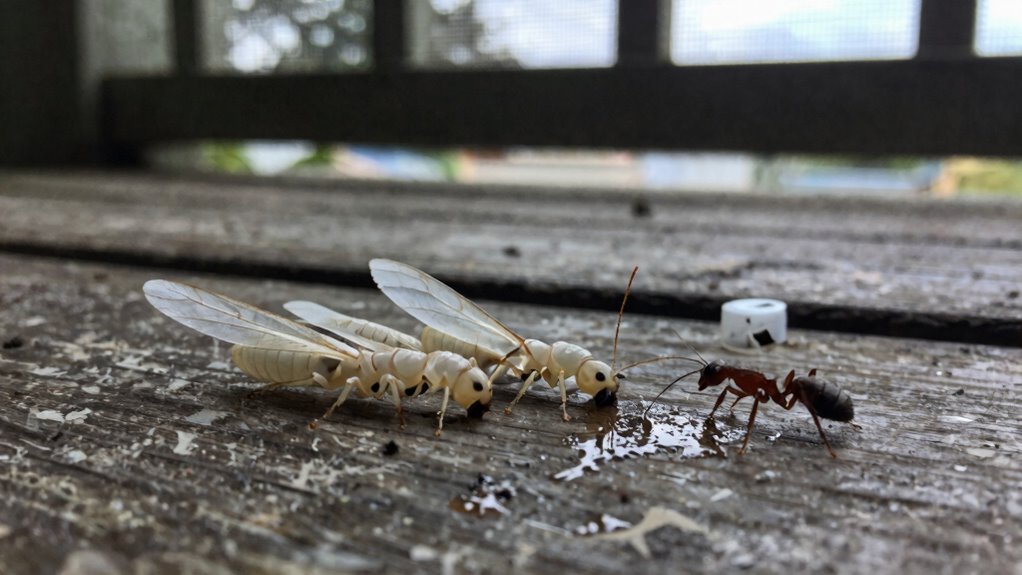
Once you spot a straight waisted insect with identical wings, it is time to call a professional. That straight waist means termite, and termites cause structural damage, not just a nuisance.
Once you spot a straight-waisted insect with identical wings, it’s time to call a professional.
A professional termite inspection typically costs between $100 and $300. This inspection catches hidden colonies before they turn your framing into sawdust.
For flying ants, you can save your wallet with DIY ant baits. Bait placement trumps sprays because ants carry gel baits back to the nest to kill the queen. For best results, choose dual-formula baits that target both sweet-eating and protein-loving ants.
Professional inspection is non negotiable for termite control. A missed colony can cost thousands in repairs.
Ant baits cost $10 to $20 at hardware stores. Termite treatments start around $1,500.
Termites swarm in spring, while flying ants prefer hot, dry midsummer weather. If you see wings piled by a window, that is a termite crime scene.
Bottom line: use DIY ant baits for flying ants. For termites, call the pros and your house will thank you.
Frequently Asked Questions
Can Both Species Cause Structural Damage to My Home?
No, both species do not cause structural damage. Only termites do, as they eat wood from the inside out.
Flying ants, despite their alarming swarm, do not chew through beams. Their behavior focuses on nesting in damp wood, not the wood itself.
That is a critical difference for pest control. Termites need professional help fast, so call a pro immediately.
Ants just need moisture sources fixed to stop their nuisance. For termites, contact a pest control expert for an inspection.
Use a termite treatment product to protect your home. For flying ants, fix leaks and remove damp wood.
Termites are a structural threat requiring fast action. Flying ants are a nuisance, not a demolition crew.
Do Flying Ants or Termites Have Queens That Also Have Wings?
Yes, both flying ants and termite queens originally had wings as part of their reproductive lifecycle.
After mating, the queen termite sheds her wings to start a new colony, a process called wing shedding. Flying ant queens also shed their wings after mating, though ant queens are harder to spot.
So, winged queens are a shared stage, but termite queen wing shedding is more obvious. You’ll often find piles of discarded wings near windows, which is a solid clue for pest control identification.
For effective home pest control, look for these wing piles to confirm a termite infestation. If you’re considering termite treatment options, knowing this difference helps you choose the right pest control product or professional service.
How Long Do Termite and Flying Ant Swarms Typically Last?
Termite swarms typically last 30 to 40 minutes, while flying ant swarms can drag on for a few hours or even days depending on the species. Swarm duration varies with seasonal timing, as termites emerge in spring or fall after rain and ants appear in hot, dry midsummer.
Both are brief events, but termites’ shorter, more concentrated swarms mean you’ll see a sudden flurry near windows, then they’re gone. Ants linger like that one guest who won’t leave, so you need a reliable pest control spray or bait station to handle the nuisance.
If you spot a swarm, act fast to prevent structural damage from termites. Professional pest control services and termite treatments are your best bet for protecting your home.
For flying ants, a simple insecticide spray or ant killer gel usually does the trick. But remember, termites are quick and urgent, while ants are a longer, less structural nuisance.
Are There Any Natural Predators That Help Control These Pests?
Yes, natural predators help control these pests by reducing termite and flying ant populations. Birds, ants, and spiders actively eat termites and flying ants, which cuts down on swarms around your home.
Predators play a key role in maintaining natural balance, but they are not a complete pest solution. For targeted termite control, biological control methods like introducing nematodes or fungi work well.
These microscopic worms infect and kill termites without using chemical treatments, making them a smart, eco friendly choice. For flying ants, birds and lizards handle the job effectively when encouraged into your yard.
If you are dealing with a termite infestation, consider termite bait stations or professional pest control for long term protection. Encouraging birds and using nematodes can help, but for severe cases, a full pest management plan is essential.
Bottom line: support natural predators around your property and pair them with proven pest control products for the best results. Ready to buy termite control solutions? Look for nematode based treatments or bird friendly pest management tools.
What Should I Do Immediately After Spotting a Swarm Indoors?
First, vacuum immediately to remove the swarm. Suck up every insect you see, then throw the bag outside right away.
Next, isolate the source by checking windows, doors, and cracks. Seal any gaps with caulk to prevent more pests from entering.
A professional pest inspection costs between $200 and $500. It is worth the investment if termites are the hidden problem.
Flying ants are usually just a nuisance. But termite swarmers signal structural damage that needs immediate treatment.
For termite control, look for local exterminators with solid warranties. For flying ants, a simple insecticide spray often works fine.
Quick cleanup buys you time to find the right solution. However, a licensed pro confirms the real infestation and recommends targeted treatments.
Do not try to wing it with DIY fixes alone. You want a long term pest management plan that actually works.


