
Identifying small brown bugs in flour is the first step to getting rid of them for good. Those tiny invaders are likely flour beetles, but knowing exactly which pest you’re facing changes how you handle the problem.
Check their antennae: if it gradually thickens, it’s a confused flour beetle; if it ends in a three-segment club, it’s a red one. Sawtoothed grain beetles have six saw-like projections on their thorax and often invade pantries, while weevils have a distinct snout and prefer whole grains.
Psocids, or booklice, are even smaller with threadlike antennae—a magnifying glass helps spot the difference. Stick around, and we’ll walk you through how to identify each pest quickly and evict them permanently.
At A Glance
- Look for reddish-brown, 3–4 mm beetles with flat, segmented bodies: flour beetles.
- Check antennae: gradually thickened tips mean confused flour beetle; club-like tips mean red flour beetle.
- Weevils have a distinct snout, unlike flour beetles, and prefer whole grains.
- Tiny, slow-moving booklice have long threadlike antennae and thrive in humid flour.
- Dark specks resembling fine dust in flour signal beetle waste and a hidden colony.
Why Those Tiny Brown Bugs in Flour Are Usually Flour Beetles

The larval lifespan is where the real mischief begins, as those tiny, yellowish-white grubs feed on flour for one to four months before maturing into adults. A single female flour beetle can lay up to 400 eggs over her two-year life, so an open bag of all-purpose flour quickly becomes a breeding ground.
The larval stage turns flour into a breeding ground, with one female laying up to 400 eggs.
That pantry staple is practically a beetle hotel with a buffet and a nesting suite, which is why homeowners often search for “how to get rid of flour beetles” or “pest control for pantry bugs.” If you spot a small, brown, slow-moving insect in your flour, it is almost certainly a flour beetle, and the fastest solution is to discard the contaminated product.
Check nearby cereal boxes, pet food, and spice jars for signs of infestation, then vacuum the shelf and wipe it with vinegar or soapy water. For long-term prevention, store all dry goods in airtight glass or plastic containers to stop these pantry pests from returning. Silicone gaskets compress against the rim to form a hermetic barrier that blocks humidity and keeps beetles out.
Professional pest control services can treat the entire kitchen area if the infestation spreads, but a thorough cleanout often solves the problem without chemical sprays. Remember that flour beetles are harmless to humans, though they ruin food texture and taste, so throw out any bag that shows live bugs or webbing.
Adopting a “first in, first out” rule for dry goods and checking expiration dates weekly reduces the risk of a repeat outbreak. You can also place bay leaves or diatomaceous earth near storage shelves, as these natural deterrents are popular among homeowners seeking eco-friendly pest management.
If you notice dark specks in your flour that look like fine dust, that is beetle waste, and it signals a hidden colony deeper in the pantry. Act quickly by removing all shelving liners and inspecting crack and crevices where larvae may hide, since these tiny beetles excel at squeezing into tight gaps.
Once you’ve cleaned and discarded affected packages, monitor the area for two weeks, because newly hatched adults can emerge from overlooked eggs. A second treatment using a targeted pantry pest spray from your local hardware store ensures complete eradication, and most brands label it safe for food preparation areas when used correctly.
How to Tell Confused vs. Red Flour Beetles Apart
Confused flour beetle vs. red flour beetle is a classic pantry pest identity crisis. Telling them apart requires a close look at key features.
Both are reddish brown, 3 to 4 mm long, and love your flour. Their life cycle is identical: egg, larva, pupa, adult.
Females lay 300 to 400 eggs over 2 to 3 years. Check antennae for your best clue without a microscope.
The confused beetle has antennae that gradually thicken toward the tip. The red beetle has antennae that abruptly enlarge in the last three segments.
The confused beetle cannot fly. The red beetle sometimes flies, so flight behavior can help.
A smooth, tapered antennae end means confused. A club like antennae end means red.
If it flies, it is the red flour beetle. If not, it is likely the confused flour beetle.
Your first step in pest control is proper identification. Then you can choose the right treatment for your stored product infestation. Non-toxic glue traps are safe to place near dry goods to monitor for these pests.
A dad quip: they are both confused about whose turn it is in your cupboard. Bottom line, check antennae shape for a reliable ID.
Identify the Sawtoothed Grain Beetle by Its Saw-Like Thorax
The sawtoothed grain beetle (*Oryzaephilus surinamensis*) is easy to identify by its thorax, which looks like a tiny bread knife with six distinct, saw-like projections on each side. Those pronounced body joints, where the head meets that spiky middle section, give it a segmented, almost armored look that flour beetles simply lack.
If you see those six thoracic notches under a magnifying glass, you’ve found your pest. This beetle has no flight, just a very distinctive silhouette that’s hard to mistake.
For effective pest control, check stored grain, cereal, and pet food for these telltale notches. Catching an infestation early helps you protect your pantry and avoid costly food replacement.
If you need targeted grain beetle treatment, focus on sealing cracks and discarding contaminated packages. Professional pest management can also eliminate hidden populations in hard-to-reach storage areas.
When you’re shopping for prevention products, look for airtight containers and pheromone-based traps that attract male moths from up to 25 feet away to break the breeding cycle. These practical tools stop the sawtoothed grain beetle from spreading in your kitchen.
Always inspect new food packages before bringing them home, since this pest often rides in from the store. A quick check of the thorax under a loupe confirms your diagnosis and guides your next step.
Saw-Like Thorax Markings
| Feature | Description | Why It Matters |
|---|---|---|
| Thorax shape | Six saw-like teeth per side | Instantly separates it from flour beetles |
| Body profile | Flattened, narrow joints | Helps it sneak into packaged foods |
| Size | 2–3 mm long | Small enough to hide in flour dust |
| Color | Reddish-brown to dark brown | Blends with whole grain debris |
Those six saw like teeth on each side of the thorax are your first clue you are not dealing with a standard flour beetle. This bug is built like a tiny flat cracker, which lets it slip through the tiniest gaps in cereal boxes or bagged rice.
At just 2 to 3 millimeters long it can vanish into a fine dust of flour or cornmeal without being seen. Its reddish brown to dark brown coloring helps it hide among whole grain debris and broken kernels.
You need a targeted grain pest treatment to stop these saw tooth grain beetles from moving into your stored products. For effective saw toothed grain beetle control check the folds and seals of every pantry package and use pheromone traps to catch early infestations.
Pronounced Body Joints
Just one glance at that saw-like thorax and you already know this isn’t a flour beetle. The sawtoothed grain beetle, *Oryzaephilus surinamensis*, measures just 2–3 mm but its pronounced body joints make it easy to spot.
That narrow thorax, with six projections on each side, gives it a distinctly armored appearance, like a tiny, six-legged tank. Its life cycle is speedy, taking only 3–4 weeks in warm weather, which fuels those impressive reproductive rates.
Females deposit over 250 eggs, so populations explode fast. This pest loves dry foods like cereals, pasta, and pet kibble, so proper pest control starts with inspecting your pantry.
Keep an eye on packaging seams because it is a pro at sneaking in. If you want to prevent an infestation, seal all dry goods in airtight containers like ProKeeper or ComSaf, which use silicone seals and locking lids to keep pests out.
Bottom line: if you see that saw-toothed profile, act quickly with targeted treatments. It multiplies faster than you can say “flour,” so early detection is your best defense.
Six Thoracic Projections
Six saw toothed projections on each side of the thorax are the hallmark of the sawtoothed grain beetle, *Oryzaephilus surinamensis*. This flat, brown bug measures just 2 to 3 mm and has a distinctly serrated look that sets it apart from flour beetles.
These pests are common infestation sources, often arriving in packaged cereals, dried fruit, pasta, or pet food from stores. They can chew through unopened boxes with ease, so always inspect for entry points during pest control checks.
Life cycle timing works in their favor. A female lays over 250 eggs, and in summer heat, the whole cycle takes only 3 to 4 weeks.
That means multiple generations per year multiplying fast, requiring quick action for effective home pest management. Look for them darting in flour or hiding in crevices in your pantry.
Unlike weevils, they cannot fly. If you see them, check nearby packages for signs of grain beetle damage.
The bottom line is that the saw like thorax is your giveaway. Spot it, toss the source, and freeze remaining goods for four days to kill all stages.
If you need a spray, plant-based spinosad breaks down quickly in sunlight and soil, making it a safer option for indoor use.
Weevils in Flour vs. Whole Grains: Key Differences
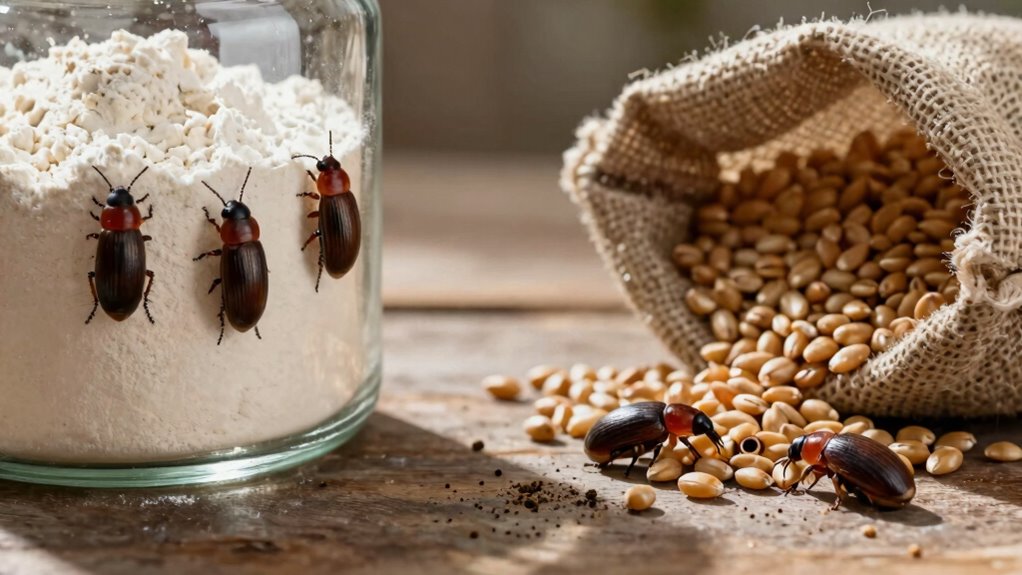
Weevils in flour are easy to confuse with flour beetles, but they are completely different pests. Think of it like a giraffe and a zebra: both have stripes, but one has a long neck.
Weevils have a distinct snout, while flour beetles have flat, segmented bodies. Their dining habits also set them apart. Flour beetles thrive in processed milled products like flour, meal, and cake mix.
Weevils have a distinct snout; flour beetles have flat, segmented bodies.
Weevils, however, prefer intact whole grains, seeds, rice, and dried beans. They bore into kernels to lay eggs, making them whole grain hitchhikers rather than flour dust dwellers.
This distinction matters for pantry hygiene since weevils often arrive from field or bulk storage. For effective pest prevention, inspect whole grain bags before purchase and freeze suspect batches for four days.
Flour beetles chew through packaging, but weevils rarely gnaw into unopened boxes. They are more about riding along quietly, so check your grain, not just your flour.
For homeowners looking to buy pest control solutions, focus on inspecting incoming whole grains and storing them in airtight containers. Freezing is a proven method to kill weevil eggs without chemicals. Combining traps with proper sanitation and storage practices prevents re-infestation and keeps your pantry pest-free.
Psocids: Tiny Brown Bugs That Aren’t Actually Beetles
Psocids are tiny, soft-bodied brown or gray bugs about one to two millimeters long. They are often mistaken for flour beetle nymphs, but they are not beetles at all. These pests prefer fresh flour, sugar, and the microscopic molds that thrive in dark, humid pantry corners. They are not attracted because you are messy, but because they love cozy, damp packaging.
To prevent psocids, store dry goods in sealed containers and reduce humidity below 50 percent. Effective pest control starts with airtight storage to stop pantry bugs from spreading. Psocids do not fly in or crawl through packages. Instead, they hitch a ride on a newly opened bag of flour and call it home. Using a quality dehumidifier ensures humidity stays below the critical 50-percent threshold, directly targeting the damp conditions that allow psocids to thrive.
Appearance and Size
These tiny brown bugs, often called flour weevils despite not being true weevils, are actually psocids. They are a different beast entirely from the beetles we’ve been discussing.
Psocids are minuscule, typically under 1/16 inch, with color ranging from pale tan to dark brown. This makes them hard to spot in flour, especially when you’re inspecting for pest control issues.
Their antennae are especially long and threadlike, with many segments, unlike a beetle’s clubbed antennae. To help you identify these pantry invaders for targeted pest management, here’s a quick reference:
| Feature | Psocid (Flour Weevil) | Beetle (e.g., Flour Beetle) |
|---|---|---|
| Size | Under 1/16 inch | 3–4 mm |
| Color | Tan to dark brown | Reddish-brown |
| Antennae | Long, threadlike, many segments | Abruptly clubbed at tip |
| Body Shape | Soft, oval, slightly flattened | Hard, elongated, jointed |
Psocids don’t bite, and they move slowly, so they’re more annoying pantry guests than real pests. For effective flour insect prevention, start by discarding infested packages and vacuuming shelves thoroughly.
Then store all dry goods in airtight containers, which is the best way to stop psocid infestations before they spread. If you’re shopping for pantry pest solutions, look for food-safe desiccant powders or traps labeled for psocids.
Regular cleaning and checking expiration dates will keep these tiny bugs from returning to your kitchen. Food-grade diatomaceous earth with particles between 5 and 15 microns can also be dusted lightly in pantry cracks and crevices to mechanically eliminate psocids on contact.
Preferred Food Sources
The cupboard’s quiet crisis has a favorite menu, and it’s not the gourmet stuff you’d pick. Psocids, those tiny brown bugs that aren’t actually beetles, prefer fresh flour, sugar, and the microscopic molds that thrive in damp, warm corners.
They’re less interested in whole grains or spices, unlike their beetle cousins. Their diet is simple: starchy pantry staples plus a side of humidity.
Biological control works here, since psocids are vulnerable to freezing infested items for four days. Seasonal prevention matters, too, as their numbers spike in summer and early autumn when warmth boosts mold growth.
Keep dry goods sealed tight and arid, and you’ll cut off their buffet before it starts. Store smart, stay arid, and they’ll find the menu empty.
For effective pest control, focus on moisture management to remove their mold food source. A dehumidifier or silica packets can help lower humidity in your pantry. Maintaining humidity levels between 50-60% creates an environment unsuitable for silverfish and similar moisture-loving pests.
If you need a treatment solution, freezing infested flour or sugar for 96 hours kills psocids completely. This buyer-intent friendly method avoids harsh chemicals entirely.
Entry and Prevention
For a pest that doesn’t actually originate in food factories, the psocid has a talent for showing up uninvited. These tiny brown bugs hitch rides in packaged flour, crawling from older bags to new ones.
They love warm, damp cupboards, not poor hygiene. To stop them, inspect all dry goods before bringing them home.
Use airtight pest control containers for all bulk items. Store flour in glass jars to block reinfestation.
Reduce indoor humidity with a dehumidifier or silica packs. Clean spills right away to prevent mold growth.
For long term storage, freeze flour for four days to kill eggs and nymphs. Seasonal prevention means checking bags more often in summer.
Rotate your stock and use the oldest first to stop cross-contamination. Bottom line: seal it, chill it, or toss it because psocids hate that. To target hidden psocids, you can apply a food-grade diatomaceous earth in dry cracks and crevices around your pantry.
What Flour Beetle Larvae Look Like and Why You Should Care
Flour beetle larvae look like tiny yellowish-white grubs, often under 3 mm long. Their segmented bodies have dark hook-like projections at the rear, which sounds worse than it is.
Finding these larvae means your pantry has a problem that needs immediate attention. Larval detection is your early warning system, signaling that adults have been laying eggs for weeks.
A quick check of cracks and crevices helps you catch an infestation early. This is a pantry hygiene red flag, but it is not your fault since they hitchhike in.
Vacuum everything thoroughly, toss infested bags, and seal the rest in airtight containers. To get rid of flour beetles for good, you need to go nuclear on cleanup.
Use targeted pest control products to eliminate both larvae and adults. Trust me, you will sleep better after a deep clean. For effective control, boric acid powder can be sprinkled into cracks and crevices to target these pests naturally.
Where Small Brown Bugs in Flour Actually Come From
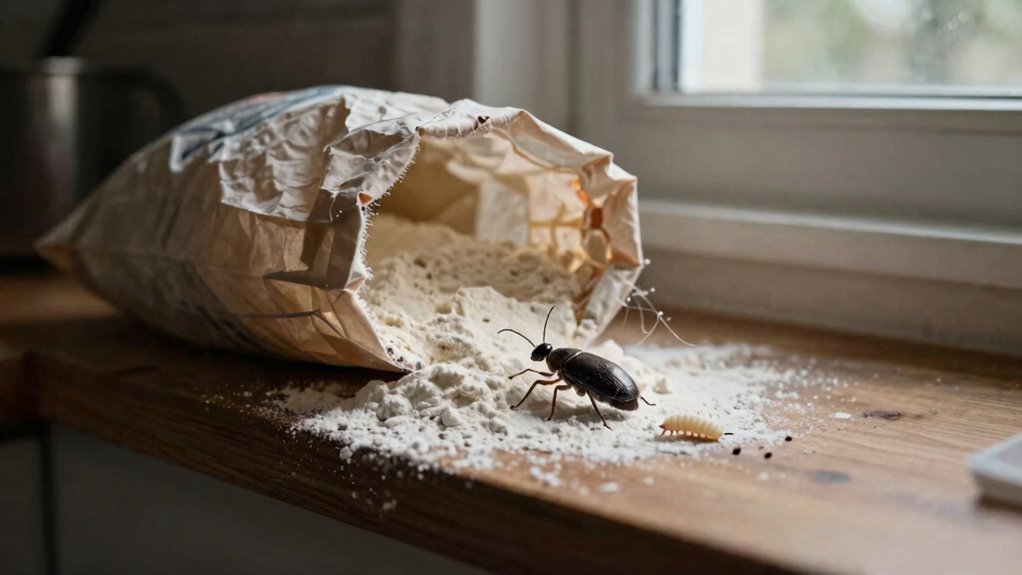
If the larvae are the early warning system, the adults are the ones who actually broke in. Their ecological origins trace back to grain storage, not your kitchen. These beetles evolved to exploit cereal products, making flour a prime target for pest control.
The reproductive timeline matters here. Females lay hundreds of eggs over months, so a single adult can seed a slow, compounding infestation. They arrive via infested packaging from mills, warehouses, or grocery stores. Some fly or crawl in through tiny seams, so sealing entry points is key for elimination.
Once inside, they multiply quietly in cracks and crevices. They feed on scattered dust, so thorough cleaning is essential for prevention. You rarely spot the first invader. You notice the offspring months later when the infestation is already established.
Always check packages before buying, since by the time you see adults, the reproductive timeline is already running ahead of you. Applying granular perimeter treatments along your home’s foundation can help stop these crawling invaders from entering through exterior cracks and gaps.
Which Foods Are Most Likely to Harbor Infestations?
Most small brown bugs in flour have a surprisingly broad menu. They target far more than just white powder.
Flour beetles happily munch on cake mixes, spices, dried fruit, nuts, and even chocolate. Basically, anything in your pantry that is not sealed in a vault can be at risk.
Flour beetles don’t stop at flour—they’ll hit spices, nuts, chocolate, and anything left unsealed.
Sawtoothed grain beetles are even less picky. They invade cereals, pasta, dry pet food, and sugar.
Weevils prefer whole grains and seeds. They lay eggs inside kernels, which is why proper grain storage is critical for effective pest control.
A single infested bag can ruin an entire shelf. Psocids, those tiny booklice, thrive on mold growth in humid conditions.
They feast on flour and sugar, so controlling humidity is a key step in pest prevention. If you spot a bug, do not assume it is just the flour.
Check all similar items for signs of an infestation. Use airtight containers and regular inspections as part of your home pest control routine. Airtight lids with locking buckles can block these pests from detecting odors and entering your stored goods.
How to Check Your Pantry for Signs of an Active Infestation?
Your pantry can look perfectly neat while hiding dozens of tiny invaders, so a thorough inspection is your first line of defense.
Look for live bugs crawling on packages or tiny exit holes chewed through cardboard and plastic.
Check the seams and folds of bags, since beetles often sneak into those tight spaces.
Inspect under canisters and inside pet food bins, because spilled flour dust can attract a full-blown beetle buffet.
Spot tiny, grain-like droppings or webbing near flour and cereals? That’s a clear red flag.
An active infestation often leaves a fine, powdery residue, think of it as bug confetti that’s far less fun than the party kind.
Focus your search on dry goods like crackers, nuts, and even spices.
If you see bugs on multiple items, your pantry is officially compromised and needs immediate pest control action.
Don’t panic, but do prepare to act fast by removing all affected food and wiping down every shelf.
For long-term protection, consider pantry pest elimination products like pheromone traps or airtight storage containers to stop re-infestation, and remember that most pheromone traps last between 6 to 12 weeks before requiring replacement.
Finally, check behind loose wall panels or under the pantry baseboard, as some pests hide in cracks.
If the problem persists, schedule a professional pantry inspection to confirm the source and treat the area thoroughly.
What to Do Immediately After Finding Small Brown Bugs in Flour
Finding small brown bugs in flour is a moment that tests your composure, but panic is a waste of energy better spent on swift action.
Immediate sanitation is the first step: toss that infested flour into an outside bin, not your kitchen trash, then vacuum every cabinet crack and crevice.
Ditch the vacuum bag outside immediately to prevent reinfestation.
Containment measures come next: seal all unopened packages in ziplock bags or airtight containers.
Freeze flour, grains, and pasta for four days to kill weevils and beetles cold.
Then wipe shelves with soapy water, no bleach or spray, just remove dusty crumbs.
Finally, laugh at the absurdity of tiny freeloaders and buy fresh flour in glass jars.
Your pantry is now on lockdown for effective pest control, though for other storage areas you might consider natural cedar blocks to repel moths and insects without chemicals.
Frequently Asked Questions
Can These Bugs Survive in Sealed Plastic Containers?
Yes, these pantry pests often survive in sealed plastic containers. Condensation inside the container provides the moisture they need to thrive.
The plastic material itself is a problem. Tiny insects like sawtoothed grain beetles can chew right through thin plastic, and weevils, which are only 1/8 inch long, slip through microscopic gaps in the seal.
To stop a pantry pest infestation, freeze your flour for four days to kill any eggs or bugs. After that, transfer all dry goods into glass jars or thick metal tins for long term storage.
Remember that even an airtight seal won’t stop bugs that are already hiding inside the flour. For effective pest control in your kitchen, always inspect new food packages and use proper food storage containers from the start.
Do Any of These Bugs Bite Humans or Pets?
No, these bugs do not bite humans or pets. They are pantry pests, not vampires, and their mouthparts are only designed for chewing flour.
The real issue is flour contamination from bug hair and body fragments. This can trigger allergies or asthma, so think of it as dusty, unwelcome seasoning in your food.
The bugs are gross but not dangerous, so you can handle the problem without worrying about bites. Vacuuming and freezing infested food is an effective pest control solution that removes the issue quickly.
For long term pantry pest prevention, focus on the flour, not the bugs. Use airtight containers and inspect your dry goods regularly to keep these pantry pests away.
If you need fast pest control products to eliminate infestations, consider food safe traps or freezing methods. These simple steps help protect your family and your home.
How Long Can Flour Beetles Live Without Food?
Flour beetles can survive without food for two to three weeks, sometimes longer in cool conditions. Pantry sanitation directly impacts their lifespan, so crumbs and spills extend their survival time.
Grain storage temperature matters too, with warm humid environments keeping beetles active while cold slows them down. They are resilient but not immortal, so a thorough clean up and airtight containers will starve them out.
Think of it as a hunger strike you will win by using effective pest control products. For pantry pest elimination, seal grains in glass or hard plastic containers to cut off their food source.
If you want targeted insecticide sprays or traps, look for solutions labeled for stored product pests. This practical prevention strategy ensures your kitchen stays beetle free long term.
Are These Bugs Harmful if Accidentally Eaten?
Accidentally eating these bugs is typically not a health concern, though it can feel unpleasant. They are not toxic, so there is no need to panic if you find a stray insect in your food.
The main risk involves potential allergic reactions in sensitive individuals. You should also watch out for mold or bacteria these pests might carry into your pantry.
Think of it as an unwelcome, unintended protein boost. These bugs are more of a gross out factor than a medical emergency.
This is why proper pest control in your kitchen matters so much. If you spot a bug in your flour or cookies, it might be time to check your stored goods.
Look for signs of pantry pests like weevils, beetles, or moths in your cupboards. A thorough clean out and a good pest control product can stop infestations before they spread.
You want to keep your food safe and your family comfortable. For peace of mind, consider using airtight containers and pantry traps to prevent these unwelcome guests.
Just be aware, and maybe double check your next batch of cookies. If you need to buy pest control supplies, look for options labeled for food storage areas.
Can Bugs Spread From Flour to Other Rooms?
Yes, these bugs can spread to other rooms, though it’s a slow and determined crawl. Flour mite migration happens when infested packages are moved or when adults crawl through cracks and under doors.
Pantry pest spread is real but limited. These pests prefer food sources, not living spaces.
Check for hitchhikers on bags, in pet food bowls, or near baseboards. Most won’t colonize your bedroom because they are lazy, not ambitious.
Vacuum thoroughly and seal all dry goods. Invest in airtight storage containers to stop these bugs from multiplying.
The bottom line is keep flour contained and they stay put. For the best pantry pest control products, look for food grade diatomaceous earth or pantry moth traps that target flour mites.


