
German cockroaches max out at ⅝ inch with two dark stripes, while American cockroaches can hit 2 inches with a blurry shield—size tells them apart instantly. Knowing which pest is in your home is the first step to effective control, and this guide covers both.
One breeds indoors nonstop, producing up to 30,000 nymphs yearly; the other matures slowly over 600 days. You’ll learn which baits or sprays work best for each species, and what a pro might cost.
Stick around for the full showdown on gel baits versus sprays, plus the products that actually stop an infestation.
At A Glance
- German cockroaches are light brown with two dark stripes; Americans are reddish-brown with a faded yellow pattern.
- German females produce up to 30,000 nymphs yearly; American females produce only about 800.
- German roaches mature in 90 days; American roaches take 600 days to reach adulthood.
- German roaches infest indoors, especially kitchens; Americans live outdoors in sewers and drains.
- German cockroaches cluster socially; American cockroaches are solitary and enter homes alone.
Physical Appearance: German vs. American Cockroaches
Spotting the difference between a German cockroach and an American one starts with size. The German version maxes out at about ⅝ inch, light brown or tan, with two dark parallel stripes behind its head.
Spotting the difference between a German cockroach and an American one starts with size.
The American cockroach is a beast, stretching 1½ to 2 inches, reddish-brown, with a pale yellowish pattern. That is like comparing a minivan to a monster truck.
Their antennae offer another clue for pest identification. German roaches have shorter, thinner antennae relative to their body, while Americans sport long, thick ones that sweep around like radar dishes.
For nymph identification, German nymphs are tiny, dark, and lack wings, often clustering near harborage. American nymphs are larger, reddish-brown, and more solitary.
If it looks like a tiny tank with stripes, it is a German cockroach. If it looks like it could fly away and it can, that is the American.
For professional cockroach control, knowing these traits helps you choose the right treatment plan. Call an exterminator if you see either species in your home. Using a black light can help reveal these pests in dark areas.
How to Tell Them Apart by Sight Instantly
Size is the first giveaway: German cockroaches top out at about half an inch, light brown, while American roaches are huge, reaching two inches with a reddish-brown hue.
Look behind their heads: the German has two dark, parallel stripes on its pronotum, but the American sports a yellowish or pale pattern there instead.
Check the wings next, since German roaches can’t fly, so any flutter means you’re likely dealing with an American, which is not great news for your sanity.
If you spot those larger, flying pests, you’ll want to call a licensed exterminator for a thorough roach inspection and fast treatment plan.
For accurate identification and targeted pest control, note the size and markings before you purchase any DIY sprays.
A professional pest management service can confirm whether you have a German infestation or a more aggressive American problem, then recommend the right baiting and exclusion methods.
Act quickly if you see wings in action, since American roaches breed faster and spread bacteria in kitchens and basements, though boric acid products can kill them within 72 hours if applied correctly.
Getting a free quote from a local roach control expert is the smartest next step to protect your home and peace of mind.
Size and Color
If you see a roach and your first instinct is to measure it, welcome to the club. That is actually the fastest way to know which pest you are dealing with.
German cockroaches are the small fry, barely reaching half to five eighths of an inch long. American cockroaches are the giants, stretching one and a half to two inches.
The color variation is a dead giveaway for proper pest control identification. Germans are light brown or tan, while Americans are a darker reddish brown.
That stripe contrast helps you spot them quickly. Germans have two dark parallel lines behind the head, but Americans show a yellowish or pale patch instead.
For expert pest management, remember that German roaches cannot fly. American cockroaches can fly, which is a key detail for treatment planning.
If you need pest control services, measuring first helps you choose the right bait or spray. Consider using long-lasting residual sprays applied to hidden spots and entry points to prevent re-infestation for months. Bottom line: if it is tiny and striped, it is German.
If it is huge and dark, it is American. Measure first, panic later.
Pronotum Markings
Look at the spot behind the head, the pronotum, that shield like plate right behind the eyes. This single feature provides instant species identification for pest control purposes.
German cockroaches boast two dark, parallel stripes running front to back, like tiny racing stripes. American cockroaches show a blurry, yellowish, shield shaped pattern, no stripes at all.
A German pronotum has two bold, dark, parallel lines that are a distinctive stripe pattern. An American pronotum shows a pale, uneven yellow or brownish blotch.
German markings are sharp and symmetrical, easy to spot even on a fast moving roach during an inspection. American markings look washed out, like a faded watercolor stain.
Once you learn these, you will never confuse the two again. This visual guide helps you choose the right roach treatment for your home. Since German cockroaches prefer sweet and greasy foods, the correct gel bait must match their dietary attractions to prevent bait aversion, while American roaches require a formula designed for their larger appetites and different scents.
Wing Length Differences
The wings tell the story fast, no magnifying glass needed. German cockroaches have fully developed wings that cover their abdomen, yet they almost never fly.
Their flight ability is a common myth. American cockroaches boast long wings extending past the body tip, allowing them to glide short distances.
For wing venation, the pattern is similar between species, but a key clue is sexual dimorphism. Male German roaches have slightly longer wings than females, whereas American males and females show less difference.
So check wing length for a quick pest identification. If wings cover the whole abdomen and the roach skitters instead of flies, it is likely a German.
If wings extend past the body and it takes off, that is an American roach. Bottom line: wings are your instant ID tool for effective pest control solutions. When choosing a treatment, remember that German roach bait stations may not work on other species like Oriental roaches.
No guesswork needed for your next infestation inspection.
Which One Reproduces Faster (and Why That Matters)
The German cockroach reproduces at a stunning pace, with a single female capable of producing up to 30,000 nymphs in one year. The American cockroach, by contrast, manages only about 800 offspring annually, which makes its growth rate seem sluggish by comparison.
That speed difference comes down to egg capsules, since the German species carries 30 to 40 eggs per case while the American holds just 10 to 20. Each German egg batch can quickly become a small army, and that means a serious infestation can take hold in weeks, not months.
For homeowners, this rapid reproduction is a critical reason to act fast and schedule a professional cockroach inspection as soon as you spot any signs. Early pest control treatment is far more effective than waiting for the population to double, which can happen in under a month for German roaches.
If you need cockroach extermination services, prioritizing a German roach problem is essential, because a minor sighting can explode into a full-scale invasion before you finish your morning coffee. Understanding this reproductive timeline helps you choose targeted pest management solutions that stop the cycle before it spirals out of control. For fast-acting control, consider bait stations with active ingredients like fipronil that trigger a deadly ripple effect through the nest.
Annual Nymph Production
A single German cockroach female can produce up to 30,000 nymphs per year. That number dwarfs the American cockroach, which only produces about 800 nymphs annually.
This massive reproduction rate means one German female can outproduce an entire colony of Americans. The difference explains why German roach infestations explode so quickly.
German roaches breed continuously, year round, and always indoors. American roaches have slower, seasonal nymph production.
Each German female carries her egg capsule internally until the nymphs are ready to hatch. American cockroaches glue their capsules to surfaces, which leaves them at risk of predation.
German nymphs stay close to food sources, speeding their growth and reproduction. The bottom line is clear: if you see one German roach, you likely have thousands hidden.
Call a professional exterminator for immediate cockroach treatment. Fast action stops a full blown infestation before it takes over your home. For effective control, consider using a fogger every 3 to 4 months to prevent reinfestation.
Egg Capsule Size Differences
Why does egg capsule size matter in a roach race? It’s the difference between a speedster and a plodder. The German cockroach’s ootheca is slender, bean shaped, and held internally until hatching.
Its egg case texture is smooth, almost polished, carrying 30 to 40 eggs. The American cockroach’s ootheca is bulkier, darker, with a ridged egg case texture and a more rounded, pill like shape.
It carries just 10 to 20 eggs and glues the capsule to a surface immediately. That capsule size gap, 30 to 40 versus 10 to 20, is why German roaches outpace American ones.
Each German egg case packs nearly double the nymphs. Since German females carry their ootheca until hatching, those eggs stay safer.
For sheer speed of reproduction, the German roach wins. If you see one, do not wait.
Population Growth Timeline
Egg capsule size hinted at which roach breeds faster, but the population growth timeline really seals the deal. German cockroaches cause a true population explosion, while American roaches inch along.
A single German female spawns up to 30,000 nymphs yearly, but American ones manage only 800. German nymphs become adults in 90 days, while Americans take 600 days.
So German infestation progression goes from a few roaches to a full crisis in weeks. Americans multiply slowly, meaning infestation takes months to become serious.
This speed explains why German roaches dominate indoor pest problems, whereas Americans stay background issues. For effective pest control, targeting German roaches quickly is critical to stop an explosion.
Basically, German roaches treat your kitchen like a speed dating event, breeding constantly. Americans take the slow, scenic route.
For fast moving infestation, German wins the “who reproduces faster” race every time. If you spot a few, call a pest control professional for immediate treatment.
This rapid growth mirrors why slow-acting poison like borax, which allows foragers to return to the colony before dying, is essential for eliminating entire roach populations rather than just visible ones.
Lifespan Comparison: 90 Days vs. 600 Days

Time is a funny thing, unless you are a German cockroach. For this pest, time becomes a luxury item in the race to reproduce.
A German cockroach matures from egg to adult in just 90 days. This fast lifecycle lets a single female produce up to 30,000 offspring per year.
Its life is so short that diapause triggers are rarely needed. Even an unfertilized egg won’t slow this relentless pest down.
By contrast, the American cockroach takes a leisurely 600 days to reach adulthood. It can live up to 18 months as an adult, offering more time for detection.
However, slower growth means fewer generations each year. Offspring per female cap at around 800 for the American cockroach.
For fast infestations, the German cockroach wins the race with rapid turnover. For persistence and longer survival, the American cockroach plods along. Fipronil-based gels achieve a 97 to 99 percent kill rate against both species within two weeks.
If you spot either species, professional pest control can stop them before numbers explode. Early inspection is key to managing both fast and slow breeding cycles.
Where They Live: German Indoors, American Outdoors
House hunting is serious business, and cockroaches have very different real estate agents. German roaches are indoor only tenants, clinging to human dwellings like they are on a rent controlled lease.
German roaches are indoor-only tenants clinging to homes like they are on a rent-controlled lease.
American roaches are outdoor vagabonds who crash indoors when the weather turns nasty. German roaches infest kitchens and bathrooms, hiding under sinks and inside appliances.
Their humidity preference keeps them near leaky pipes and damp crevices. American roaches favor the outdoor drain habitat, living in sewers, storm drains, and mulch piles.
They invade basements and garages after heavy rain, seeking warmth and food. German roaches rarely stray far from their harborage, while Americans roam freely from outdoor haunts.
The bottom line is that German roaches are clingy indoor squatters, and Americans are outdoor drifters. If you spot a big flier, check your drains.
A tiny one means your kitchen cabinets are likely their new condo. For effective pest control, target kitchen areas with bait gel and crack sealing for German roaches.
For American roaches, proper home drain maintenance and trimming mulch away from your foundation can help prevent invasions.
If you are buying a home, inspect these high moisture zones first for signs of infestation. A quick check of sink pipes and basement drains can save you from a pest problem later.
For either species, using products with non-repellent active ingredients like fipronil or imidacloprid can ensure colony-wide control when applied in cracks and voids.
Behavior Differences: Gregarious vs. Solitary
German cockroaches are highly social and thrive in large groups using aggregation pheromones.
This clustering behavior makes them a common target for professional pest control treatments.
American cockroaches are solitary and often enter homes alone from sewers or outdoor areas.
Effective roach prevention for this species focuses on sealing entry points and reducing moisture.
If you see one German roach, there may be hundreds more hiding nearby.
A thorough inspection is key to eliminating an infestation before it spreads.
American roaches prefer to wander in solo, but one female can still start a new problem.
Quick action with baits or sprays can stop a solitary invasion from becoming a recurring issue.
Baits containing indoxacarb 0.6% are effective against both species, as the poison spreads through feces and carcasses to eliminate entire colonies.
Gregarious Clustering Behavior
German cockroaches thrive on gregarious clustering, using powerful aggregation pheromones to draw family members into dense, squirming huddles.
They engage in social foraging, moving as a coordinated group toward food sources near their harborage.
Chemical communication via pheromones marks safe zones and alerts others to danger, reinforcing colony unity.
Nymphs and gravid females rarely stray far, clustering in crevices under appliances or inside wall voids.
This behavior allows rapid detection of food and threats, but it also means a single bait station can impact many roaches.
The tight social structure speeds population growth, making early detection critical for effective pest control.
For a targeted infestation treatment, place gel baits in these common hiding spots to break the colony’s cycle.
In short, German roaches treat loneliness like a foreign concept, preferring to party in packed crowds.
A professional exterminator can help you choose the right insecticide to disrupt this clustering behavior quickly.
Using a bait with imidacloprid can eliminate the entire colony through the Domino Effect of poisoned ants sharing the bait.
Solitary Invasion Patterns
Why do German cockroaches pack into crevices like a living carpet, while American cockroaches prefer to go solo? The answer lies in their solitary invasion patterns, key for effective pest control.
American cockroaches exhibit lone intruder behavior, entering homes via sewer drains or after rain. They fly in as single, uninvited guests, not social insects seeking company.
These pests wander through your home seeking warmth and dampness, not a crowd. You won’t find a cluster of Americans under your fridge. Just one or two may commit a quiet, slow-motion burglary, leaving droppings larger than pepper flakes.
Their large, reddish-brown bodies signal a loner’s trail, unlike the German’s wall to wall carpet effect. For professional pest management, spotting a single flyer means expect a few, not a full brigade. Contact a local exterminator to address these solitary invaders before they breed, as persistent issues may require professional pest control services for a full treatment plan.
Why German Cockroaches Are Harder to Control Indoors
It is not the big, flying ones you need to worry about. German cockroaches are the real indoor menace, and they are harder to control for specific reasons.
They reproduce insanely fast, with a single female producing up to 30,000 nymphs per year. A small problem becomes huge in just weeks.
A single female German cockroach can produce up to 30,000 nymphs per year.
They carry egg capsules internally until hatching. This protects the next generation from sprays and traps.
They live strictly indoors, hiding in tiny cracks near kitchens and bathrooms. This makes them tough to reach during pest control treatments.
They pose serious human health risks, spreading bacteria and allergens that trigger asthma. Their droppings and shed skin are common indoor triggers.
They have developed strong pesticide resistance. Many common sprays simply do not kill them anymore.
Their gregarious nature means they cluster together in tight spaces. Their rapid reproduction and resistance make them a stubborn, costly foe to eliminate. Insect growth regulators disrupt their development, with some sprays targeting cockroaches effectively for about six months after a single application.
American Cockroaches: When They Fly Indoors After Rain
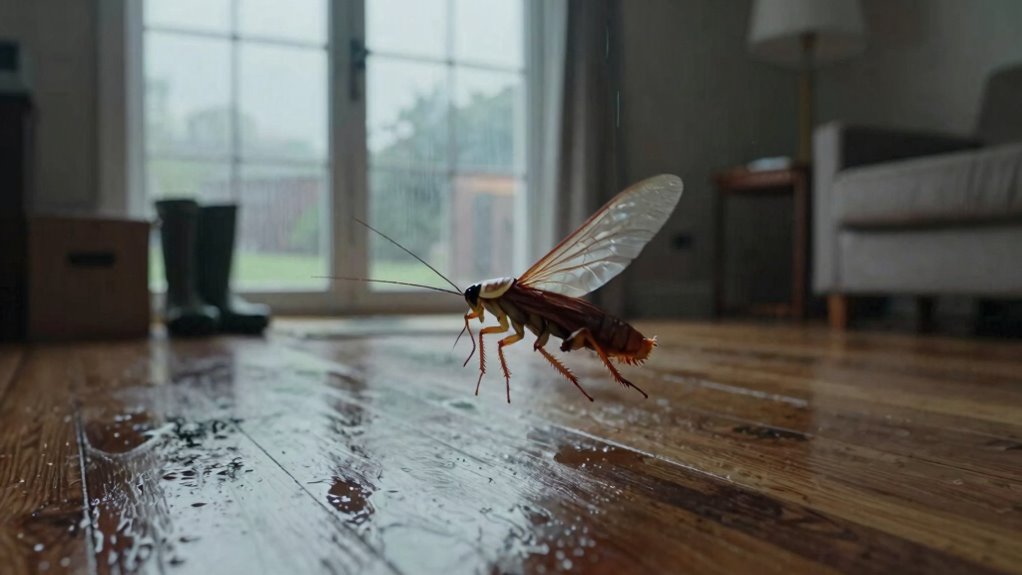
After rain, American cockroaches have a nasty habit of showing up where they are least welcome inside your home. They often fly in through an open window or gap under a door.
These seasonal triggers, namely heavy downpours and flooding, force them from outdoor haunts like sewers and mulch beds. Their flight patterns are direct and unsettling because they are strong fliers drawn to warm, humid indoor air.
So when a storm passes, they do not crawl. They launch like an uninvited, airborne houseguest with zero social graces.
A single adult can glide in from ten feet away, landing on a lampshade or counter. It is not personal, just survival.
Your best defense is to seal window gaps and check door sweeps before the next downpour. For effective pest control, consider a professional cockroach treatment plan that targets outdoor breeding sites.
Infestation Signs: German Droppings vs. American Egg Cases
American cockroaches may be the ones crashing your living room after a storm, but the German cockroach leaves a more personal calling card: tiny, pepper-like droppings that show up in kitchen drawers and behind toasters.
The difference in signs between the two species is stark, making early detection possible if you know what to look for.
German droppings are small, dark, and resemble ground pepper, often found near food sources.
American cockroach droppings are larger, like mouse droppings, with blunt ends.
For egg case identification, American cockroach egg capsules are dark brown, about ⅜ inch, glued to surfaces.
German cockroach egg cases are lighter, carried by the female until hatching, so you rarely see them.
The infestation timeline for German roaches is rapid, with populations exploding in weeks.
American roaches develop slowly, taking months, which is why a professional pest control inspection is your best bet for catching a German problem early.
If you spot these droppings in your pantry or behind appliances, you likely need a targeted cockroach treatment plan.
Buyers hunting for a fast-acting roach killer should focus on gel baits and growth regulators for German species, while American roach control often requires broader perimeter sprays.
Calling a local exterminator for a same-day roach inspection can save you from a costly full-home fumigation later.
Knowing which droppings you see tells you exactly which product to order or which service to book.
What Attracts Each Roach Species to Your Home
German cockroaches are drawn to greasy crumbs and pet food left in kitchens. They need water from condensation and sink drips to survive in your home.
American cockroaches prefer decaying leaves, garbage, and even soap residue. They seek moisture from sewer drains and outdoor puddles.
German roaches often hitchhike inside on grocery bags or boxes. Their prime hiding spots are under the fridge and behind the toaster.
American roaches enter during warm, wet weather seeking shelter. They thrive in crawlspaces and garage corners where humidity is high.
The key attractant for German cockroaches is starch and sugar residue. For American cockroaches, humidity and darkness are the main lures.
How to Choose Baits for German Roaches vs. Sprays for Americans
Why choose bait for German cockroaches but a spray for American roaches? German roaches breed rapidly, so bait placement optimization targets their hidden colonies directly. American roaches wander in from outdoors, making spray chemical selection the faster kill method.
German roaches require gel baits near harborage like under fridges or behind stoves. They feed, share poison, and slowly die, hitting up to 30,000 potential nymphs per year.
German roaches need gel baits near harborage; they share poison, slowly killing up to 30,000 nymphs yearly.
American roaches respond better to sprays on entry points such as basement drains and garage cracks. A fast acting pyrethroid stops them cold before they settle in.
For bait placement optimization, place multiple small dabs instead of one big blob. German nymphs need easy access to every feeding spot.
For spray chemical selection, choose non repellent residuals for American roaches. They cannot detect it and will track it back to sewers.
The bottom line is bait for hidden German crowds and spray for wandering American loners. Both work effectively, just do not mix them up or you will get a messy roach filled surprise.
When to Call an Exterminator for Each Infestation Type?
Know when to call in the pros, since waiting too long can turn a roach problem into a rental property. For German roaches, a single female can produce 30,000 nymphs yearly.
If your DIY inspection frequency reveals droppings or nymphs daily, professional remediation cost is worth it, typically $200 to $500 per treatment. These guys multiply faster than bad jokes at a wedding.
For American roaches, they are slower but can fly. If you see them after rain or in basements, try bait first.
But if your DIY inspection frequency finds egg cases or large droppings weekly, call a pro. Their professional remediation cost averages $150 to $350, and it is cheaper than a new sewer line.
Bottom line: German roaches need a pro fast, and American roaches can wait a bit. If you are outmatched, do not be a hero.
Call the exterminator to handle the pest control job for good.
Frequently Asked Questions
Can German Cockroaches Infest American Cockroach Habitats?
Yes, German cockroaches can infest American cockroach habitats without any problem. While American roaches prefer sewers and damp basements, German roaches are opportunistic hitchhikers that invade any warm, food rich indoor space.
If these environments overlap, the German roach’s rapid reproduction quickly outcompetes the slower American species. A single female can produce up to 30,000 nymphs per year, making this one of the fastest breeding pests you will face.
This niche competition often pushes American roaches out of shared territory. To prevent a German roach infestation, you need targeted pest control products like gel baits, growth regulators, and residual sprays.
Acting fast is critical because their breeding speed turns shared spaces into a one sided infestation. If you see signs of roach activity, schedule a professional inspection or buy commercial grade cockroach killers today.
Do Both Species Spread Diseases the Same Way?
Yes, both species spread diseases in a comparable manner, though not in an identical way. German cockroaches, with their explosive reproduction, produce droppings faster, creating quicker contamination risks in your kitchen or bathroom.
American cockroaches, living longer, shed pathogens for extended periods, often within sewers and damp areas. Both can transmit salmonella and E. coli, so effective pest control is essential for health.
Contrasting fecal spreading rates mean German roaches amplify disease quicker in tight indoor spots. Differing pathogen survival times give American roaches a longer, messier legacy in basements and crawlspaces.
For serious infestation control, treating both species early is key. Always choose a professional grade roach bait or gel for targeted elimination and long term prevention.
Can German and American Cockroaches Crossbreed?
No, German and American cockroaches cannot crossbreed. Genetic barriers block successful mating between these two species.
Their DNA is far too different for any hybrid offspring to survive. Think of it like trying to mix oil and water, only buggier.
Even if they attempted to mate, hybrid viability is zero. This means you won’t get a super cockroach from these two species.
For effective cockroach control, focus on targeting each species separately. German cockroaches thrive indoors, while American roaches prefer damp, dark spaces like basements and sewers.
If you spot either in your home, professional pest control products are your best bet. Baits and sprays formulated for specific roach species work best for elimination.
Don’t wait for an infestation to grow. Call a licensed exterminator or order proven roach killers today to protect your home.
Which Cockroach Is More Likely to Trigger Asthma?
German cockroaches are more likely to trigger asthma because of higher allergen potency. Their droppings and shed skins pack a stronger punch, whereas American roach allergens are less concentrated.
German roaches additionally stay indoors, so their migration patterns keep them close to humans. Unlike Americans that wander in from sewers, German roaches live right where you are.
More roaches indoors mean more allergen exposure, plain and simple. For effective roach control, you need a targeted pest treatment that reduces indoor allergens fast.
If you want to prevent asthma triggers, focus on eliminating German roach infestations with professional pest control products. Smart buyers choose indoor roach baits and sprays to break the allergen cycle.
How Long Can Each Cockroach Survive Without Food or Water?
The German cockroach survives only a few days without water, as it’s tied to high humidity dependence. Without food, it might last a week, making professional pest control a must for infested kitchens.
The American cockroach, on the other hand, can live up to a month without food and two weeks without water. These survival timelines highlight why German roaches need constant access to kitchens or bathrooms.
American ones tough it out in drier spots, so you need targeted cockroach baits and gel treatments. For a smart purchase, choose products with long residual effects to tackle both species effectively.


