
Diatomaceous earth for cockroaches is one of the safest, most effective DIY pest killers you can use—if you apply it correctly.
Most people pile it on like snow, but that actually repels roaches instead of killing them.
This guide walks you through the exact dusting technique that gets results, where to place it, and the critical mistakes that ruin your treatment.
Keep reading for the full breakdown, including when to reapply and what to avoid.
At A Glance
- Use only food-grade diatomaceous earth; pool-grade contains harmful crystalline silica.
- Apply a thin, even dust layer into cracks, crevices, and along baseboards.
- Keep DE dry; moisture ruins its abrasive action and effectiveness.
- Reapply after cleaning or humidity changes to maintain contact with roaches.
- Combine DE with other methods, as it does not kill roach eggs.
How to Apply Diatomaceous Earth for Maximum Roach Contact
Apply a thin, even layer of diatomaceous earth directly into the cracks and crevices where cockroaches hide and travel. Imagine dusting a donut, not frosting a cake, for the best roach control results.
Apply a thin, even layer of DE, like dusting a donut, not frosting a cake.
For maximum roach contact, think like a bug. They hug walls and edges, so barrier placement is key.
Draw a fine line of DE along baseboards and around cabinet perimeters. This forces them to march through the powder for effective pest elimination.
An aerosol application of insecticide might blast them fast, but DE’s mechanical grind is patient. Use a bulb duster or condiment bottle for precision.
Squeeze it into wall voids behind outlet covers to target their harborage areas. It is slow poison, not a bomb, so let it sit for days.
Drier is deadlier because moisture ruins its edge. Reapply after cleaning to maintain a strong roach killer barrier.
Bottom line: target their highways, not random corners. Unlike boric acid, which acts as a stomach poison ingested during grooming, DE works by physically damaging the exoskeleton. This strategy ensures you buy a solution that works with patience and care.
Best Places to Dust Diatomaceous Earth in Your Kitchen and Bathroom
In the kitchen, focus on thin gaps where cabinets meet walls and dark crevices behind the fridge and stove. Also treat the undersides of sinks, since roaches follow pipes and crumbs like tiny commuters.
For the bathroom, dust along baseboards and under the vanity for effective roach control. Keep diatomaceous earth out of damp zones like the shower floor, because wet DE becomes useless.
Instead, lay a light coating on a dry piece of cardboard tucked under the sink. This creates a walking path for roaches while keeping the powder’s sharp edges dry and effective. Use an OMRI-listed product to ensure organic certification and safety for food preparation areas.
Kitchen Crack Targets
| Kitchen Crack Target | Why It Works |
|---|---|
| Under sink cabinet | Humidity and pipe access points |
| Behind stove | Warmth and food debris |
| Along baseboard cracks | Dark travel routes |
| Countertop edges | Common foraging paths |
Apply a thin, dry layer with a bulb duster. Avoid clumps for best pest control results. Reapply after cleaning because dampness kills diatomaceous earth’s sharp edges. This natural insecticide works slowly but reliably. Give it a week to dry out those invaders. Patience is key for long term home defense. Always use a product that is 100% pure, food-grade to ensure safety around family and pets.
Bathroom Damp Zones
Moisture is the enemy of diatomaceous earth, making the bathroom a tricky battlefield.
For effective roach control, focus on strategic placement near pipes and under sinks.
Avoid wet tile or open showers.
Instead, create dampness barriers by dusting behind the toilet base and inside vanity cabinets.
These dry spots keep DE sharp against roaches.
Place a light coating around drain pipes, as they are prime highways for cockroaches.
Tuck DE into corner cracks near the tub.
Avoid the shower floor, it is a no go zone unless you want clumpy, useless dust.
That is a rookie mistake, like forgetting to replace a wet paper towel roll.
For best results, hit dry zones only.
Reapply after steamy showers or leaks.
Diatomaceous earth works best when it stays thirsty, not soggy.
Always use food-grade diatomaceous earth for extra peace of mind around your family.
What Is Diatomaceous Earth and How Does It Kill Cockroaches?
Diatomaceous earth, or DE, is basically the microscopic equivalent of walking through a field of broken glass if you are a cockroach. It is fossilized algae ground into a fine powder.
Those tiny shards slice the roach’s waxy shell so it leaks moisture and dies of dehydration. No poison is involved, just simple physics.
Those tiny shards slice the roach’s waxy shell, causing it to leak moisture and die from dehydration—no poison, just physics.
That is why DE is a solid pick for homes with toddlers. It has low toxicity to kids, though you will still want it swept up.
For outdoor application, dust a dry perimeter. Rain wrecks it fast, so reapply after storms for the best roach control.
DE works slowly over days, not minutes, but it keeps working as long as it stays dry. Just do not breathe the dust during application.
Bottom line is that this pest control powder is cheap, safe-ish, and brutally effective. If you want a long term solution, it is worth a shot.
Using food-grade, OMRI-listed diatomaceous earth ensures the safest option around children and pets.
Why Food-Grade Diatomaceous Earth Is the Only Safe Option for Roach Control
Food-grade diatomaceous earth is the only type safe for roach control, since pool-grade DE is heat-treated with crystalline silica, a lung irritant that poses serious health risks. Food-grade DE, by contrast, has very low mammalian toxicity, so it won’t harm people or pets when used as directed. Its mechanical action abrades the roach’s waxy shell until the insect dehydrates, which means pests can’t develop resistance to it. That makes it a long-term, reliable choice for indoor pest management, especially for homeowners seeking a natural roach killer. You can apply it along baseboards, under appliances, and in cracks where roaches hide, and it stays effective as long as it remains dry. For best results, reapply after cleaning or moisture exposure, and pair it with proper sanitation to reduce roach activity. This diatomaceous earth for bugs works without toxic chemicals, so it’s a safe roach treatment around kids and pets. It’s also a cost-effective solution for ongoing roach prevention, since one dusting can last for months. A single dusting can cost as little as $5 to $15 for small infestations.
Food-Grade vs. Pool-Grade
In the context of diatomaceous earth for cockroach control, not all bags are created equal. Pool-grade DE, used in pool filters, is a no-go because it is heat-treated and creates tiny crystalline silica particles dangerous to breathe. Food-grade DE is safer for home use because it contains less than 1% crystalline silica, making it safe for pets and humans when directions are followed.
This makes it a serious hydration hazard for your lungs, not for roaches. Food-grade DE, however, complies with pesticide regulations and is safe for home use when applied correctly.
The dust particle size in food-grade DE is finer and less harmful, though you should still avoid inhaling it. Pool-grade DE will clog your lungs, not just your pool filter, so stick with food-grade for roach control.
It kills cockroaches by abrasion, not poison, and costs around $10 to $15 per bag. Your lungs will thank you for choosing the safe diatomaceous earth option.
Bottom line: use food-grade DE for roaches and pool-grade DE for the pool, and keep them separate.
Low Mammalian Toxicity
Low mammalian toxicity makes diatomaceous earth a smart choice for pest control. It kills by physical abrasion, not chemical poisoning, so it’s gentle on humans and pets.
Food grade DE leaves no toxic residue, making it safe around kids and pets when applied dry. But avoid eating it directly, as repeated ingestion can irritate the digestive tract.
No poison buildup means DE won’t linger like baits in your kitchen or pantry. Low inhalation risk is manageable with a dust mask, though pool grade DE contains dangerous crystalline silica.
Accidental small amounts just pass through, but large amounts cause stomach upset. Keep it off food surfaces to stay safe.
For roach control, stick to food grade DE. Pool grade isn’t worth the risk.
A $12 bag lasts months for baseboards and sinks. It offers natural bug killer benefits without toxic worries.
To ensure maximum effectiveness, choose a product with particles under 10 microns to damage weevil exoskeletons.
Mechanical Action Prevents Resistance
Diatomaceous earth’s real beauty isn’t just that it’s safer than harsh chemical sprays. It kills by mechanical action that evolution can’t outsmart.
Unlike neurotoxins that roaches adapt to over generations, DE is a physical insecticide. Resistance is simply impossible against it.
Those fossilized diatoms are microscopic razors, shredding the waxy cuticle and causing dehydration. No mutation lets a roach develop armor against that; it’s like trying to evolve immunity to a cheese grater.
Chemical sprays breed super-roaches, but DE stays effective indefinitely. You don’t need to rotate products or worry about tolerance building up.
Just dust, wait, and watch them dry out. That’s it.
Bottom line: if you want roach control that won’t fail you next year, DE’s mechanical kill is the only safe bet for lasting pest elimination.
For effective results, use food-grade diatomaceous earth and apply it in thin, dry layers along entry points, cracks, and baseboards.
Does Diatomaceous Earth Kill Roach Eggs or Just Adults?
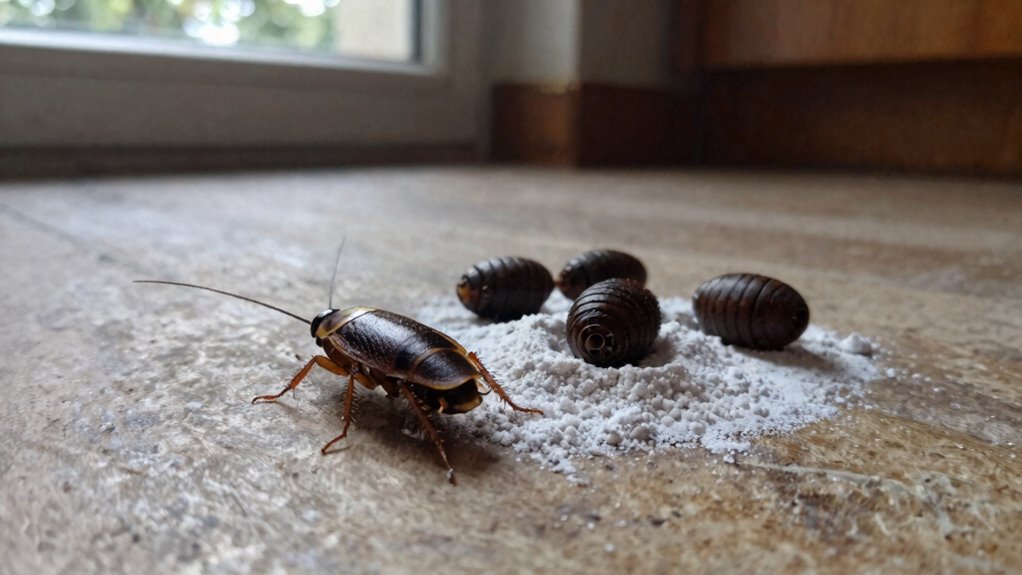
Diatomaceous earth kills adult cockroaches and nymphs, but it will not destroy their eggs. This means roach survival hinges on the egg case’s protective shell, which DE cannot penetrate.
Egg development continues undisturbed, so new nymphs emerge later. The ootheca shields eggs from DE’s abrasive action, preserving roach survival.
DE only works on direct contact with insects, not on enclosed eggs. You must reapply DE after eggs hatch to kill emerging nymphs before they mature. For lasting control, consider pairing DE with a high-purity boric acid powder that kills via ingestion within 72 hours.
How Fast Does Diatomaceous Earth Kill Roaches?
Diatomaceous earth takes time to kill roaches, usually three to four weeks, not overnight. The dehydration process starts when they crawl through the dust, but death comes in days, not hours.
Young nymphs can die in about three days because they are small and lose moisture fast. Adult roaches, being larger and tougher, may last seven to ten days before they shrivel up.
DE works by scraping the roach’s waxy coating, which leads to slow dehydration. For a heavy infestation, plan on a month of steady dust applications to achieve full control. Amorphous silica gel works by physically dehydrating insects for effective pest control, similar to diatomaceous earth.
Keep the powder dry and leave it undisturbed for the best results. Patience is key, so let time do the work while you patrol with regular treatments.
5 Common Mistakes That Ruin Diatomaceous Earth’s Effectiveness
People often sabotage their diatomaceous earth treatment without realizing it. One classic blunder is applying a thick, cake-like layer that cockroaches just walk around like a tiny, sandy moat.
People often sabotage diatomaceous earth treatment without realizing it, applying a thick layer cockroaches walk around like a tiny, sandy moat.
Instead, a fine, nearly invisible dust is the goal for effective pest control. A few other common missteps can ruin your DE powder.
First, mixing DE with ant traps or gel baits attracts roaches but the moisture instantly clumps the dust. Keep them separate so the baits lure and the DE kills.
Second, adding aromatic oils like peppermint oil for scent creates a dampness bomb that cakes the powder. Roaches avoid the wet, ineffective mess anyway.
Third, vacuuming too soon ruins the slow mechanical death process. Patience is key when using this organic pest control method.
Keep your diatomaceous earth dry, thin, and undisturbed for the best results. That dry powder recipe is your winning strategy for buying pest control that works.
Fourth, applying the powder in humid areas where silica dust remains ineffective quickly wastes the product.
How to Keep Diatomaceous Earth Dry in Humid Rooms
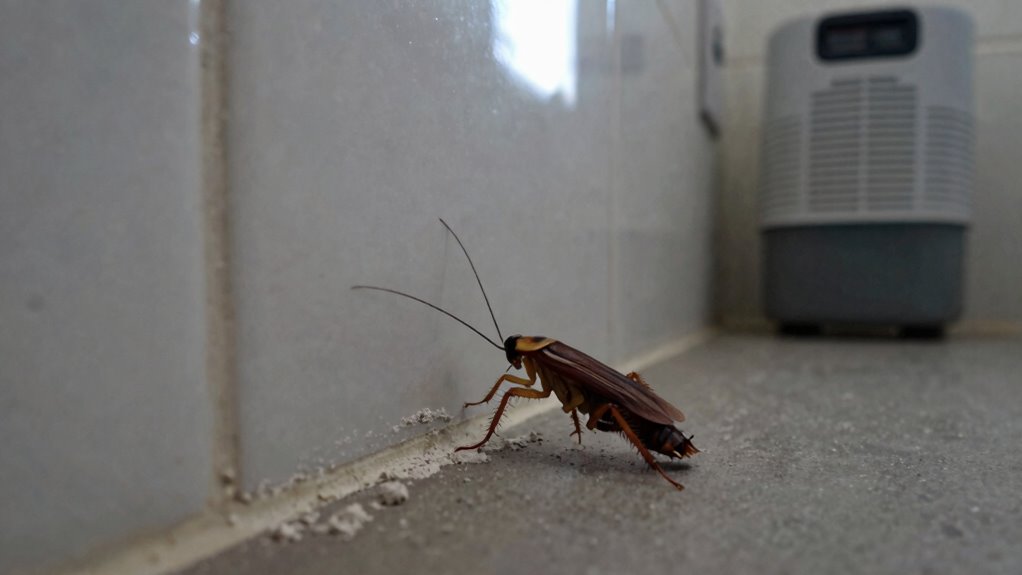
Keeping diatomaceous earth dry in a humid room takes smart placement and a little home ingenuity. Use a bulb duster or squeeze bottle to puff the fine dust into tight cracks where moisture rarely reaches.
For open areas, slide a piece of cardboard under the fridge or sink, dust it lightly, and slip it out later to inspect. This simple trick prevents moisture from ruining your pest control efforts.
If the powder clumps within days, you are in a high humidity zone and must replace it weekly without exception. Remember that damp DE is worthless, just clumpy sand that won’t kill bugs.
A $10 duster and a scrap of cardboard can turn any wet room into a viable killing field for insects. Keep the powder dry, apply it thin, and check it often for best results. For larger areas, consider an electric duster for fast, uniform application.
When to Combine Diatomaceous Earth With Other Roach Treatments
Knowing when to call in reinforcements is the secret to winning the war against cockroaches, not just a single battle. Diatomaceous earth works well on its own for light infestations, but heavy roach problems need a tag team approach.
The moment you spot nymphs or see the same roaches three weeks in a row, it is time to combine treatments. Use borax baits to target the roaches hiding deep inside walls where DE powder cannot reach. For a more effective alternative, consider using a gel with an insect growth regulator to stop resistant roaches from reproducing.
The moment you spot nymphs or see roaches for three weeks, combine treatments immediately.
Mix borax with sugar, place it near nests, and let the roaches carry the poison back to the colony. Sticky traps help you monitor hotspots and reveal if the DE is still working or if the roaches are simply avoiding the dust.
Professional pest control becomes necessary when DE and baits fail after four weeks. They bring stronger gels and foggers that can end the nightmare for good.
Combine DE with borax baits first, then call a licensed exterminator if the roaches laugh at your efforts. This layered strategy turns a losing battle into a winning solution.
Frequently Asked Questions
Can Diatomaceous Earth Be Used Outdoors for Cockroaches?
Yes, diatomaceous earth can be used outdoors for cockroaches. However, moisture is its biggest enemy in a yard or garden setting.
Rain or dew will turn food grade DE into useless paste if it gets wet. Apply it only in dry, covered areas like under eaves or on porches.
Outdoor pest control works best when you dust cracks, near foundations, or inside drains. Reapply after any wet weather to maintain effectiveness against roach infestations.
It kills cockroaches slowly through mechanical action rather than poison. That is why no chemical resistance can build up with repeated use.
For heavy outdoor roach populations, you may need to combine DE with other methods. Prepare for a longer battle if you rely solely on diatomaceous earth as your natural roach killer.
Will DE Harm Beneficial Insects Like Spiders or Ladybugs?
Yes, diatomaceous earth will harm beneficial insects like spiders or ladybugs. It is not a pest selective natural insecticide.
Its mechanical action shreds the waxy coating of any bug with an exoskeleton, friend or foe. This includes roaches, spiders, and ladybugs alike.
So, applying it outdoors risks collateral damage to helpful critters. For targeted indoor roach control only, it is fine.
But for garden use? Expect unintended casualties. Bottom line: keep it inside, away from beneficial bugs.
Does DE Expire or Lose Effectiveness Over Time?
DE doesn’t expire like milk, but it can lose its mojo over time. Storage conditions matter, so keep it bone-dry in a sealed container to avoid clumping issues.
Humidity makes those sharp edges dull, and wet DE just becomes gritty mud, useless for pest control. Unopened, diatomaceous earth is basically immortal. Opened, you have maybe a year before it’s too damp to bother with for cockroach or ant control.
Quick test: sprinkle some on a plate. If it clumps, toss it. Otherwise, dust away, friend, and enjoy effective natural pest control.
Buy quality DE that stays dry for long lasting results. Smart shoppers know to check storage conditions before purchasing their pest control products.
Can I Mix DE With Water to Spray on Roaches?
No, mixing diatomaceous earth with water creates a paste that loses its killing power. The sharp, dry particles work by scraping the roach’s waxy shell and causing dehydration.
Once wet, the abrasive edges collapse and the drying effect stops. This application method ruins DE entirely for pest control.
Use it dry, in thin layers, around baseboards or behind refrigerator coils. A bulb duster costs only eight dollars, which is a smart investment for roach treatment.
Wet DE is just dirty grit that won’t eliminate cockroaches. For best results, keep your diatomaceous earth powder completely dry.
Is It Safe to Sleep in a Room Treated With Diatomaceous Earth?
Yes, it’s generally safe to sleep in a room treated with diatomaceous earth, but only if you use food-grade DE and apply it dry. The main concern isn’t toxicity, since DE works by abrasion, not poison; it’s the fine dust that can irritate your lungs and indoor air quality.
So, wear a dust mask while applying and keep ceiling fans or AC off until the powder settles, which usually takes about an hour. For pet owners tackling flea control, it’s fine for dogs and cats after the dust settles, but never let them inhale the airborne particles directly.
If you’re looking for a natural pest control solution for bed bugs, roaches, or ants, spread a thin layer along baseboards and cracks, not thick piles. Sleeping on a fresh mound is a bad idea, since it can cause respiratory irritation and make less effective contact with pests.
Wait at least 60 minutes after treatment, then vacuum any excess from sleeping surfaces for a safer night’s rest. For long-term pest prevention, reapply after cleaning or humidity spikes, because DE loses its cutting power when wet.
If you have asthma or allergies, consider wearing a respirator during setup and ventilate the room overnight before you sleep there. Buy food-grade diatomaceous earth specifically labeled for pest control, since pool-grade versions contain crystalline silica that’s dangerous to inhale.
For the best results, combine DE with other integrated pest management tactics like sealing entry points and removing food sources. That way, you get lasting bed bug treatment or roach control without compromising your sleep comfort or health.


