
Getting rid of termite swarmers means stopping the nuisance, but also killing the hidden colony behind them. Those winged termites signal a mature nest in your foundation or crawlspace, so quick action matters more than just sweeping them up.
Kill-on-contact liquid barriers like fipronil intercept tunnels underground and work for five to ten years. Bait stations target the queen slowly but cost $300 to $800 plus annual fees, while vacuuming and sealing cracks handles the immediate mess.
A professional will find mud tubes and hollow baseboards you might miss. Below, you’ll get clear steps for keeping termites gone for good, from DIY fixes to pro treatments.
At A Glance
- Vacuum swarmers and immediately dispose of the bag outdoors to stop the nuisance.
- Close blinds and turn off lights to reduce their attraction to your home.
- Collect shed wings for accurate identification before cleaning.
- Killing swarmers only removes symptoms, not the hidden mature colony.
- Schedule a professional inspection for long-term colony elimination.
Termite Swarmers vs. Flying Ants: How to Tell Them Apart
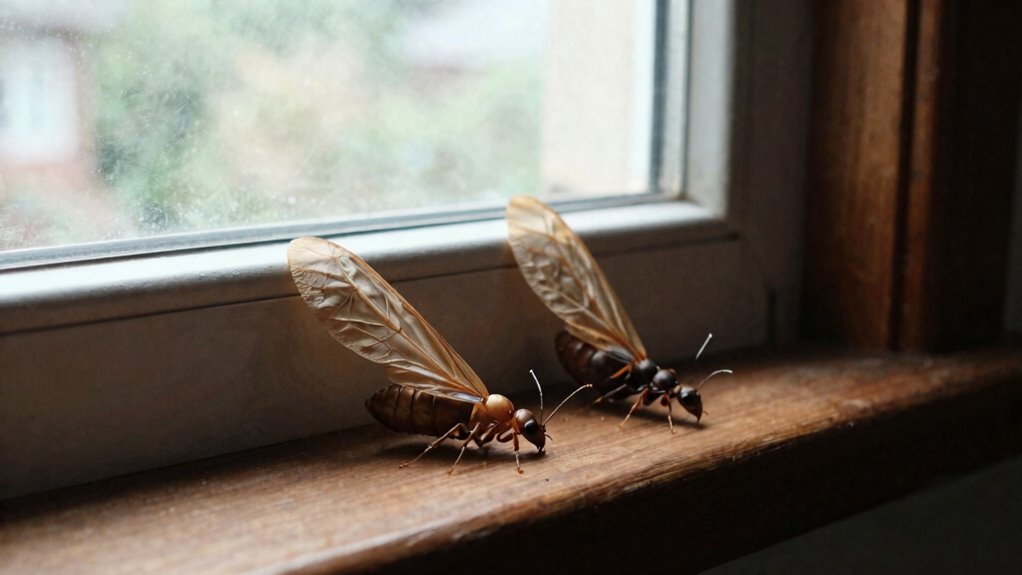
Mixing up termite swarmers and flying ants is a common mistake, but it matters because one points to potential structural damage while the other is just a nuisance.
Start by checking the wings, since they are the fastest clue. Termite swarmers have four wings of equal length that often pile up near windows, while flying ants have two larger wings in front and two smaller ones behind.
The antennae tell the rest of the story. Termites have straight, bead-like antennae, whereas ants have a distinct bent or elbowed shape.
The antennae tell the story: termites have straight, bead-like antennae, while ants have bent or elbowed ones.
During swarming season, both insects appear, but termites are strongly attracted to lights around doors and windows at night. You might spot them near porch lights, patio lamps, or indoor fixtures, which is a key sign to book a professional termite inspection.
Size and body shape also separate them. Termites are dark, about a quarter inch long, with a thick, straight waist, while ants have a clearly pinched waist that makes them look segmented.
If you find shed wings scattered on a sill or floor, that almost always means termites, since ants keep their wings attached until they die. Flying ants typically die quickly after mating, but termite swarmers trapped inside your home strongly suggest an active colony nearby.
The bottom line is simple: check the wings and waist before you panic, but do not ignore the evidence. If you see equal-length wings and a thick body, call a local pest control service for a termite treatment quote right away.
Catching a termite problem early can save you thousands in foundation repairs, and a quick inspection gives you peace of mind. Knowing the difference helps you react correctly and avoid paying for unnecessary ant removal when the real issue is termites. To detect the excess moisture that attracts these pests, professionals often use a pinless moisture meter to scan walls and wood without leaving damage.
What Exactly Are Termite Swarmers and Why Do They Appear?
Finding a neat pile of identical wings on your windowsill often means termite swarmers have been active in your home. These winged termites are the colony’s reproductive members, sent out to start new infestations.
Their sudden appearance is driven by the termite reproductive cycle, which is triggered by warm and rainy spring weather. Swarmers fly out, mate, and then shed their wings, hoping to land in damp soil to begin a new colony.
If you see them indoors, it signals a mature termite colony is already established nearby, likely at least three to five years old.
These swarmers do not bite or chew wood, but their presence means professional termite control is needed. Warm, humid conditions and recent rainfall are the main swarming triggers for these pests.
After mating, the swarmers quickly die inside because they lack the moisture required to survive. The piles of shed wings are an easy sign for identification and a clear call for pest inspection services.
Acting fast with a termite treatment plan can prevent serious structural damage to your property, such as using foam sprays that expand to reach hidden pests inside walls.
Found Termite Swarmers Inside? Why That Means a Colony Nearby
Finding those neat rows of shed wings on your windowsill means a mature termite colony is already established in or near your home.
Those dark brown winged adults, called swarmers, only leave when the colony is large enough to reproduce, which is a clear sign of colony maturity.
They are responding to swarm triggers like warmer temperatures and rain, not a random fly by event.
It takes a colony about three to six years to reach maturity and produce swarmers, so this is not a new issue.
The colony’s nest is likely hidden in your foundation, a crawlspace, or a nearby tree stump.
Although swarmers themselves do not eat wood, the worker termites in that colony have been tunneling and damaging your structure for years.
An indoor swarm is almost always a confirmed infestation, not a stray visitor.
Your bottom line is that a professional termite inspection is non negotiable, and you need it soon to prevent further damage.
Foam with active ingredients like fipronil or dinotefuran can be applied directly into voids for targeted colony control.
How to Safely Remove Termite Swarmers Right Now

The vacuum cleaner is your first and most satisfying tool for termite swarmers. Simply suck them up and dispose of the bag outdoors to stop the nuisance fast.
This prevents them from dying inside, though that is not a problem anyway. For accurate pest identification, collect a few wings before vacuuming.
Wings confirm the type of termite and help with termite inspection later. Remember, swarmers indoors reveal a likely colony location nearby.
Wings confirm the termite type and help with inspection, while swarmers indoors reveal a nearby colony.
They are just scouts, not the actual destroyers. Worker termites do all the structural damage in a termite infestation.
A vacuum stops the nuisance instantly, but it does not eliminate the colony. That requires professional pest control treatment. Bait stations(recommended) offer a targeted approach for colony elimination once swarmers are identified.
Should You Vacuum or Sweep Up Termite Swarmers?
Both options work, but the vacuum earns the crown for efficiency. Sweeping can scatter swarmers, leaving you chasing escapees.
A vacuum sucks them up, bag and all, without the hassle. You will want to empty it outside to prevent re infestation.
When choosing, consider these four points for effective termite swarm control. First, wing count helps confirm the species.
Termite swarmers have four equal length wings. Vacuuming preserves them for accurate pest identification.
Second, antenna shape is clearer in a vacuum’s catch. Their straight, bead like antennae are not lost in a dustpan’s mess.
Third, speed matters during active swarming. Vacuuming takes seconds versus sweep and chase minutes, especially near light sources.
Fourth, cleanup is simpler with a bagged vacuum. Bagged swarmers die fast, leaving no sweeping residue behind.
The vacuum wins for speed and specimen preservation. Sweep only if you are out of batteries.
Bottom line for homeowners: vacuum first, always. This keeps your termite prevention plan on track. For long-term control, consider a bait station system that targets colonies directly.
Why Closing Blinds and Turning Off Lights Works Against Swarmers
Closing blinds and turning off lights exploits a simple, predictable behavior: termite swarmers are drawn to light like moths to a flame. This creates light interference, confusing their navigation and keeping them outside where they belong.
Indoors, bright windows or lamps act like landing strips for swarmers, so cutting power removes the signal. But there’s a twist: pitch darkness alone won’t stop them if they already smell a mate.
That’s where pheromone confusion kicks in, because without light cues, they rely on scent, but closed blinds reduce the airflow that carries those smells. Swarmers, then, wander aimlessly and die within a day from dryness.
This is a practical pest prevention tip for termite control, not a cure, just a quick fix for swarm season. Think of it like turning off the porch light to stop moths, simple, cheap, and oddly satisfying.
For about $0 in electricity savings, you buy time until a pro arrives, which is why homeowners use this as an emergency termite treatment tactic. It also pairs well with sealing cracks and scheduling an inspection for lasting termite protection. For alternative control, stationary zappers with dual-band LED lights can lure and kill different flying insects outdoors, though they may also attract beneficial bugs.
Why Killing Termite Swarmers Won’t Solve Your Real Problem
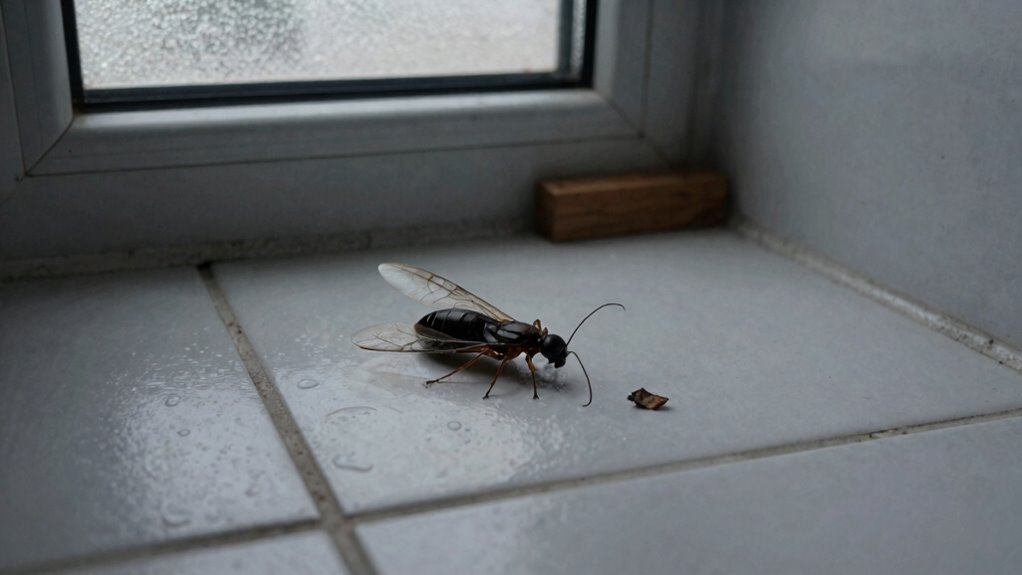
Killing a few dark, winged termite swarmers with a vacuum cleaner feels satisfying, like you’ve won.
But those are just the colony’s scouts, and they’re already dead within a day due to their short, fragile termite swarmer lifespan. You’re only cleaning up the mess, not the source.
Swarmer light attraction draws them to windows, not your walls. So killing them indoors does not touch the mud tubes hiding in your foundation.
Worker termites, not swarmers, chew through wood 24/7.
Vacuuming the flying ones is like swatting a mosquito while ignoring the flooded basement. Each swarmer you kill represents a colony that’s already mature, often years old, and churning out hundreds more.
Without a professional barrier treatment like a liquid termiticide or baiting system, the real colony keeps thriving.
Bottom line: stop celebrating the decoy. Call a licensed inspector to find the colony and schedule termite control before structural damage worsens. Unlike roach infestations where a quarterly fogging schedule can help control surface outbreaks, termite swarmers signal a hidden colony that no fogger can reach.
What a Licensed Inspector Looks For in Your Home
A licensed inspector starts by searching for termite trouble spots you’d never notice. They focus on the gap between your foundation and the soil where mud tubes can hide in plain sight.
They tap on baseboards, listening for hollow sounds that reveal hidden damage. Then they probe wood with a screwdriver to confirm any soft spots.
Subterranean signs like tiny piles of sawdust or discarded wings near windows point to a colony location. The inspector crawls into crawlspaces, peering at floor joists and sill plates for moisture stains from leaky pipes.
Moisture meters help them find damp wood, which is the perfect nursery for termite pests. They also check where concrete meets wood, a common entry point for subterranean termites.
A thorough inspector never assumes past treatment is enough. They look for evidence of old treatments and any current activity to give you a clear picture of the problem’s size. They also evaluate whether any exposed wood has been treated with borate-based preservatives that provide deep-penetrating defense against termites.
How Liquid Termiticide Barriers Stop the Colony Underground
Once the inspector confirms a live colony, the focus shifts from detection to elimination. Liquid termiticide barriers create a chemical zone around the foundation that intercepts subterranean tunnels before they reach the slab.
Because the treatment is non repellent, termites unknowingly walk through it and carry the poison back to the nest. The barrier’s longevity depends on the formulation, with many products holding firm for five to ten years.
Full coverage means hundreds of gallons are injected under slabs and along footings. Kill on contact ingredients like fipronil eliminate workers immediately upon exposure.
Soil binding properties help the product cling to dirt, resisting rain and runoff. There is no bait reliance here, so the protection is purely passive and requires no colony feeding.
It is not glamorous, but it is highly reliable. For a fast, lasting knockout, this barrier is the go to move for pest control professionals. This residual effect offers long residual activity of 30–90 days under favorable conditions, keeping the treated zone active for extended protection.
Why Termite Baits Take Longer but Work Better
Liquid barriers work fast because they kill worker termites on contact in the soil. Termite baits take weeks or months but target the entire colony including the queen.
A liquid treatment lasts five years or more, making it a good immediate shield. Bait systems need annual monitoring but cost less upfront, between $300 and $800 plus yearly fees.
For quick protection, a liquid barrier is best if you have a visible infestation. Bait stations are better for persistent, hard to reach colonies that need long term elimination. Like bait stations for ants, the slow-acting poison ensures worker termites carry the bait back to the nest, sharing it with the colony and queen for complete eradication.
Long-Term Prevention to Keep Termite Swarmers Away for Good
Termite swarmers are a sign of an active colony that has already found a way inside your home. The real solution is to make your structure completely uninviting for termite treatment and long term protection.
Focus on eliminating excess moisture that makes wood appealing to pests. Seal every crack and gap that serves as an entry point for termite control.
Remove any wood to soil contact that creates a direct pathway from the ground to your foundation. These simple steps in pest prevention will stop swarmers from returning for good.
Once you handle these three major invitations, you will see far fewer wings on your windowsill. Pairing prevention with non-toxic trapping using glue boards and safe adhesives can capture occasional indoor insects without harsh chemical residues. Professional termite inspection can also verify your home is fully protected against future infestations.
Eliminate Moisture Sources
Fixing leaky pipes and dripping faucets might not sound like termite control, but dampness acts like a welcome mat for these pests. Termite swarmers, the reproductive stage, seek humid environments to start new colonies, so eliminating moisture sources is key for long-term prevention.
To keep them away for good, a homeowner should take these steps. First, repair all leaks including outdoor spigots and irrigation heads, because a single drip can sustain a termite colony.
Second, grade soil to direct rainwater away from the foundation, preventing puddling near walls. Third, clean gutters regularly and guarantee downspouts extend at least three feet from the home.
Fourth, reduce humidity in crawl spaces using a dehumidifier or improved ventilation. Using a dehumidifier that maintains humidity below 50% is critical, as termites and other pests cannot tolerate that dry environment. Additionally, schedule yearly termite inspections to catch damp spots early.
Also remove clutter like stacked firewood or cardboard boxes that trap moisture. Dry homes simply do not interest termites, making moisture control your best pest prevention strategy.
Seal Entry Points
Sealing cracks and gaps is where you literally close the door on termite swarmers. A mature colony sends out these winged reproductives, but sealing entry points breaks the termite lifecycle before it starts.
The swarmer lifespan is short, often just a day indoors without dampness. Blocking their exit paths from walls or foundations is critical for effective termite control.
Use exterior grade silicone caulk around pipes, wires, and foundation gaps. Pay attention to attic vents and roofline cracks to stop termite infestations early.
Apply expanding foam to larger openings, but keep it neat. Termites are picky but persistent, so proper pest control materials matter.
For concrete gaps, use hydraulic cement costing about ten dollars per tube. It takes effort, but each sealed gap denies swarmers a chance to start a new family.
The bottom line is to seal everything tight. For example, brush seal strips with dense nylon bristles fill uneven gaps around sliding doors or weathered frames where termites might enter. You stop them before they settle in with this simple home protection step.
Reduce Wood-to-Soil Contact
A second key step is to eliminate any wood-to-soil contact around your home. That is the main invitation for termite swarmers, plain and simple.
Swap out wooden posts for concrete or metal, and keep mulch at least a foot away from the foundation. Moisture plus wood equals a termite buffet.
To prevent an infestation, think like a termite inspector. Replace wood siding that touches the ground.
Use gravel or stone instead of wood chips near the base. Raise firewood stacks off the soil, ideally on a rack.
Store lumber scraps in a dry shed, not on the dirt.
Now about chemical barriers. They are helpful but useless if wood grading sits against wet earth.
Termites bypass the poison by tunneling straight up through the wood. Fix the wood-to-soil contact first, then treat the ground.
That combination keeps swarmers from ever showing up and protects your home long term.
Frequently Asked Questions
Can Termite Swarmers Bite Humans?
No, termite swarmers cannot bite humans because their mouthparts are designed only for chewing wood and plant fiber, not skin. During a termite swarm, these winged reproductives are solely focused on finding a mate and starting a new colony, so they pose no direct threat to people.
However, seeing swarmers inside your home is a clear warning sign of an active termite infestation nearby. If you spot them, it is time to schedule a professional termite inspection to prevent costly structural damage.
Termite swarmers themselves are harmless, but the colony they left behind can cause thousands of dollars in damage before you even notice. For effective termite control, you need a reliable pest control treatment that targets the entire colony, not just the flying adults.
Buying a DIY termite bait station or a liquid termiticide can help catch the problem early, but an expert assessment is the smartest first step. Look for pest control products labeled for wood destroying insects and consider a preventive barrier treatment for long term protection.
Do Swarmers Mean I Have Drywood or Subterranean Termites?
Swarmers alone don’t tell the whole story, but wing differences are the real giveaway. Subterranean termite swarmers shed their wings quickly, leaving piles of equal sized wings.
Drywood termite swarmers don’t shed as readily, and their wings have a distinct vein pattern. Swarm timing also matters for accurate termite identification.
Subterranean swarms typically happen in spring after rain, especially when humidity rises. Drywood swarms can pop up later in summer or fall, often near eaves or attics.
A professional pest inspection is the best way to sort this out for certain. Calling a termite control expert early can save you from costly structural damage.
If you see winged termites inside your home, don’t wait to schedule a termite treatment. Knowing the exact species helps you choose the right drywood termite treatment or subterranean termite control solution.
Get a local termite inspection to protect your property and make a smart purchase decision. Professional pest control products and targeted bait systems work best when the infestation type is confirmed.
Can I Use Over-The-Counter Sprays to Kill Swarmers?
Yes, over the counter pest control sprays can kill swarmers on contact. But it’s a temporary fix, not a real solution for an active termite or ant problem.
The OTC aerosol lifespan is only a few hours, so direct treatment effectiveness is high for the moment, then zero. You will kill a few bugs, but the hidden colony remains untouched, still active somewhere in your walls or foundation.
Think of it like swatting a mosquito while ignoring the swamp. For true termite control or ant elimination, a professional pest inspection is the real move you need to make.
If you want to stop swarmers for good, you need to address the source with a full colony elimination treatment. That is where a pest control company or a certified applicator comes in with proven termiticide and baiting systems.
How Long After Seeing Swarmers Should I Call an Exterminator?
Call within 24 hours of spotting swarmers. That window is your best shot at stopping a full infestation.
Swarm season timing means winged pests indoors signal a mature colony already in your home. They are not just strays that flew in from outside.
Delaying gives termite workers more time to chew through your wooden structure. DIY prevention options like vacuuming or sealing light gaps only address the visible few.
Those quick fixes won’t touch the hidden thousands already eating your walls. A professional pest inspection costs around $200 to $400, but it buys real peace of mind.
Professional termite treatment runs $1,500 to $3,000 typically, and it is worth every penny. Act fast, or they will bill you later in expensive lumber repairs.
Will Painting or Sealing Cracks Stop Swarmers From Entering?
Painting or sealing cracks won’t stop swarmers from entering your home. It is only a temporary fix for entry points, not a real barrier.
Think of it as putting a bandage on a leaky pipe. It looks good but does little to solve the problem.
Exterior sealants can fill visible gaps, but termites and ants will find other ways in. Seasonal prevention actually requires professional pest control treatments, not just caulk.
For five to ten dollars, it is worth a try, but do not expect miracles. Real termite control costs between five hundred and two thousand dollars.
Seal cracks by all means, but then call a licensed inspector. They will handle the actual swarmers and remove your sense of false security.


