
After a heavy rain, ants often march indoors looking for dry shelter and food.
This sudden invasion can be frustrating, but you can stop it with the right steps.
In this guide, you’ll learn why rain drives ants inside and how to get rid of them fast.
Follow these simple, proven methods to clear your home and keep it ant-free.
Below, you’ll find the essential products and tools you need for each step.
At A Glance
- Wipe all visible ant trails with soapy water to erase pheromone signals.
- Fix leaks and use a dehumidifier to keep indoor humidity below 50%.
- Wait 3–5 days after rain, then place non-repellent gel baits near trails.
- Avoid using repellent sprays that scatter ants and break scent trails.
- Allow bait to circulate for 2–3 weeks before sealing entry cracks.
Why Does Rain Send Ants Marching Into Your Home?
Rainfall above 30 millimeters over 48 hours saturates the soil next to your foundation, and that is the tipping point that turns a mild inconvenience into an indoor invasion.
Ants’ sensory biology detects rising dampness and dropping air pressure, triggering a frantic evacuation.
Ants sense rising dampness and dropping air pressure, triggering a frantic evacuation.
Their nesting depth, usually just inches underground, becomes a flooded death trap.
Pavement ants and odorous house ants, for example, nest shallowly and they cannot swim.
So they flee upward into your dry walls and under your slab.
This is not a casual visit but a survival migration.
Your home offers warmth, food, and dry surfaces, making it the most attractive shelter option during heavy rain.
Those washed away outdoor pheromone trails are gone, but indoor trails persist and shift foraging routes inside.
The result is a determined, wet, and hungry pest control problem you need to solve quickly.
Professional ant treatment can stop these flood driven invasions before they spread.
Using a slow-acting poison like borax ensures worker ants carry bait back to the colony to kill the queen and nest.
Rain Ant Signs: Where to Look Indoors First
Watching ants march in a straight line is like reading their mind. Follow them backward and you’ll find the trail origin, often a crack in a baseboard or along a window sill.
These entry cracks, which can be as narrow as 1/16 of an inch, are most common where walls meet floors or near plumbing penetrations. Check dark, undisturbed areas like under the refrigerator first, since that’s where ant highways start after rain washes away their outdoor paths.
For fast relief, focus your initial pest inspection on moisture-prone spots like behind the dishwasher or near the water heater. If you’re ready to book an ant control service, a professional will target these same hidden zones with bait stations and crack sealing. For immediate action, plant-based sprays with peppermint or citrus oils provide contact kill and long-lasting repellent effects.
Indoor ant prevention starts by wiping down counters and fixing leaky pipes, since damp wood attracts foraging workers. After heavy rain, look for trailing lines near baseboards, door thresholds, and utility lines that enter your home.
A quick way to confirm the source is to place a small piece of damp cardboard overnight. If ants gather there, you’ve found a high-traffic zone that needs treatment.
Call a local exterminator for a thorough crack sealing treatment if you see more than a dozen ants per hour. Your first step indoors should always be the kitchen perimeter, as that’s where food residue and humidity meet.
Trail Origin Points
Since those rain soaked ants are now marching through your home, finding trail origin points is the first step in pest control.
Look for basement wall trails first, as those dark damp seams show where pavement ants enter from saturated soil.
Kitchen baseboard paths are your other prime suspect, often leading to a tiny gap under the toe kick or near the dishwasher.
The trail’s start is not the entry crack itself but the spot where the line becomes consistent, so check for a sudden thickening of workers.
You are chasing the source, not chasing ants, so trace backward calmly.
A flashlight and a dry rag help, and wipe the path to confirm they return.
That confirms the origin point for now.
No sealing yet, just mapping.
Using a trap with sensitive trigger pedals quickly captures the ants at the confirmed origin point.
Entry Crack Hunting
Entry crack hunting sounds about as fun as watching wet paint dry, but it is the only way to stop a rain driven ant parade before it becomes an indoor colony.
Start with baseboards and window frames. Look for tiny, dark smudge lines, which are soil from their trails.
Check where the foundation meets the floor. Rainwater runoff often seeps in here, softening the seal.
Don’t forget around pipes and vents. Gaps as small as 1/16 inch let whole foraging parties slip through.
After rain, ants follow those dampness trails straight into wall voids. They seek dry nesting chambers for their colony.
Use a flashlight and a putty knife to probe suspect cracks.
For outdoor barrier protection, apply perimeter pest control granules in a 6-10 foot band along the foundation to intercept rain-driven ants before they find entry points.
Seal any you find with silicone caulk, about $5 a tube. The payoff is fewer trails and no surprise colony in your kitchen.
Two Mistakes That Worsen a Rain Ant Invasion
Colony scenting is ruined by sprays, which mask trails and scatter workers. Bait placement must be near trails, not random spots. Use bait rotations with different ingredients to prevent resistance and ensure effective colony elimination.
Day 1–2: Wipe Trails and Remove Moisture
The first 48 hours are your best shot at stopping a rain driven ant invasion before it becomes a permanent houseguest arrangement. Focus your wiping technique on every visible trail, using soapy water to erase the pheromone signals ants follow.
A simple spray bottle with dish soap works wonders. It breaks the chemical trail without scattering the colony like repellent sprays do.
A simple spray bottle with dish soap works wonders, breaking ant trails without scattering the colony.
Dampness metrics matter here, check humidity levels under sinks and near foundations. Aim for below 50% with a cheap hygrometer.
Fix leaky pipes, wipe counters dry, and run a dehumidifier in damp basements. Ants need water more than food after a storm.
Remove standing water from potted plants, pet bowls, and crawl spaces. If you skip this step, you are basically rolling out a welcome mat.
Choose a dehumidifier with continuous auto drainage to prevent moisture buildup that attracts pests.
Bottom line, wipe every trail you see, then starve them of dampness. That buys you time.
Start Baiting After 3–5 Days of Persistent Trails
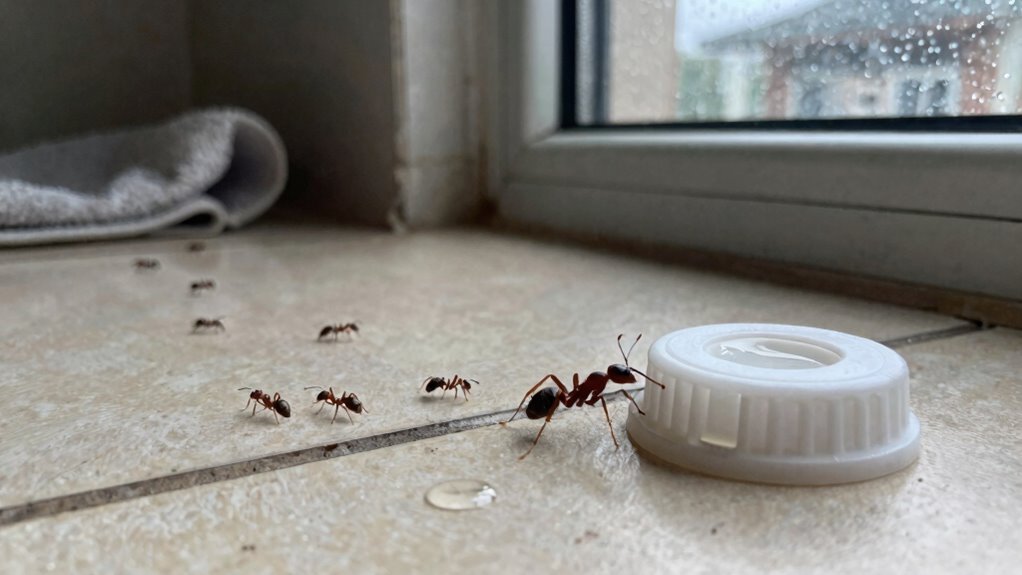
By day three to five of unbroken trails, the wait-and-wipe approach has proven its limits. That is your signal to switch tactics and deploy pest control baits.
Non-repellent gel baits are the right tool here, since they let foraging ants carry poison back to the hidden nest without spooking the colony. Give the bait a full two to three weeks to circulate before sealing any cracks.
Patience now beats spraying later, so trust the baiting process for long term ant control. This method targets the colony directly, making it a proven solution for eliminating infestations. For travelers concerned about household pests, similar principles apply when using travel-sized bed bug sprays that rely on non-repellent, long-lasting formulas.
Wait For Persistence
Waiting is the hardest part, especially when ants are parading across your kitchen counter like they own the place. Nevertheless, hasty baiting often backfires, so give trails three to five days to reveal their true nature.
Group behavior shifts happen as foragers either return outside or commit to indoor nesting. The outdoor recovery timeline usually resolves minor flooding quickly.
If lines persist past day five, they signal relocation, not mere scavenging. Consider these signs before taking further pest control action.
Trails remain heavy after three days of dry weather. Ants ignore wiped surfaces, forging new routes.
Multiple rooms show activity, not just the original entry point. Worker size or color changes suggest a different, possibly larger colony to treat.
Patience separates a one‑day nuisance from a structural problem worth baiting. Watching them march feels foolish, but timing is the real weapon for effective ant control.
For persistent trails, consider using a fast-acting contact spray to eliminate visible foragers before starting a baiting program.
Non-Repellent Gel Baits
Switching to non repellent gel bait after three to five days of persistent trails is like finally pulling the right tool from the drawer. This stuff does not scare ants off. It lets them eat, then waddle home, sharing the poison with the whole colony. When ants carry the imidacloprid back and share it with the queen, the Domino Effect eliminates the hidden nest.
Bait application methods matter. Squirt tiny dabs, pea sized, along trail intersections, not in thick globs. Placement beats volume. They will find it, trust me.
About gel bait storage. Keep tubes sealed in a cool, dry spot, away from heat or freezing. Spoiled bait gets ignored, which is just wasted effort.
A 30 gram tube runs about $8, covering a few rooms. Bottom line: patience, then precise dabs, with stored bait ready for round two if needed.
Allow Bait Spread Time
The bait is in place and the dabs are set along the trails. Now patience is your secret weapon for ant control success.
Wait at least 3 to 5 days after persistent trails appear before expecting results. Bait longevity means the gel stays fresh and tasty for weeks, so don’t rush to reapply.
Colony feedback is the key signal for effective pest elimination. Workers carry poison back, share it with nestmates, and the colony gradually declines.
Without enough time, you are just feeding the scouts. Ants eat bait then return for more over several days, spreading the poison deep into the nest.
Colony feedback builds as sick ants signal danger. This causes others to avoid food and die off naturally.
Bait longevity guarantees the gel remains effective for up to 14 days. Even in humid conditions, the formula stays potent for complete colony elimination.
Stop checking every hour and trust the process. Otherwise you will waste bait and confuse the colony during treatment.
Bottom line: let the bait work its magic for a full week. Judge the results only after giving the poison time to spread.
Seal the Tiny Cracks Ants Squeeze Through
How small is small? Tiny enough that an ant can squeeze through a gap as thin as a dime, just 1/16 of an inch. That is the scale of crack sealing needed for real ant exclusion.
A good tube of exterior-grade silicone caulk runs about $5 to $8 and seals foundation cracks, window frames, and plumbing penetrations. Check your foundation for hairline cracks, then fill them.
Don’t forget gaps around doors, thresholds, and utility lines. Water-damaged wood attracts carpenter ants, so swap rotted trim for pressure-treated lumber, which costs around $15 per board.
One missed gap defeats the whole effort. Ants don’t need a welcome mat, just a crack.
One missed gap defeats the whole effort. Ants don’t need a welcome mat, just a crack.
So inspect thoroughly, seal everything, and make them find another home. This complete pest control approach keeps ant infestations from taking hold.
Use silicone caulk to close every entry point you spot. For lasting results, focus on ant exclusion near plumbing and wiring openings.
Apply boric acid powder in cracks and behind appliances as a natural stomach poison that ants ingest during grooming, killing them within 24 to 72 hours.
Redirect Water and Clear Nesting Sites Around Your Yard
Dampness is the invitation ants can’t refuse. Rain soaked soil and soggy nesting spots force them to seek higher ground, your home.
Stop that by making your yard inhospitable to outdoor colonies. Gutter maintenance isn’t optional. Clogged gutters dump water right next to your foundation. This creates a swampy paradise for ants. Clean them out twice a year, or pay a pro around $100 to $200.
Grading repair means sloping soil away from the house. You need at least six inches of drop over ten feet. Fill low spots where puddles linger after storms. Ants love those mini lakes for moisture.
Move firewood, mulch, and compost piles at least three feet from the exterior. Those materials are five star ant hotels that invite infestation. Extend downspouts four feet from the foundation using flexible extensions. Dry ground means ants move on and look elsewhere for nesting sites. For added defense, consider a whole-home kit that creates a long-lasting barrier
When Rain Ants Relocate Indoors Permanently: Call a Pro
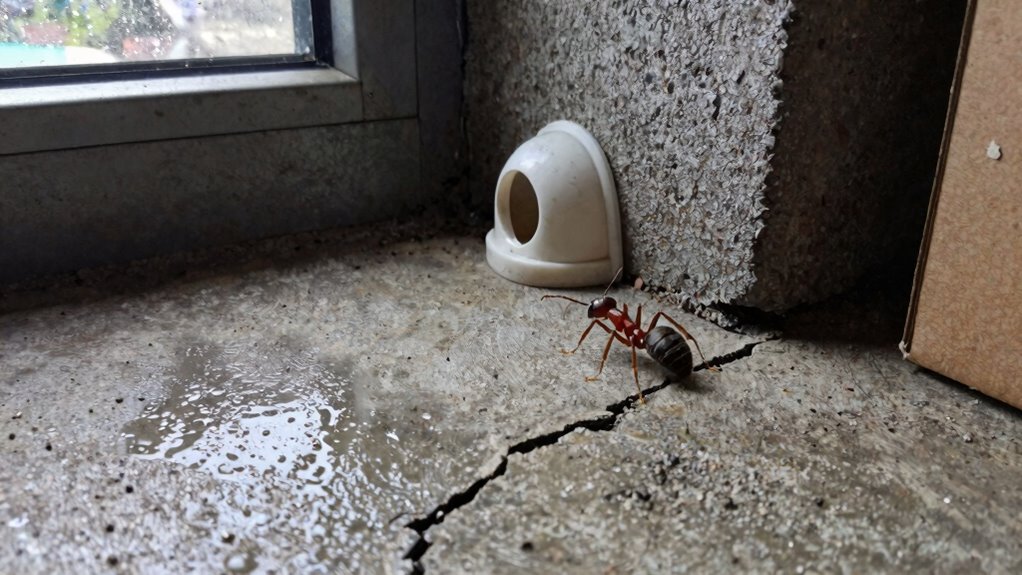
Once ants settle in, they don’t leave on their own. Call a pro, get a warranty, and sleep better knowing the colony is gone for good. For ongoing prevention, consider using a delayed-action formula like Advance Carpenter Ant Bait, which allows worker ants to carry the poison back to the nest to eliminate the queen and entire colony.
Frequently Asked Questions
Will Ants Eventually Leave on Their Own After Heavy Rain?
Most ants will leave on their own within 2 to 3 days after the rain stops. Their flooding behavior is temporary, they are just waiting for the soil to dry out.
But if you see ants in multiple rooms after day three, that signals colony relocation, not a visit. They have moved in and those ants won’t leave without help.
Can I Use Vinegar to Remove Ant Pheromone Trails?
Vinegar can disrupt ant trails, but its effectiveness is temporary. It removes the pheromone scent, confusing workers for a few hours.
This method won’t kill the colony or stop new scouts from re laying trails. Think of it as a quick mop up, not a long term pest control solution.
For persistent post rain invasions, you’ll want to use a targeted ant bait instead. Vinegar works best as a short term disruptor, wiping surfaces clean.
Expect ants to return once the smell fades, usually within a day. To buy real ant control products for lasting results, consider gel baits or granular treatments that target the nest.
Are Ants Attracted to Certain Indoor Foods After Rainfall?
After rain, ants show stronger sweet food preferences and seek moisture sources indoors. Crumbs of jelly, honey, or syrup become irresistible, as do leaky pipes or damp sponges.
Humidity drives them toward pet food left out, spilled soda, or even a forgotten banana peel. Check your kitchen’s damp spots first to find the colony trail.
Think of your home as a post storm snack bar for pest control needs. To stop ants, use gel baits or granular treatments near those sweet spills.
Sealing cracks and drying damp areas cuts off their water and food supply. For professional grade ant control, consider a bait station that targets the whole colony.
Manage those areas with routine cleaning and targeted pest control products. The party ends when you remove the food and moisture they crave.
How Do I Find Hidden Ant Nests Inside Walls?
Finding hidden ant nests inside walls requires patience and a sharp eye for moisture. Start by listening near baseboards at night for faint rustling, which often signals carpenter ants.
Inspect wall voids around water pipes, heaters, or leaky windows, since ants actively seek damp spots. Tap the walls gently; a hollow sound reveals empty spaces where colonies may be hiding.
Use a flashlight to spot tiny piles of sawdust or frass, which are telltale signs of active tunneling. After heavy rain, ants become desperate for dry shelter, so prioritize areas with poor ventilation.
For DIY pest control, consider using a moisture meter to confirm high humidity zones before drilling inspection holes. If you spot activity, inject a labeled ant bait gel or dust insecticide into the void for targeted elimination.
When buying products, look for non repellent termiticides or borate based dusts, as they work best inside enclosed wall cavities. Always pair treatments with sealing cracks and fixing leaks, otherwise the colony will simply relocate.
If the infestation persists, professional pest control services can use thermal imaging or borescopes to locate nests without cutting drywall. Remember, routine moisture control is your best long term defense against hidden ant colonies.
Does Diatomaceous Earth Effectively Kill Rain-Displaced Ants?
Diatomaceous earth works for killing ants but only if you apply it correctly on dry surfaces. This natural pest control powder kills ants by absorbing their waxy coating, which causes dehydration and death.
Rain or high humidity ruins DE’s ability to absorb moisture, so it becomes useless outdoors after storms. For rain-displaced ants that move indoors, dust DE into wall voids and along baseboards instead.
Wait until you see new ant trails and the surfaces are bone dry before applying. Application timing is everything with this product: apply too early and it clumps, apply too late and the colony moves deeper into your home.
A $10 bag offers decent spot control for small ant infestations but is not a full solution. To stop ants for good, combine DE with bait stations and outdoor perimeter treatments for complete pest management.


