
If you spot small brown bugs that look like cockroaches, don’t panic—they’re almost always harmless beetles. The real problem is knowing which is which, because the wrong ID can lead to wasted time and money on pest control.
In this guide, you’ll learn the three key markings that separate roaches from their look-alikes, plus how to identify the most common species. By the end, you’ll know exactly what you’re dealing with and what to do next.
Let’s start with the quickest way to tell them apart using just a magnifying glass.
At A Glance
- Lookalike beetles share oval, brown shapes but have short, clubbed antennae versus roaches’ long, threadlike ones.
- Check for a hidden head under a shield-like pronotum; beetles have visible, forward-facing heads with mandibles.
- True roaches are flat, oval, and under 10 mm usually means a non-roach insect.
- Field cockroaches (Ectobius) have a cream rim on their pronotum and never infest indoors.
- Roach legs have spines on the thigh; many look-alikes lack this distinct feature.
Why You Might Mistake a Small Brown Bug for a Cockroach
You’re looking at a small brown bug, your brain screams “cockroach,” and your hand is already reaching for the nearest shoe. This visual similarity triggers initial panic, but lookalike confusion is common among homeowners.
Many harmless beetles share that oval, brown shape, leading to pest misidentification during a DIY inspection. The Smoky brown cockroach nymph, for instance, has a whitish stripe on its thorax, not a roach’s uniform shell.
Many harmless beetles share that oval, brown shape, leading to pest misidentification during a DIY inspection.
Field cockroaches, genus *Ectobius*, are tiny with a yellow pronotum rim, details your panicked eye skips. Your brain sees “brown bug” and jumps to worst-case, but these lookalikes often prefer forests or gardens, not your kitchen.
They are just clumsy aerialists, not invaders that require pest control treatment. So pause, count legs (six), and check for antennae to confirm a real roach infestation before you grab the shoe. For thorough nighttime inspections, a 395nm UV light can reveal hidden pest traces like droppings or shed skins that confirm an infestation.
If you need help identifying pests in your home, professional pest control services can offer a thorough inspection. Accurate pest identification prevents unnecessary panic and ensures you use the right extermination methods.
What’s the Difference Between a Cockroach and a Beetle?
1. Antennae: Beetles have short, clubbed Antennae. Roaches sport long, threadlike ones that constantly twitch, which can help you spot an infestation early.
For effective pest control, recognizing these sensory differences is a smart first step before you call a professional exterminator. Sticky traps positioned along baseboards and corners can passively intercept wandering roaches without attracting more into your home.
2. Legs: Beetles have stout, grabbing Legs built for climbing and holding. Roaches have spiny, running legs that let them scatter at lightning speed.
This explains why roach control often requires fast-acting baits and crack-and-crevice treatments to catch them before they flee.
3. Head: Beetles have distinct, forward-facing heads with visible mandibles. Roaches hide theirs under a shield-like pronotum, which gives them a rounded, armored look.
If you’re dealing with a roach problem, that hidden head is a key sign you need targeted roach extermination services rather than a general bug spray.
Check your baseboards and kitchen cabinets for those twitching antennae or spiny legs.
For guaranteed removal, schedule a professional inspection and ask about long-term roach prevention plans.
How to Spot a True Cockroach by Its Body and Legs
True cockroaches have a flat, oval body that barely seems thicker than a credit card. This silhouette is rarely mimicked by beetles or other common household pests.
Check the legs carefully for reliable pest identification. A cockroach’s hind femurs are lined with stout spines, unlike the smooth legs of look-alikes.
If you see a flat body and spiny back legs, it is likely a true roach. No need to make a buggy mistake when selecting pest control treatments.
Identifying roaches accurately helps you choose the right solution. For effective roach extermination, focus on these key body features.
Once identified, using non-repellent indoxacarb baits ensures roaches consume the poison without detecting it, allowing for complete colony elimination.
Body Shape Clues
Examine the body shape closely, since a true cockroach has a distinct silhouette that many look-alikes fail to mimic perfectly. A cockroach’s body is flat, oval, and sleek, built for squeezing into tight cracks.
Three key clues stand out for effective pest control identification. First, the hind leg shape: true cockroaches have long, spiny legs that angle backward, helping them scurry fast, while look-alikes often have stubbier legs.
Second, check the wing position. In adults, wings lie flat across the back, overlapping tightly, and smoky brown cockroaches have wings covering the entire abdomen.
Brown-banded males also have full coverage, but females’ wings stop short. Third, examine the pronotum shield: that large, curved plate behind the head is usually wider than the head itself, a roach hallmark you can spot easily.
Use these clues to confirm an infestation before choosing a treatment. Spotting these signs helps you buy the right pest control products for quick results. After identifying a pest, use six-sided zippers with fully sealed encasements to trap and starve any remaining insects.
Leg Spine Check
A quick look at the legs can settle the roach or imposter debate faster than a sticky trap. True cockroaches have six legs, which is the standard pest leg count.
The real clue is the spines on the thigh. Many look-alikes, like Ectobius species, have heavy spines on the bottom of the front thigh.
This feature is a dead giveaway for a roach imposter during a leg spine check. Cockroaches have smoother legs with only tiny, barely-there hairs.
Also, check the eye shape during your pest inspection. True roaches have large, kidney-shaped eyes for easy identification.
Look-alikes often have rounder, simpler eyes to confuse homeowners. For effective cockroach control, always verify these key traits. Super sticky glue traps provide a non-toxic way to catch these pests for easy identification.
Three Markings That Confirm It’s a Cockroach
Cockroaches have a few reliable trademarks, and if you spot them, you can stop guessing. These three markings seal the deal with no need for a magnifying glass, just sharp eyes.
One key identification feature is the leg spine anatomy. Look for conspicuous spines on the ventroposterior margin of the front femur, which is the lower back edge of the thigh. This is a roach giveaway and not a beetle trick.
The egg case, called an ootheca, is a dead giveaway for pest control professionals. A dark brown, blunt pointed ootheca larger than a penny means a smoky brown or American roach laid it. No other household bug produces that structure.
The pronotum shield is the plate directly behind the head. It is smooth and uniformly colored with no translucent rim or yellow bands. If it appears glossy black or mahogany, you have a real roach and not a look alike.
Bottom line for roach removal: these three marks are your positive ID. Spot them and you have a genuine pest infestation.
Smoky Brown Cockroach: The Shiny Impersonator

Identifying the smoky brown cockroach is a good place to start, as it is the one most often mistaken for a small brown beetle. This pest control target is a true roach, uniformly shiny mahogany, about an inch and a half long by adulthood.
Their habitat is your clue. They love warm, humid spots like tree holes, mulch piles, and damp attics, not dry homes.
The nymphs start black with tiny white markings on the thorax, fading as they grow. That is a dead giveaway if you spot them during an inspection.
The nymphs start black with tiny white markings on the thorax, a dead giveaway during inspection.
They are nocturnal, so you will find them scurrying at night, not sunbathing. If you need effective treatment, focus on moisture reduction and sealing entry points, or use fipronil-based gels for fast knockdown and residual protection.
Bottom line: That shiny, uniform bug in your mulch is almost definitely a smoky brown roach, not a beetle. Check those nymph white markings to be positive and confirm your infestation.
Brown-Banded Cockroach: Tiny, Striped, and Easy to Overlook
The brown-banded cockroach is often the one you barely notice until it’s too late. At just half an inch, it’s small, but those two pale bands across its wings make it a stripy little troublemaker.
Unlike its bigger cousins, it doesn’t crave dampness. It’s a dry-heat fanatic, which is key to its indoor habitat preferences.
It will happily live high in cabinets, behind picture frames, or inside electronics. No damp basement for this guy, so control methods must target those warm, hidden spots.
Surface sprays alone won’t cut it for effective pest control. It glues egg cases to furniture, not floors.
It’s nocturnal, so you’ll see droppings, not roaches. Any crack above 80°F is prime real estate for an infestation.
Forget sticky traps as a fix. They are just census takers, not a solution for roach elimination.
Vacuum thoroughly, then use gel baits near wall voids. Gel bait formulas often include insect growth regulators to prevent population resurgence, making them essential for this species. It’s a slow war, but you can win with targeted treatment.
Field Cockroaches: Tiny Forest Species That Invade Homes
That shield-like plate behind the head sets them apart from glossier smoky brown or striped brown-banded species. Inside a home, they pose no real infestation risk and only cause a brief, harmless encounter.
These bugs lack the breeding drive to colonize your kitchen, so professional pest control is rarely needed. If you spot one, simple home pest prevention like sealing cracks will keep them out. For persistent infestations, homeowners might consider using first-generation anticoagulant baits like diphacinone for safer multi-day control.
For effective pest management, just sweep or vacuum any accidental visitors. Their presence is more of a curiosity than a threat to your pest extermination routine.
Physical Features
Though they share a name that suggests fields, these Ectobius cockroaches are actually tiny forest dwellers that occasionally wander indoors. Their physical features are distinct, and you’ll need to spot them to avoid confusion with other common roach species.
Key traits include a dark brown or black pronotum plate behind the head, often with a cream or translucent rim. This pattern differs from the uniform look of smoky brown roaches.
Look for a row of conspicuous spines on the thigh’s rear edge as a key ID trick for accurate pest identification. Their tiny size, typically under ½ inch, makes them smaller than most look-alikes you might encounter during a home inspection.
Their geographic distribution is limited to parts of North America, mostly northern states and Canada. Seasonal activity peaks in late spring and summer when they wander indoors from forest edges.
They are not the roach you are used to. Think of them more like a confused hiker who needs a season-long control option to stay outside your kitchen.
Indoor Encounter Risks
Infestation anxiety spikes when a tiny Ectobius cockroach appears on your kitchen counter. Unlike smoky brown or brown banded roaches, field cockroaches don’t breed indoors.
They wander in from leaf litter or firewood. Still, their presence signals potential health hazards.
They may carry bacteria from soil and decaying plants onto food prep surfaces. For severe indoor populations, professionals can apply imidacloprid-based gel baits to eliminate these invaders through ingestion and secondary kill. Standard pest control methods work: seal cracks, trim vegetation touching the house, and remove mulch near foundations.
A professional can treat perimeter zones with residual sprays for about $150 to $300. Vacuuming stragglers helps, but don’t panic.
They won’t colonize your pantry. Just scoop up the invader, release it outside, and give your entry points a quick inspection.
The verdict is that Ectobius visits are annoying, not apocalyptic. For ongoing prevention, consider a home pest control plan with regular perimeter treatments.
Where Small Brown Bugs vs. Cockroaches Actually Live
A smoky brown cockroach’s preferred address is your attic, gutter, or a pile of damp mulch. These warm, humid, dark spots make them the headliners of household pest problems.
Small brown bugs like field cockroaches (Ectobius) are more like indie bands playing in forests and grasslands. Urban habitat overlap is common, though, so roaches sneak into kitchens while look-alikes often get lost indoors by accident.
Light attraction differences matter too, since true cockroaches hate light and flee at the flick of a switch. Field roaches, however, buzz around porch lamps like they’re at a disco, which is a handy clue for identification.
Key habitat distinctions help you target your pest control efforts. Smoky brown roaches love attics, gutters, and damp mulch, so inspect those moisture-heavy zones first.
Key habitat distinctions help you target your pest control efforts.
Brown-banded roaches prefer greenhouses and gardens, not your kitchen, which changes your baiting and trapping strategy. Field roaches stick to dead leaves, grass, and scrubby woodland margins, so they rarely require chemical treatments.
If you find a brown bug near moisture or clutter, it’s likely a roach, and you should consider professional pest control or targeted roach baits. If it’s near plants or windows, it’s probably a harmless mimic, so you can skip the insecticide and just seal entry points.
Know your locale to save your sanity, and use a flashlight to check dark crevices before assuming an infestation. For persistent issues, a local exterminator can confirm species and apply the right product for bed bug or roach elimination.
Monitor damp basements, under sinks, and along baseboards for droppings or egg cases, since these are strong signs of a true cockroach problem. If you see scattered wings or a musty odor, call a pest management service for a thorough treatment plan.
For true roach problems, bait stations with fipronil deliver a lethal ripple effect that eliminates colonies within hours and lingers for months.
Egg Cases and Nymphs: Quick ID Clues
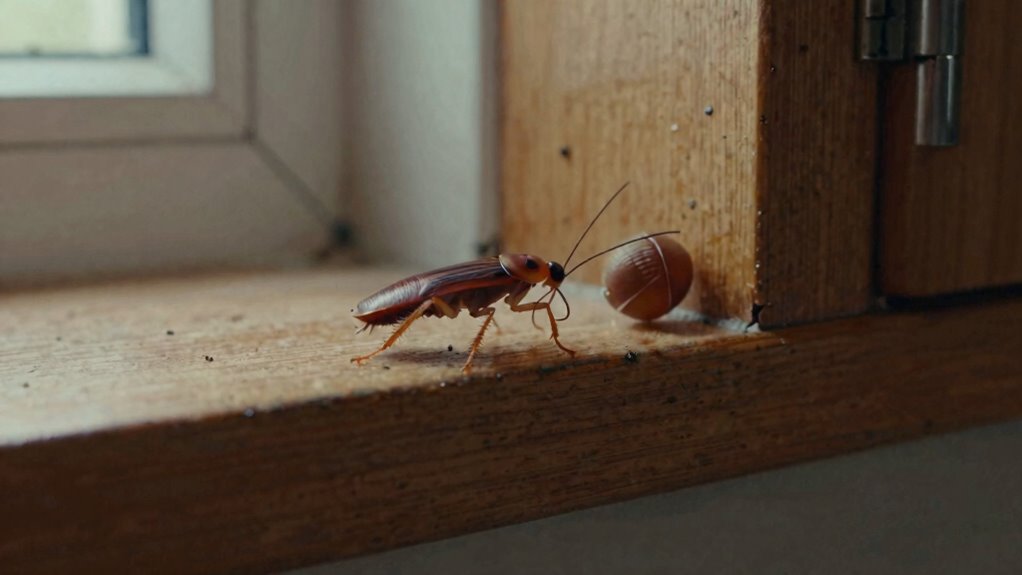
Early instar nymphs offer quick clues for pest control identification. Smoky brown nymphs are black with white markings on thorax and antennae tips.
Brown-banded nymphs lack wings but show brown-yellow patterns with light bands. Ectobius nymphs are smaller, often with translucent rims.
Check for spines on leg femurs. Ectobius species have them but roaches do not. Spot the pattern, size, and case texture fast.
This method beats smashing every brown bug you find. It is not rocket science for effective roach treatment. Use these tips for accurate pest inspection and targeted removal. For long-lasting control in damp areas, waterproof deltamethrin dusts can be applied to cracks and crevices where nymphs hide.
Why Size and Antennae Matter for Identification
Size and antennae offer two quick, measurable clues that separate a true cockroach from its innocent impostors. A standard ruler beats a guessing game, since most roach look alikes like Ectobius species stay under 12 mm. Smoky brown adults stretch to 38 mm, a gap you can feel in your hand. Antennae shape adds the punchline: roaches brandish long, threadlike filaments that sweep backward. Beetles often carry clubbed or elbowed versions instead. A magnifying glass and a steady thumb can settle the argument in seconds. For reliable pest control identification, these physical traits help you decide if professional treatment is needed. Knowing the difference saves time and prevents unnecessary spraying on harmless insects. Boric acid acts as a safe stomach poison that eliminates the nest once ants transport the powder back to the colony.
Measuring Body Length
Measuring body length is tricky because antennae, which are often longer than the body, can fool your eye. Most look‑alikes measure under an inch, but getting the exact size matters when checking against known roach sizes.
Smoky brown cockroaches reach up to 38 mm, while brown‑banded adults top out at about half an inch. Field cockroaches, or Ectobius species, are even smaller and rarely exceed 12 mm.
Nymphs of any species shrink that range further, so a 3 mm bug is likely not a roach. Focus on the body alone and ignore those wispy antennae.
This length directly relates to life cycle stage and habitat preferences. Nymphs stay tiny in damp hideouts, and adults grow larger in warm attics.
A tape measure or ruler beats guesswork for accurate pest control identification. If the bug is under 10 mm, you are probably looking at something else.
Use this guide to confirm whether you need professional pest treatment. Quick measurements help you choose the right pest management approach for your home. For comparison, fungus gnats are tiny flying insects under 3 mm that are attracted to bright yellow sticky traps placed at soil level.
Antennae Shape Clues
Two antennae can tell you more than a ruler for pest identification. Size matters, but antenna length differences are the real giveaway for roach control.
Cockroaches have long, whip-like antennae, often longer than their body. Look-alikes like ground beetles have shorter, thicker ones.
The segmented antenna structure is key for accurate pest inspection. Each segment is visible, like a tiny, bendy straw.
Smoky brown cockroach nymphs even have white antennae tips early on. Brown-banded roaches have plain brown antennae instead.
Ectobius species have similar length but thinner antennae for comparison. A ruler gets you close, but antennae get you exact for roach elimination.
It is like comparing a garden hose to a drinking straw. Both are flexible, but one is for washing the car and the other for lemonade.
Check the antennae first for professional pest removal. It saves the guesswork and your sanity during home pest control.
Common Beetles That Fool Homeowners
Homeowners often mistake several beetles for cockroaches, a mix up that can lead to unnecessary panic. These beetles share similar brown coloring and oval bodies, but their habits differ.
For example, carpet beetles leave tiny fuzzy larvae skins, not the familiar egg casings you would find with roaches. Click beetles snap and flip when disturbed, a far cry from common nymph behavior seen in true cockroaches.
Here are three key giveaways for professional pest identification. First, long antennae or not, beetles have short clubbed antennae while roaches whip long thin ones.
Second, wing folding shows beetles fold wings straight down their back, but roaches overlap them flat. Third, leg shape reveals beetle legs are thick ending in claws, while roach legs are spiny and slender.
If it jumps or clicks, it is likely a beetle. No fluttering panic needed, just a broom for simple home pest control.
Quick ID Guide to Tell Small Brown Bugs Apart
Start by checking three simple features to identify small brown bugs: leg spines, antenna length, and wing patterns. Field cockroaches like *Ectobius* species have obvious spines on their front legs, which sets them apart from pests.
Smoky brown and brown-banded roaches have no leg spines and their antennae are longer than their bodies. If you spot short, feathery antennae, you are likely looking at a beetle instead of a roach.
Wing patterns give you the final clue for accurate pest identification. Brown-banded males have full wings, but females only cover half their back.
Check a suspected smoky brown nymph for a white stripe on its thorax. That stripe confirms it is a roach, not a beetle, and helps you avoid unnecessary pest control treatments.
Leg spines are your best sign of a harmless field roach that stays outdoors. This quick check prevents confusion and helps you focus on real pest problems in your home.
Frequently Asked Questions
Can Ectobius Cockroaches Infest Homes Like Other Roaches?
No, Ectobius cockroaches do not infest homes like other roach species. Their natural habitat is strictly outdoors in forests, moorlands, and grasslands under dead leaves or moss.
Unlike smoky brown roaches that invade attics and kitchens, Ectobius species only wander inside by accident. For effective outdoor cockroach control, focus on sealing gaps near foundations and entry points.
These bugs rarely survive indoors because they lack the adaptations for indoor living. So skip the panic and the expensive pest control treatments.
Think of them as clumsy tourists that got lost on their way to the garden. If you spot one, simply sweep it outside rather than reaching for roach baits or sprays.
For homeowners worried about real infestations, focus on exclusion methods around doors and windows. You can also use granular insecticides along the perimeter for prevention.
Ectobius cockroaches are not a threat to your pantry or your peace of mind. Buy a simple door sweep or caulking gun instead of calling an exterminator.
These bugs are a sign of a healthy outdoor ecosystem, not a home invasion. Save your budget for pests that actually breed inside like German or American cockroaches.
Do Smoky Brown Cockroaches Fly?
Yes, the smoky brown cockroach can fly and is a strong flier on warm, humid nights. This flying behavior is most common in summer when they search for food or mates.
If you see one flying indoors, it is often attracted to light, so check your gutters and outdoor lighting. For effective smoky brown roach control, start by sealing entry points and reducing moisture around your home.
Professional pest control treatments can target these flying roaches before they become a full infestation. You can outrun them, but a preventive spray or bait station is a smarter purchase for long term protection.
How Can I Tell a Brown-Banded Cockroach From a Beetle?
A brown-banded cockroach is easy to distinguish from a beetle by its antenna length and leg shape. The roach’s antennae are long, thin, and whip-like, often exceeding its body length, while beetles have short, segmented antennae.
The roach’s legs are spiny and uniform, whereas beetles have smooth, clubbed hind legs designed for jumping. Another key difference: beetles have hard, shell-like front wings that meet in a straight line down the back, but roach wings overlap.
If you’re dealing with a suspected infestation, knowing these clues helps you choose the right pest control treatment. For effective brown-banded roach elimination, look for gel baits or insect growth regulators specifically labeled for cockroaches.
Buying a targeted spray or bait station is your best bet for quick results. Check these visual cues, and you’ll avoid mistaking one pest for the other, saving time and money on the wrong product.
Are Field Cockroaches Harmful to Indoor Environments?
Field cockroaches are not harmful to indoor environments and pose no real pest control threat inside your home. Their two year field cockroach lifespan is spent entirely outdoors in forests, grasslands, and under dead leaves.
Unlike common indoor pests like German cockroaches, they rarely enter houses and cannot establish an infestation. If one wanders inside by accident, it will not reproduce or spread disease indoors.
That means you do not need to buy insecticides or call an exterminator for these outdoor critters. For effective pest management, focus your prevention efforts on species that actually invade your kitchen or bathroom.
Leave field cockroaches alone outside and they will stay out of trouble. If you need proven indoor pest control solutions, look for products labeled for roach baiting or crack and crevice treatments instead.
What Attracts Smoky Brown Cockroaches to Attics and Gutters?
Smoky brown cockroaches are drawn to attics and gutters primarily by moisture, decaying organic matter, and outdoor lighting. These warm, humid zones serve as perfect harborage sites for nocturnal pests that need high humidity to survive.
Gutters trap rainwater, leaves, and debris, which creates a consistently damp breeding ground that roaches find irresistible. Attics, especially those with leaky roofs or poor ventilation, mimic the humid tree hollows these roaches naturally prefer.
If you have outdoor lighting near your roofline, it will attract these flying roaches at night, and they often slip under shingles or loose siding to get inside. Once they establish a foothold in your gutters, it’s only a matter of time before they migrate into your attic and then into your living spaces.
To prevent a smoky brown cockroach infestation, start by cleaning gutters regularly and ensuring downspouts drain away from the foundation. Fix any roof leaks promptly and install attic ventilation to reduce moisture buildup that invites these pests.
Trim back tree limbs that overhang or touch your roof, as these act as bridges for roaches moving from foliage to your eaves. For active problems, use a quality insecticide bait or granular treatment specifically labeled for cockroaches around the roofline and gutter system.
You can also apply a residual perimeter spray around the attic entry points and gutter edges for longer-lasting control. If you’re dealing with a heavy infestation, consider hiring a licensed pest control professional to inspect and treat these hard-to-reach areas safely.
The key is to remove the moisture source first, because no amount of spraying will work if the environment stays humid. Pair that with targeted roach baits, and you’ll starve out the population instead of just chasing them around.
Smoky brown roaches are strong fliers, so don’t assume they only come from the ground; they can easily enter from roof vents, soffits, or ripped screens. Check your attic for water stains and condensation on pipes, and wipe down any damp wood to reduce the appeal.
Use a dehumidifier in the attic if your climate is especially muggy, and swap out bright white outdoor bulbs for yellow or sodium vapor lights that are less attractive to insects. When you buy pest control products, look for ones with active ingredients like fipronil, hydramethylnon, or boric acid, as these are proven against smoky brown roaches.
Read the label to confirm the product is safe for attics and outdoor use, especially if you have pets or kids. A well-sealed home is your best defense, so caulk gaps around utility lines, vents, and roof flashing to block their entry routes.
For ongoing protection, schedule a monthly roof and gutter inspection during warm, rainy seasons when these roaches breed most actively. Ultimately, the smartest purchase is a combination of moisture control, exclusion, and a high-quality cockroach bait that targets the entire colony.


