
The “common house spider” actually refers to two very different pests. The American version is a tiny, marble-shaped cobweb weaver that hangs upside-down in messy tangles, while the UK version is larger and builds flat funnel webs near baseboards. Neither species is dangerous, but knowing which one you’re dealing with makes pest control faster and more effective. The American spider plays dead when disturbed; the UK one bolts for cover. This guide covers how to identify them at a glance, plus simple tips to keep them out of your home. Read on for the specifics that make spider control straightforward.
At A Glance
- US species has bulbous abdomen; UK species has elongated, flattened oval abdomen.
- US species builds messy, 3D tangle webs; UK species builds sheet-like funnel webs.
- US species drops and plays dead; UK species runs fast when disturbed.
- Female US body length 5–8 mm; female UK body length 7–11 mm.
- Both species have mild venom; bites are rare and not medically concerning.
What Is a Common House Spider, Really?
The common house spider isn’t one single species. It’s actually two distinct spiders that barely know each other.
In the US, you’ll find *Parasteatoda tepidariorum*, a tiny cobweb weaver that looks like a marble on legs.
Across the Atlantic, the UK’s *Tegenaria domestica* is a bigger, brown funnel weaver.
They diverged so long ago the fossil record can’t even agree on a common ancestor.
Their venom composition differs too. Both are mild, but the US species’ venom is slightly weaker, barely a pinprick to humans.
Think of them as distant cousins who never attended the same family reunion.
If you need pest control, knowing which spider you’re dealing with helps determine the right treatment, such as whether to use natural plant-based sprays that offer up to 90 days of residual protection.
One name, two distinct spiders.
One name, two distinct spiders. Don’t assume yours is the same as theirs.
Don’t assume your house spider is the same as your mate’s in London.
They are strangers with webs, so call a pro if you want effective removal.
US vs. UK Common House Spiders: Key Differences
Across the pond, the name “common house spider” refers to two very different roommates. In the US, it is *Parasteatoda tepidariorum*, a small tan cobweb weaver. In the UK, it is *Tegenaria domestica*, a larger brown funnel weaver. Species misidentification runs rampant since both are called common, but they are not even in the same spider family. Their geographical distribution explains the mix-up. Each evolved locally and then hitched global rides.
The US version stays small with a bulbous abdomen. It builds messy tangle webs that catch dust and pests alike. When threatened, it drops and plays dead. For pest control, this spider is a helpful ally against flies and ants.
The UK version grows larger with an elongated body. It creates sheet-like funnel webs near baseboards and corners. It runs fast when disturbed, which can startle homeowners.
Neither spider poses a medical worry, though the UK one looks scarier. If you need spider removal, identifying the species helps choose the right treatment. Both are harmless, but their webs can indicate a larger pest problem. For example, natural spider repellents like peppermint-based sprays or pouches can help manage infestations.
Common House Spider Size, Color, and Shape
Adult female American house spiders measure 5 to 8 mm in body length, while males are noticeably smaller at 3 to 5 mm. Their round, high-set abdomen looks like a tiny marble perched on legs, which makes them easy to spot during a routine pest inspection.
The mottled pattern of faint chevrons or speckles on that bulbous back helps pest control professionals tell them apart from slimmer look alike species. If you are dealing with these spiders indoors, knowing their size and shape is a useful first step for identifying a potential infestation.
For homeowners seeking effective spider control, the female’s nearly spherical body is a key visual cue during a quick room check. Recognizing this common house spider’s silhouette can help you decide whether to call in an exterminator or handle it with targeted pest management products.
Their compact body and short legs mean they often hide in corners, ceilings, and behind furniture, which matters for any DIY treatment plan. A quick look at their chevron markings and small size will prevent you from confusing them with more dangerous species like the brown recluse.
If you want reliable removal tips, focus on sealing cracks and reducing clutter, since these spiders thrive in undisturbed areas. That simple approach, paired with regular vacuuming, can lower the chance of a recurring home invasion, and applying diatomaceous earth in cracks adds a non-toxic barrier against them.
Size Variation
| Species | Female Body Length | Male Body Length |
|---|---|---|
| *P. tepidariorum* (US) | 5–8 mm | 3–5 mm |
| *T. domestica* (UK) | 7–11 mm | 6–9 mm |
| Leg span (US) | 15–20 mm | 12–15 mm |
| Leg span (UK) | 25–30 mm | 20–25 mm |
The leg span ratio is higher in *T. domestica*, giving it a leggier, scarier look. This difference matters if you are trying to identify a common house spider for effective pest control.
In both species, males have thinner bodies and longer legs relative to their size. Nature’s way of saying the male is here to mate, not to hunt for food.
Most people do not notice the difference until a larger one sprints across the floor. For quick spider removal tips, focus on females, which are bulkier and more likely to stay near their web.
If you need professional pest management, knowing these size cues helps you describe the intruder accurately. Buyers often request targeted treatments for *T. domestica* because its longer legs make it appear more threatening.
For effective capture, use non-toxic glue traps that are safe around children and pets.
Abdomen Shape & Pattern
The abdomen is the telltale feature for identifying these common house spiders. In the American house spider, it is bulbous, nearly spherical, and set high, creating that classic marble on legs silhouette.
Abdomen coloration runs from pale tan to dark brown, often with faint, mottled patterns across the top. Look carefully, and you might spot chevron markings pointing toward the spinnerets, like tiny arrows saying this way out.
It is not dramatic, but it is diagnostic for reliable pest identification. *Parasteatoda tepidariorum* is not flashy, just dependable for knowing your home invader.
For the UK version, *Tegenaria domestica*, the abdomen is longer and less round, shaped more like a flattened oval. Both use these subtle patterns, though American house spiders keep theirs softer.
Either way, if the abdomen looks like a tiny, patterned marble perched on legs, you have likely found your culprit. Bottom line, shape and pattern together seal the ID for effective spider control. For those seeking added prevention, consider pairing identification with natural peppermint oil sprays as a safe, chemical-free deterrent.
Why the Bulbous Abdomen Is a Dead Giveaway
The bulbous abdomen is the spider’s most telling feature, a nearly spherical body perched high above the legs like a marble on stilts. This shape, combined with a pale-tan to dark-brown color and faint chevron pattern, separates it from look-alikes at a glance.
When the spider rests upside-down in its cobweb, legs splayed to feel vibrations, that round silhouette is a dead giveaway for identifying a common house spider. You do not need to get closer to confirm what you are dealing with, which makes pest control faster and safer for your home.
Spotting this round body early helps you decide on targeted spider removal before an infestation spreads. If you see that distinct marble-like form in a web corner, it is a clear signal to call a local exterminator for a professional inspection.
Knowing this trait also helps you avoid unnecessary sprays, since you can tell the harmless look-alikes apart from the ones that warrant treatment. For ongoing prevention, sealing cracks and reducing clutter near webs will discourage these eight-legged visitors from settling in, and you can also place natural plant-based repellent pouches in corners or along baseboards for chemical-free, long-lasting spider deterrence.
A quick glance at that round silhouette saves you time and worry, especially when you are checking basements or garages for activity. That familiar shape is your cue to schedule a routine pest management service and keep your living spaces spider-free.
Size and Shape
Seeing a small brown spider clinging to your ceiling corner might make you wonder if it’s dangerous, but one look at its body shape tells the story.
The bulbous abdomen, nearly spherical and perched high like a marble on legs, is the dead giveaway.
Genetic diversity across regions hasn’t changed this core silhouette.
Females run 5–8 mm, with males slimmer at 3–5 mm, and that round rear end does the heavy lifting for web mechanics.
It’s not just decoration.
That plump shape houses silk glands and digestive machinery, letting them hang upside-down and fling sticky threads with precision.
Size varies slightly, but the bulbous form is non-negotiable.
If you spot a pest with that round, globular abdomen, you are looking at a harmless house spider, not a threat.
For effective pest control, knowing this simple body shape can help you avoid unnecessary worry.
If you need professional inspection or removal services, look for local exterminators who target invasive species.
For continuous monitoring, consider using non-toxic glue traps that last up to three months without chemical footprints.
Color and Pattern
Color, for the common house spider, is less a fixed trait and more a suggestion. That bulbous abdomen ranges from pale tan to dark brown, often with faint chevron or mottling across the top.
Males are slimmer and darker, but pattern varies so much you cannot rely on shade alone for pest control identification. Instead, focus on body shape: a nearly spherical abdomen perched high like a marble on legs.
Fresh web silk appears white, aging to gray in dusty corners where you might need to treat an infestation. Web architecture comparison helps: cobwebs are messy 3D tangles with upper retreat zones, not flat funnels.
For those looking to remove these pests, sticky traps can catch spiders alongside cockroaches and ants, offering long-lasting effectiveness and child-safe adhesive.
Resting Posture
From its upside-down perch inside a messy tangle web, the common house spider gives a dead giveaway. You will see a nearly spherical abdomen sitting high above its legs, like a marble balanced on toothpicks.
This resting posture makes immediate identification easy, with no second guessing needed. The spider relies on vibration detection through web threads because its vision is limited.
Its calm, patient demeanor hints at surprising spider intelligence for trap placement. A few clues cement the identification.
It always hangs inverted with legs splayed like a starfish, ready to sense prey. The abdomen is round and prominent, not elongated like cellar spiders.
The spider stays motionless for hours and plays dead when dropped, acting dumber than it looks. Pest control professionals note that messy cobwebs in dark corners are a key sign, never neat sheets or funnels.
Spot that marble on toothpicks silhouette? That is your confirmation for targeted pest removal.
Where Common House Spiders Build Their Cobwebs
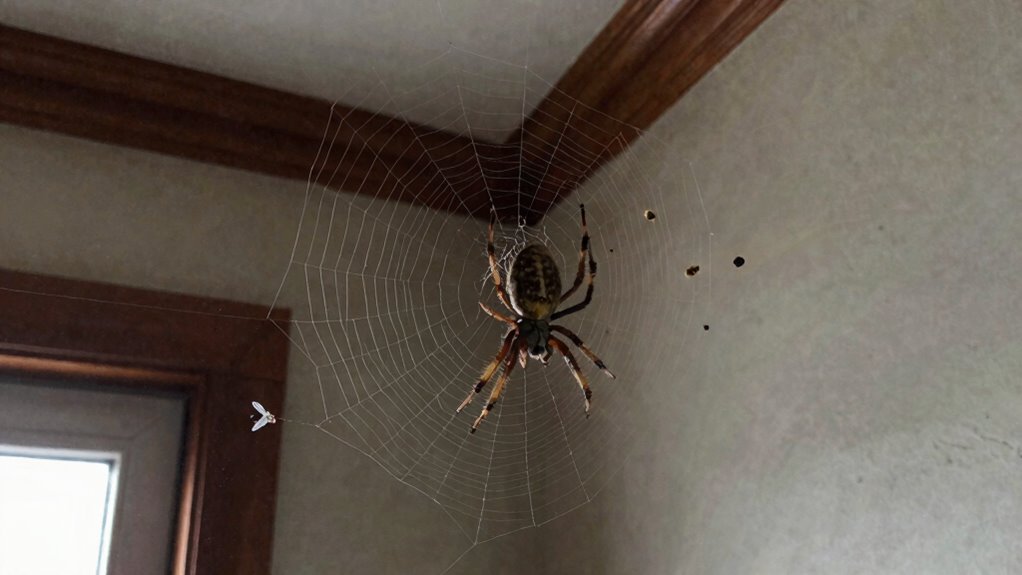
The domestic geography of a common house spider is less about aesthetics and more about survival. Think of it as a strategic real estate choice for pest control.
Web placement is never random. You will find the tangle structure in ceiling corners, behind furniture, or near window frames where airflow and insect traffic are highest.
Basements, garages, and sheds are prime spots, especially where clutter offers anchor points. The web itself is not pretty. It is a messy 3D maze with a cramped retreat up top where the spider waits upside-down.
Lower gum-foot threads catch prey with glue droplets near the floor. Hot, dry winters push these spiders indoors, so check your storage boxes for hidden webs.
Egg sacs, tan and round, hang right in the web. For additional control, you can dust diatomaceous earth along baseboards and corners where spiders travel. Bottom line, they pick spots where they can eat, not decorate, which is why professional pest control services can help manage spider infestations.
Common House Spider Behavior You’ll Notice
Why does a common house spider seem so lazy, hanging motionless for hours in a dusty corner? It’s not lazy. It’s an ambush engineer.
This spider waits upside down in its tangled cobweb, legs splayed like trip wires. The moment vibration hits a gum foot thread, it springs into action.
Using a comb of bristles on its rear foot, it hurls sticky silk strands over prey like a tiny web slinging cowboy. Disturbed? It drops from its web, curling up motionless on the floor for minutes.
A surprisingly dramatic performance, but effective for avoiding threats. Females stay glued to their tan, round egg sacs, rarely leaving them alone until dark.
It violently shakes the entire web when a larger intruder gets tangled. This startles them away without a fight, acting as a smart, natural pest control solution. For homeowners seeking additional exclusion methods, rust-resistant stainless steel wool works well for sealing gaps around pipes and vents.
If you want low energy pest management in your home, let this worker handle it. It’s efficient and harmless to humans.
Are Common House Spiders Dangerous?
Common house spiders are not a threat to humans when it comes to household pest control. Their venom is mild, comparable to a bee sting at worst, and bites are very rare.
Bites usually only happen if the spider is accidentally pressed against skin. No special first aid is required beyond soap, water, and ice for itching.
Medical treatment is unnecessary for healthy adults, so you don’t need to worry about professional pest control for them. These spiders actually help reduce unwanted insects in your home. If you do want to remove them, simple catch and release is safe for you and the spider. For a spider infestation, a local exterminator can provide targeted pest removal solutions, though using non-toxic glue traps can serve as a safe, pesticide-free alternative for incidental capture.
Venom Potency Explained
Common house spiders are not dangerous. Their venom is mild and causes only short-lived local irritation.
Extensive venom research places them far below black widows or brown recluses. A house spider bite is less annoying than an itchy mosquito bite.
Their venom contains simple neurotoxins for small insects only. It lacks the complex proteins needed to harm human tissue.
No deaths or severe allergic reactions have been documented from their bites. At worst you might see a tiny red mark with brief mild itching.
That reaction resolves within hours without any medical pest control treatment. For first aid just use soap and water or an ice cube for comfort.
You do not need a doctor visit for this bite. Effective spider control keeps your home bite free, and plant-based formulas using oils like peppermint or lemongrass are safe to use around pets as a repellent.
Extremely Rare Bites
How exactly does a common house spider end up biting someone? The scenario is almost comically specific: the spider must be pressed against skin, trapped inside a shirt sleeve, a glove, or tangled in bedding.
It does not hunt people. It bites out of sheer panic, a last resort defense.
The bite itself feels like a mild pinprick. It produces a tiny red mark and brief itch that resolves within hours.
Venom is very mild. It is not a human threat for healthy adults.
Public perception gives this spider a villainous reputation it does not deserve. The reality is far less dramatic.
Most bites are dry. The spider’s primary goal is escaping, not attacking.
So, are common house spiders dangerous? No, they are not.
The biggest risk is probably a bruised ego from overreacting to a harmless roommate. For effective pest control, focus on sealing entry points and reducing clutter, and consider using a natural mineral powder around perimeters as a non-toxic barrier.
First Aid Not Required
Not a single first‑aid kit exists with a “spider bite” card inside, and that’s fine. These spiders pose no real danger.
Their venom is mild, bites are rare, and symptoms fade fast. For healthy adults, the biggest risk is startling yourself.
A bite feels like a mild pinprick, less painful than a bee sting, and itches briefly. No special first aid is needed; soap, water, and an ice cube handle it completely.
They’re unsung allies in pest management, eating flies, moths, and ants for free. That natural pest control means fewer crawling insects inside your home.
Their habitat preference, garages, basements, and corners, keeps them away from people. So you rarely need spider removal services for these species.
A spider that plays dead when disturbed isn’t a threat worth worrying about. Wash the spot, grab a cold drink, and let it keep catching bugs.
That’s the entire treatment plan, no sprays, no traps, no urgent calls. Just simple home pest control with zero stress.
For long-term prevention against any other pests they miss, diatomaceous earth provides a non-toxic physical barrier that dehydrates crawling insects on contact.
What Common House Spider Egg Sacs Look Like

Fortunately, a spider’s maternal instincts are not subtle. You will know a common house spider egg sac when you see one.
It is a tan or pale brown sphere about the size of a small pea. This sac often dangles in the web’s upper retreat area.
These sacs measure roughly 6 to 9 millimeters across. They hold 100 to 400 eggs.
You might spot them near corners mixed into the messy cobweb. That web additionally supports the spider’s prey wrapping behavior.
The sac’s texture is papery, not sticky. It is anchored by a few silk strands.
The color ranges from tan to pale brown. It sometimes gets slightly darker as the sac ages.
The shape is perfectly spherical like a tiny golf ball. Placement is suspended within the web, often near the spider’s resting spot.
The spider guards them until the spiderlings molt. That molting process is when they shed exoskeletons to grow.
That is the tell. If you see a brown ball in the web, it is likely a future family. This powder-based approach works best when applied to cracks and crevices where pests hide.
Spiders That Mimic the Common House Spider
Tribelline spiders copy the body shape but build sheet webs instead of cobwebs, which is a key difference for identification.
Dusty ambush spiders hide in corners and mimic the pose and size of house spiders, but their longer, hairier legs give them away.
True widow cobweb-weavers share the tangle-web style, yet their red hourglass marking is a dead giveaway, unlike the mimics.
For pest control or spider removal decisions, focus on the upside-down resting posture and faint chevron pattern, which mimics consistently miss.
For pest control decisions, focus on the upside-down resting posture and faint chevron pattern; mimics consistently miss these.
If you’re dealing with an infestation and want a safe spider extermination service, these two details help you spot the harmless lookalikes before treatment.
Always check the web structure too, since sheet webs and cobwebs point to different species and behavioral patterns.
Knowing these visual cues saves you from unnecessary worry and makes your spider inspection more accurate for professional pest management.
For severe infestations, ultrasonic pest repellers can be placed in each room to drive away spiders without chemicals.
How Common House Spiders Control Pests for Free
Every adult female common house spider works like a tiny, eight legged vacuum cleaner for your home. She captures flies, mosquitoes, fruit flies, gnats, ants, and small roaches without any effort from you.
Weekly insect consumption shows she handles 10 to 15 flies and mosquitoes, along with 20 to 30 fruit flies and gnats. She also removes 5 to 10 ants or small roaches each week.
By maintaining a steady web in a corner, she provides free pest reduction without lifting a leg. Her feeding routine covers dozens of small annoyances, from gnats to flies.
Over her 1 to 1.5 year lifespan, that adds up to thousands of bugs eaten with no invoice and no electricity. Just silent, sticky efficiency works around the clock for your home.
She does not need your permission, and she will not ask for thanks. One spider, one web, zero cost equals natural pest control you did not know you had.
It is year round pest reduction happening while you sleep. Let her keep working for free and enjoy a cleaner space.
What to Do If You Find a Common House Spider Indoors
If you find a common house spider indoors, there is no need to panic or call a pest control expert. This spider is basically a tiny, eight-legged roommate that pays rent by eating flies and mosquitoes.
It won’t bite unless terribly provoked, and its venom is milder than most bee stings. So take a breath and grab a cup for a gentle spider relocation.
It won’t bite unless terribly provoked, and its venom is milder than most bee stings.
Trap it under a glass, slide paper beneath, and release it outside or in a garage. This free pest control method requires no killing and keeps your home balanced.
Consider leaving it alone if it’s tucked in a corner. It eats dozens of bugs weekly, acting as natural pest prevention without any effort from you.
For web removal, simply sweep away messy cobwebs with a broom or vacuum. The spider may rebuild if prey remains, so you can use targeted pest elimination to reduce its food source.
Check for egg sacs, which are tan round bundles, and relocate them too. Each sac holds up to 400 future spiders, so removing them stops a major infestation before it starts.
Frequently Asked Questions
How Long Do Common House Spiders Live?
A common house spider lives about one to one and a half years. That is the usual life cycle for an adult female, who spends her time eating flies and hanging upside-down in her messy cobweb.
She will produce several tan egg sacs, each holding over a hundred eggs. So you might get more spiders than you bargained for if you don’t use a targeted spider spray.
Males are smaller and shorter-lived, dying soon after mating. This means a single female can quickly establish a home infestation without you noticing.
To prevent a spider problem, focus on sealing cracks and using residual insecticide around windows and baseboards. Sticky traps are also a smart purchase for monitoring early activity.
Don’t expect a long-term roommate from any one spider. But do expect a few generations if you skip regular pest control treatments.
Do Common House Spiders Bite Pets or Children?
Can common house spiders bite pets or children? Yes, but it is vanishingly rare.
Their venom toxicity is mild, so a bite would likely feel like a pinprick with a small, itchy red mark.
A curious cat might bat at a spider, but the spider’s first instinct is to drop and play dead, not bite.
For a safe home, most homeowners prefer reliable pest control products like sticky traps or natural repellents to prevent any risk.
No special medical care is needed after such a bite. Simply wash the area with soap and water.
If you are worried about spiders indoors, consider a quick pest inspection or a targeted spider control treatment for total peace of mind.
So, no, these house spiders are not out to get your family.
For the best pest prevention, shop for eco friendly spider sprays or call a local exterminator today.
Can Common House Spiders Climb Walls or Smooth Surfaces?
Yes, common house spiders are expert climbers, even on smooth surfaces like glass. Their secret is a specialized wall grip at the tip of each leg.
These tiny, claw like structures hook onto microscopic bumps and pores. This climbing ability lets them scurry up walls and ceilings with ease.
That is why you often find their messy webs in high corners of your home. No surface is truly safe from these uninvited guests.
If you are dealing with a spider infestation, targeted pest control is your best option. Using a quality spider repellent spray or glue traps can help keep them off your walls.
For long term prevention, focus on sealing cracks and reducing clutter around your home. Professional pest control services can also treat hard to reach areas where spiders hide.
It is their party when they hang upside down, but you can take back control. A few smart pest control products can make your home feel safe again.
What Attracts Common House Spiders Into a Home?
Common house spiders invade homes for two main reasons: a steady supply of insect prey and accessible moisture sources.
They are not after your hospitality, they are after the buffet of ants, flies, and gnats that crumbs and pet food attract.
Damp basements, leaky pipes, and clogged gutters pull in mosquitoes and fungus gnats, which spiders love to hunt.
A single common house spider can devour dozens of these pests each week, acting like a free natural pest control service.
If you want fewer spiders without harsh chemicals, start by reducing clutter, sealing cracks around windows and doors, and fixing drips.
Those simple steps cut off their food chain and entry points, which is the core of effective pest prevention for any homeowner.
For stubborn infestations, consider a targeted spider repellent spray or indoor insect traps that address both the spiders and their prey.
Pair that with regular cleaning of corners, baseboards, and storage boxes, and you will see a noticeable drop in activity within a week.
Think of this as a smart purchase decision: a small investment in caulk, door sweeps, and a quality residual insecticide saves you from costly professional visits later.
Keep your home dry, your food sealed, and your entry points blocked, and those common house spiders will move on to easier hunting grounds.
How Can I Prevent Common House Spiders From Entering?
Start sealing cracks around windows, doors, and foundations with silicone caulk for $5 to $10 per tube. This simple pest control measure blocks the main spider entry points around your home.
Reduce clutter like boxes and firewood piles to eliminate spider hiding spots. For Parasteatoda tepidariorum, a weekly broom sweep disrupts their corner webs quickly.
Install door sweeps for $10 to $15 to stop spiders from slipping under gaps. These spiders are lazy homebodies, not determined invaders.
Deny shelter and access, and they will stay outside eating bugs for the neighbors. For long term spider prevention, buy quality exclusion products like caulk and sweeps today.


