
Black Widow Identification Guide
If you spot a black, shiny spider near your foundation or woodpile, you don’t need to panic—you just need to know what you’re dealing with. The classic hourglass marking is helpful, but it varies a lot by region, so it’s not the best way to confirm a black widow. Instead, look for smooth, round egg sacs in the web; that’s the most reliable pest control sign. Spiky sacs mean it’s a less dangerous brown widow, not a true black widow. Juvenile widows can also have white stripes, so treat any suspicious spider with caution.
Keep reading to learn exactly how to tell the three main species apart and when to call a pro.
At A Glance
- Check for a glossy black abdomen and tangled web to confirm black widow.
- Hourglass shape varies: southern has wider bottom; northern is split or equal.
- Western black widows always have a complete, symmetrical hourglass.
- Brown widow egg sacs are spiky; black widow sacs are smooth and round.
- Juveniles have white and black stripes that fade as they mature.
What Makes a Spider a Black Widow?
The southern widow’s hourglass is usually complete, with the posterior half always wider than the front, like a tiny inverted pear.
This marking, along with a glossy black abdomen and tangled web, defines most black widows.
But not all hourglasses are equal.
Genetic testing reveals subtle differences among species, and venom potency varies slightly.
The northern widow, for instance, has a split hourglass, whereas the western keeps both halves equal.
Juveniles confuse things further, sporting white stripes that fade with age.
If you suspect a black widow infestation, call a pest control professional for safe removal.
The bottom line is if you see a shiny black spider with a red hourglass, complete, split, or partial, that is a widow.
Just do not assume the bite’s potency without a specimen.
Identifying the exact species helps in choosing the right pest control treatment, and opting for plant-based, chemical-free formulas can effectively manage these pests while remaining safe for your family and pets.
Five Widow Species in North America (And How to Tell Them Apart)
Telling the five North American widow species apart comes down to three key features: the hourglass marking on the belly, the patterns on the back of the abdomen, and the texture of the egg sacs. The hourglass can be complete, split, or even missing entirely, whereas dorsal markings range from white stripes in young southern widows to persistent red spots in northern ones.
Egg sacs are the easiest giveaway if you are inspecting an infestation site for pest control. Brown widows spin spiky sacs and all others make smooth, round ones, a handy trick when you are trying to tell a juvenile black widow from a brown one during a home inspection.
For accurate identification and safe removal, focus on that belly hourglass and the egg sac texture first. Many homeowners call a pest control professional when they spot a smooth, round sac, but a spiky sac signals a less dangerous brown widow instead.
Remember that juvenile black widows can look similar to brown widows, so checking the dorsal stripes helps narrow down the species. If you need help eliminating spiders from your property, contact a local exterminator who knows these widow species and their hiding spots.
Hourglass Marking Differences
The hourglass marking is famous on black widows, but it’s the least reliable way to tell species apart. Due to natural variation, a complete hourglass on one spider might be split on another of the same kind.
Geographic isolation adds confusion. *L. mactans* from the south usually has a complete hourglass with a wider back half, while *L. variolus* in the north often has a split or partial one. *L. hesperus* from the west keeps a complete hourglass with equal halves. Brown widows, *L. geometricus*, often have a split or missing hourglass. So if you suspect a pest problem, don’t rely on the hourglass alone for identification. It’s a helpful clue, but not a definitive guide for pest control needs. For targeted pest removal, plant-based sprays like peppermint oil formulas provide safe, effective repellents around entry points.
Dorsal Abdomen Patterns
Dorsal abdomen patterns are where these spiders actually start to look different from one another, so they are more reliable than checking for an hourglass. If you are dealing with a potential infestation, knowing these markings helps you decide if professional pest control is needed.
Black widow juveniles, both southern and northern, keep white stripes or spots on top. Adults lose all white, becoming solid glossy black, so there is no confusion with that stage.
For proactive home protection, spotting these differences early can save you from a bigger problem later. Red widow markings are a dead giveaway: the red widow, *L. bishopi*, sports a bright red abdomen with a dark black body and large red spots.
It is like a spider wearing a party hat, which makes identification easy for any homeowner. Brown widow dorsal patterns are subtler, as they keep mottled brown, tan, and cream blotches.
They often have a pale central stripe, even as adults, and no hourglass is needed to tell them apart. If you see these patterns near your porch or garage, contact a local exterminator for a fast inspection.
Knowing these visual cues helps you avoid unnecessary worry, but a licensed pest service can confirm the species and offer safe removal options. For peace of mind, you can also use sticky traps to monitor activity while you wait for a professional visit.
Check your sheds, woodpiles, and undisturbed corners regularly, since these are common hiding spots for all widow types. That way, you stay ahead of any potential nesting and keep your family protected from bites.
These non-toxic adhesives are safe for use around kids and pets, eliminating secondary poisoning risks.
Egg Sac Identification
Before we dive into egg sac identification, let’s clarify one key point. If you find a spikey egg sac, you have a brown widow. Black widow egg sacs are smooth and round, like a tiny golf ball. Brown widow sacs look like they are covered in little silk porcupine quills.
This is important because spider behavior often makes widows secretive. You might spot an egg sac before you ever see the spider itself. Correct identification can save you unnecessary panic about widow venom. Brown widow venom is weaker, but their sacs are unmistakable.
For quick field identification, remember these pest control tips. A smooth round sac means a black widow species. A spikey textured sac means a brown widow.
The bottom line is simple for home inspection. If it is spikey, you can relax a bit. If it is smooth, proceed with caution and consider professional pest treatment. For ongoing monitoring, glue trap strips with attractants can help detect wandering spiders near egg sac locations.
Identify a Southern Black Widow by Size and Markings
The southern black widow (Latrodectus mactans) measures 0.4 to 0.5 inches in body length for females, making it slightly larger than its northern cousin. In practical terms, that is roughly the size of a large pea, which helps during quick visual identification.
Its hourglass marking is typically complete, with the posterior half always wider than the anterior half, and this is a reliable field mark for confirmed identification. When you spot a widow during a home inspection, noting that wider rear triangle can confirm you are dealing with this species rather than a false widow.
Immature specimens display white and black stripes or spots on the dorsal abdomen, though adults lose all white coloration. If you are concerned about a potential infestation, professional pest control services can accurately distinguish juveniles from harmless lookalikes before any treatment plan is needed.
For effective spider removal and prevention, inspect dark, undisturbed areas like garages, wood piles, and crawl spaces where these spiders tend to harbor. If you are seeking immediate widow control, a licensed exterminator will apply targeted treatments at entry points and nesting sites, reducing the need for repeated self-monitoring. For long-term exclusion, homeowners can also use steel wool barriers to block gaps and holes these spiders may enter through.
Size and Shape
Identifying a southern black widow by size and shape is simpler than you might think, especially if you spot the female first. Her globe shaped abdomen is glossy black and about 0.4 to 0.5 inches long, roughly the size of a large pea.
Males are puny by comparison, reaching only 0.2 to 0.3 inches with a slim build. This size gap is your first clue for pest control identification.
Newly hatched spiderlings are tiny, under 1/16 inch, with translucent or white and black patterns. They are not yet glossy black, so spotting them early helps with home pest control.
The female’s abdomen is round and bulbous, with a small cephalothorax giving a classic ball on stilts look. This shape makes her easy to recognize during a property inspection.
Males have a lighter, more elongated body that is often mistaken for a different spider. Bottom line: size and shape alone won’t confirm a black widow, but they narrow it down fast for treatment decisions.
Hourglass Marking Details
A complete hourglass with a wider bottom half is the key sign of a southern black widow. This pest control ID tip helps you avoid dangerous misidentification of spiders around your home.
The southern version’s hourglass is always one solid mark, like an upside-down cocktail glass with a heavy pour. Its northern cousin’s hourglass is usually split into two separate spots, so you can see the difference clearly.
The western species has a complete hourglass, but both halves are the same width, which simplifies your spider identification. This marking matters because southern black widows build denser, messier cobwebs near the ground level.
Using the hourglass for quick field ID saves you from poking a spider to check its intentions, which you really do not want to do. Bottom line is that a complete hourglass with a wider bottom half confirms a southern black widow for reliable pest control.
Dorsal Abdomen Patterns
Why would a spider need a wardrobe change? The Southern black widow, *Latrodectus mactans*, starts life with flashy white and black stripes on its dorsal abdomen.
These markings fade as it matures into a glossy black adult, a process that is pure camouflage for pest control success in your yard.
Look for juvenile patterning first. Young females show bold white bands and spots on top, a look that is entirely gone by adulthood.
Adult coloration means the mature dorsal abdomen is solid glossy black. No red or white marks remain, save for rare orange or yellow highlights.
For species contrast, Northern black widows keep red spots on top. Southerns lose them entirely, which is a key identifier for pest control professionals.
A mature Southern widow’s plain top signals one thing, it is ready to defend its web. A bite response is fast, and venom toxicity is high, so never test the pattern.
Bottom line, if the top is jet black with no stripes, think Southern. Contact a pest control expert immediately if you spot this spider near your home.
How to Tell Northern and Southern Black Widows Apart by Their Hourglasses
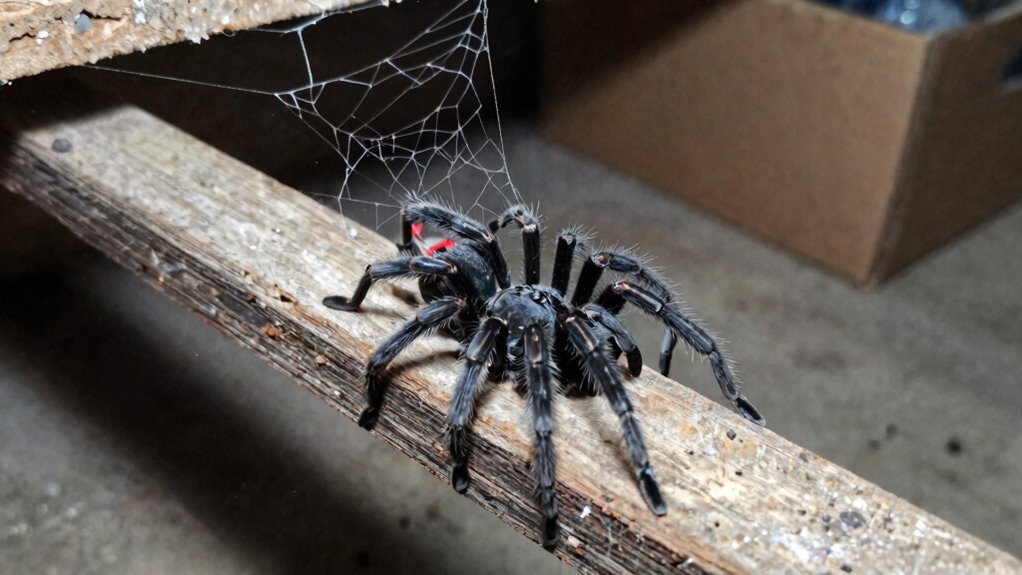
The fastest way to tell a northern black widow from a southern one is by checking the hourglass on its belly.
If you need a pest control ID, remember that the southern *Latrodectus mactans* has a complete hourglass where the bottom half is wider, like a traffic cone missing its top.
In the northern range, the *Latrodectus variolus* has a split or partial hourglass.
If the hourglass is complete, both halves are roughly equal in width, so no cone shape appears.
This difference is reliable for quick identification, though some spiders may vary.
For a practical and helpful shortcut, focus on the hourglass shape to decide your next action.
A wider bottom half points to a southern black widow.
A split or even half means you are looking at a northern black widow.
Why the Western Black Widow’s Hourglass Is Unique
When comparing hourglass markings on North American widows, the western black widow stands out with a consistency that makes pest identification simple.
Its hourglass shape is always complete, never split or partial, which is a rule it rarely breaks.
This reliability comes from minimal geographic variation across its western range from Canada to Mexico.
The posterior half of its hourglass is equal to the anterior half, a trait unique among black widows.
No other North American *Latrodectus* species maintains this perfect symmetry so consistently.
This uniform hourglass shape means you can spot a western black widow from across a garage without squinting.
If you need pest control for black widow spiders, this clear marking helps confirm the species.
Homeowners and professionals alike can use this trait for quick, accurate identification.
Red Widow vs. Brown Widow: Key Differences to Avoid Confusion
Mistaking a red widow for a brown widow is like confusing a fire truck with a rusty sedan. The red widow, *Latrodectus bishopi*, is a striking bright red spider found only in a unique red widow habitat of sandy scrub in central and southern Florida. For effective night hunting, many professionals recommend using a high-quality blacklight with a wavelength between 365 to 385 nanometers, as scorpions fluoresce brightly under this specific UV output.
Its body is vivid crimson with black markings, nothing like the dusty, muted brown of a brown widow. Brown widows have a leg span of up to two inches and are now common across the US.
For pest control concerns, inspect the brown widow egg sacs first. Those spiky little spheres look like tiny sea urchins and are the giveaway.
The red widow is shy and stays put in its sandy home. So if you spot a truly red spider, you do not have a brown widow.
As a simple, foolproof test for home pest control, check the egg sacs. Bottom line: bright red equals red widow.
Identify Widow Spiders by Their Egg Sacs (Spiky vs. Smooth)

The easiest way to tell brown widows from black is to look at the egg sacs. Brown widow egg sacs are covered in little silk spikes, whereas black widow sacs are smooth and round.
This spiky versus smooth trick is especially handy for distinguishing brown widows from young black widows. Young black widows otherwise look pretty similar, so checking the egg sacs during a pest control inspection is a reliable identification method.
If you find spiky egg sacs in your yard, you may have a brown widow infestation that requires removal. For safe spider treatment, contact a professional pest control service to handle the sacs and adult spiders.
Identifying widow spiders by their egg sacs helps you choose the right prevention plan. This simple visual check is a must for any homeowner seeking effective spider control solutions. For ongoing prevention, consider using a long-lasting residual barrier spray to treat entry points and baseboards.
Spiky Brown Widow Sacs
If you are trying to tell a brown widow from a black widow, the fastest shortcut is the egg sac. Brown widow sacs look like tiny spiky planets, covered in silk projections that deter predators from piercing the cocoon.
The egg sac color ranges from pale yellow to tan, never pure white or grayish. Those spikes are the giveaway. No other North American widow has them.
The sac is smaller and more textured than a black widow’s, usually under half an inch. Found in clusters, often on webs in garages or under porch eaves during pest control inspections.
You won’t mistake them once you see one. That spiky silhouette is nature’s little handle with caution sign.
Spot the spikes, skip the panic, and you have nailed the ID for safe removal when needed.
Smooth Black Widow Sacs
Smooth black widow sacs are the polar opposite of those spiky brown widow ones. No spikes, no fuss, just a round, silk-wrapped orb that stands out immediately.
Their smooth texture is a dead giveaway, like a tiny, pale ping-pong ball tucked into a web corner. A casual observer can spot them instantly, since brown widow sacs bristle with little projections, sort of like a medieval mace.
The round shape holds dozens of eggs, all snug and protected, and it’s the most reliable way to confirm a black widow’s presence without getting too friendly. If you’re handling pest control inspections, this visual cue saves time and keeps you safe.
Check for consistency; these sacs are firm, not squishy. They hang alone or in small clusters, often in undisturbed corners, sheds, or under eaves.
No ornamentation, no flair, just efficient arachnid engineering. When you find a smooth, round sac, don’t poke it, and don’t try to remove it yourself.
That’s your cue to step back and call a pro for professional spider removal. Bottom line: smooth equals black widow, so schedule a home pest inspection if you spot one.
Simple as that, and knowing this detail can prevent a nasty bite. For effective black widow control, early detection is your best tool. Using non-toxic glue traps around corners and basements can capture wandering spiders after a professional removes the sac.
Juvenile Widow Distinction
Juvenile widows can be tricky to tell apart, but their mothers’ egg sacs give them away every time.
Brown widow sacs are spiky, like tiny sea urchins, whereas black widow sacs are smooth as a marble.
This makes egg sac ID the foolproof shortcut for effective pest control.
No squinting at spiders is required.
Young black widows sport white stripes that fade with age.
Brown widow juveniles keep a distinct orange hourglass, so don’t rely on color alone.
Brown widows build webs in exposed, sunny spots like porch corners.
Black widows prefer dark, hidden crevices, so check the location before judging.
Spot a spiky sac for a brown widow neighbor.
A smooth sac means a classic black widow.
Let mama’s nursery do the identifying for you during your spider inspection.
That egg sac clue helps you choose the right treatment plan.
For long-term prevention, combine your identification with natural peppermint oil sprays to keep both widow types from returning.
Why White Stripes on a Spider Don’t Mean It’s Not a Widow
White stripes on a spider are a common clue, but they don’t rule out a widow. Since these spiders grow out of their stripes, a juvenile widow often sports bold white and black markings on its back.
That look is a far cry from the adult’s glossy black, so seeing stripes shouldn’t make you relax. Those markings are temporary, like a weird teenage phase, and the southern black widow (L. mactans) shows this clearly.
The white isn’t a harmless signal; it’s a juvenile costume that disappears by adulthood. So if you spot white bands, you’ve likely found a youngster, not a harmless lookalike. For pest control safety, treat any suspicious black-bodied spider with caution, especially in garages, woodpiles, or outdoor sheds. Professional spider removal services often advise against handling these immatures, since their venom is already potent. Since these tools only sense excess dampness rather than direct signs of infestation, moisture monitors alone won’t confirm a widow’s presence, but they can help identify the damp conditions that attract the pests these spiders prey on.
That immature coloration is a red herring, so don’t let it fool you during a home inspection. If you need widow identification help, call a local exterminator before touching any striped black spider.
The adult’s venom is no joke, and even juveniles can deliver a painful bite. When you see white stripes, schedule a pest control visit to confirm the species and protect your family.
Where Each Widow Species Lives: And Where Their Ranges Overlap
Where do the black widows actually live, and how likely are you to find two different species in the same backyard? The answer depends on latitude and habitat, so let’s break it down for practical pest control planning.
Southern black widows rule the southeastern states, whereas northerns dominate up into Canada. Westerns claim everything west of the Rockies, and brown widows, the newcomers, now cross all their ranges, especially in urban spots where they often displace natives.
If you’re dealing with a spider problem at home, identifying the species helps you choose the right treatment. Southern black widows (L. mactans) stick to rural areas from Texas to Florida, thriving in loose woodpiles and sheds.
Northern black widows (L. variolus) overlap with southerns in Louisiana and the Carolinas, but they prefer cooler, forested spots. This overlap means you might need a targeted removal service if you find both near your foundation.
Red widows (L. bishopi) are a Florida specialist, tied strictly to sand pine ecology and rare outside those scrubby thickets. For homeowners in that region, a red widow sighting is uncommon, but you should still call a professional if you suspect one in your landscaping.
Overlap zones produce odd combinations, like smooth-shelled black widow egg sacs near one with that distinct egg sac silk texture from a brown. Don’t panic though, they rarely share the same web, so your immediate risk stays low.
For effective spider extermination, focus on sealing gaps, reducing clutter, and removing outdoor debris where these spiders nest. If you want peace of mind, schedule a routine inspection to catch any widow activity early, especially in shared overlap areas. Long-lasting residual sprays containing permethrin can help create a barrier against these spiders when applied to foundations and exterior cracks.
Found a Widow Spider? Here’s What to Do
So you’ve found a spider you think might be a black widow. First, don’t panic; these spiders are sedentary and not aggressive hunters.
They bite only when molested, so give it plenty of space. For safe spider relocation, use a long stick and a jar to gently coax it inside.
Then release it far from your home, ideally in a shed or brush pile. Avoid crushing the spider, since that risks a bite and potential exposure to venom.
Bite symptoms vary widely. Most are dry or mild, causing only local pain and redness.
But severe cases bring muscle cramps, nausea, or sweating. That’s when you should seek medical help quickly, especially for children or the elderly.
Bottom line, relocation beats extermination here for peaceful pest control. If you’re uneasy handling it yourself, call a professional exterminator.
It’s cheaper than an ER visit, and your conscience stays clean. For hiring a pest control service, you can find local experts who handle widow removal safely. For ongoing prevention, consider placing non-toxic glue traps in dark corners and along baseboards to monitor for other pests that attract widows.
Frequently Asked Questions
Can a Black Widow Bite Kill a Healthy Adult?
A black widow bite is rarely lethal to a healthy adult. The lethal dose of venom is tiny, but a healthy body can usually fight it off.
Treatment myths persist, but most victims survive without antivenom. The real danger is intense pain and muscle cramps that last days.
Complications or allergic reactions are the bigger threat, not the venom itself. Bottom line: you would be miserable, but likely not dead.
If you spot a black widow around your home, call a pest control service immediately. Professional spider removal is your best bet for keeping your family safe from these venomous pests.
Homeowners often search for “spider exterminator near me” after finding a web in the garage. We recommend a targeted spider barrier spray for long term prevention.
The best strategy is to seal cracks and remove clutter where webs are built. For heavy infestations, a licensed exterminator can apply residual sprays that kill black widows on contact.
You can also buy diy spider traps for low traffic areas. But for peace of mind, investing in a quarterly pest control plan is the smartest move.
How Long Does It Take for Black Widow Venom to Affect You?
Venom potency timeframes vary, but symptoms usually start within 30 to 60 minutes after a bite. The timeline begins with localized pain, then progresses to muscle cramps and possibly nausea.
Severe effects can peak within 2 to 3 hours, so this isn’t a fast-acting neurotoxin, but it’s not slow either. Think of it as a lazy, grumpy neighbor who eventually shows up, but with consequences.
For anyone dealing with a black widow infestation, professional pest control services are your best first line of defense. If you’re shopping for spider sprays or perimeter treatments, look for products labeled specifically for black widow activity around sheds, garages, and woodpiles.
Recovery from a bite often takes days, while medical care is essential for severe reactions like chest pain or breathing trouble. When you’re comparing pest control products, prioritize those with residual action, so the venom risk never reaches your family.
To avoid a bite entirely, focus on habitat reduction, which means sealing cracks and removing clutter where these spiders hide. For targeted control, consider hiring a licensed exterminator who can apply professional-grade treatments that outlast any over-the-counter option.
Buyer-intent advice: choose a broad-spectrum insecticide with a pyrethroid base for quick knockdown, and pair it with a long-lasting bait or dust for ongoing protection. That dual approach turns a scary timeline into a non-event, giving you peace of mind while the pros handle the heavy lifting.
Are Male Black Widows Dangerous to Humans?
Male black widows are not dangerous to humans. Their venom is much weaker than a female’s, so a bite is rarely a medical concern.
Their fangs are also too small to deliver a meaningful bite for pest control purposes. In practice, even if you handle one roughly, you’ll only feel a slight pinch.
It’s more of a mild annoyance, like a tiny furry mosquito, not a real threat. Male aggression is practically nonexistent since they focus only on mating, not defending a web.
If you’re dealing with a spider infestation, remember that females are the ones you need to identify and control. For effective pest control products, look for sprays or traps labeled for widow spiders.
Spotting a male black widow is harmless, but a female nearby means you should act. Consider using a proven indoor insecticide or calling a professional for a thorough treatment.
A smart purchase for home defense is a long reach spray that targets corners and crevices. This keeps both males and females from settling in your space.
What Should I Do if I Find a Black Widow in My House?
First, don’t panic. For safe removal, gently trap the spider under a glass, then slide a paper under it.
Release it outside far from the house.
You can also call professional pest control for $100 to $200.
This handles the problem permanently.
Vacuuming works too, but that feels rude.
Check dark corners, basements, and garages for webs.
Seal cracks to prevent future guests.
Bottom line: calm, quick action is safer than a shoe.
For expert pest control services, search for “black widow removal near me” to find a trusted exterminator.
Do Black Widows Always Have a Red Hourglass Shape?
No, black widows do not always have a red hourglass. Hourglass variations are common, like the northern black widow’s split or partial mark.
Some species, like the brown widow, may have a faint or missing hourglass. Juvenile markings like white stripes or spots can additionally confuse identification.
So if you see a black spider without a red hourglass, it might still be a widow. Just don’t count on it without a professional pest control inspection.
For accurate widow identification, contact a local exterminator for a targeted treatment plan. Many homeowners need spider control services to eliminate dangerous nests near doorways or playgrounds.
If you suspect widow activity, buy a quality spider spray or dust for cracks and voids. Always read the label and use protective gear for safe application.
For complete peace of mind, schedule a residential pest management visit. A technician can spot the subtle signs and remove the threat before someone gets bitten.


